


-
1 of 253523 objects
Giovanni Battista Castello (c. 1525-69)
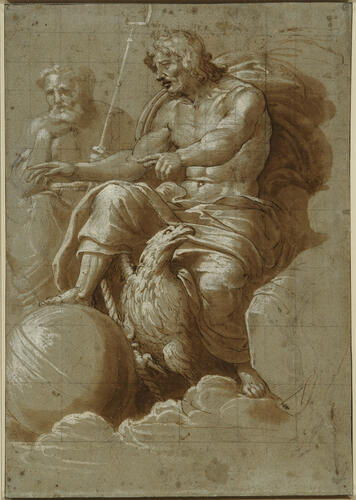
Jupiter c. 1560
Black chalk, pen and ink, wash and white heightening, on blue paper: squared in black chalk | 39.6 x 27.6 cm (sheet of paper) | RCIN 990490
Giovanni Battista Castello (c. 1525-69)
Jupiter c. 1560
Giovanni Battista Castello (c. 1525-69)
Jupiter c. 1560
-
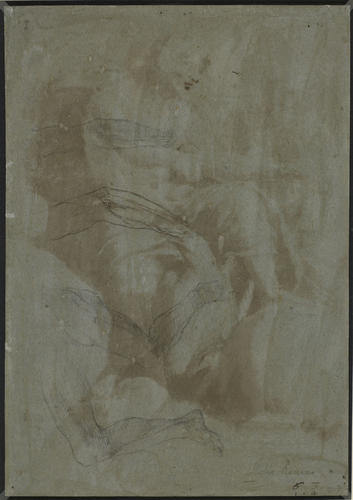
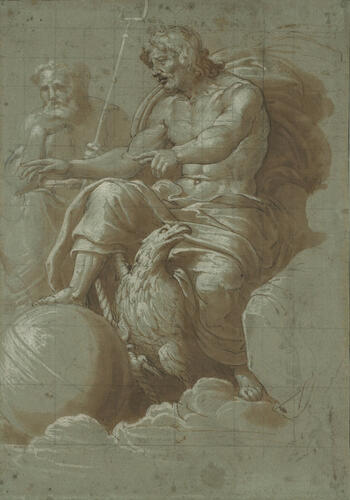
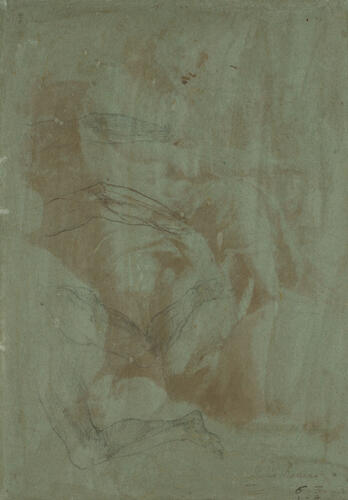
A drawing of Zeus (Jupiter) with his foot on a globe, an eagle between his legs and Poseidon (Neptune) behind him. This work is a squared study for the fresco in Villa di Tobia-Pallavicini, Genoa. Verso: studies of legs and an arm.
Around 1560 Castello executed frescoes throughout the villa of Tobia Pallavicino in Genoa. The Council of the Gods in the vault of the Salone depicts the deliberations of Zeus over whether Odysseus should be allowed to end his wanderings and return home. Castello’s frescoes owed much to paintings that he had seen in Rome some years earlier - this figure is based on Zeus in Raphael’s own Council of the Gods in the Villa Farnesina.
This drawing is a study for Castello’s fresco of the Council of the Gods, in the vault of the Salone of Pallavicino’s villa. The building was probably begun in the mid to late 1550s, supposedly to the designs of Galeazzo Alessi though possibly with Castello’s involvement, as he is documented as having been the architect of the concurrent construction of Pallavicino’s palazzo. A large part of the piano nobile was frescoed by Castello and Luca Cambiaso as the construction of each room was completed. The decorative programme owed much to frescoes that Castello presumably saw in Rome, especially those in Agostino Chigi’s villa, now known as the Villa Farnesina. The walls of the Salone are decorated with illusionistic architecture in emulation of Baldassare Peruzzi’s frescoes on the first floor of the Farnesina; above the cornice are four quadri riportati with scenes from the Odyssey, while in the crown of the vault is a homage to Raphael’s fresco of the Council of the Gods in the Farnesina loggia. Castello’s frescoes were badly damaged during the Second World War and heavily restored.
Raphael’s and Castello’s frescoes depict different subjects - Raphael’s shows Zeus permitting Psyche to enter the ranks of the gods and marry Cupid, while Castello’s shows the deliberations of Jupiter and the other gods over whether Odysseus should be allowed to end his wanderings and return home. Castello had already used a version of Raphael’s figure in his lunette fresco of the same subject in the Villa Lanzi at Gorlago (later transferred to the Palazzo della Prefettura, Bergamo). Castello’s figure of Zeus follows Raphael’s in his general attitude and in the pose of the legs, though he changed the positions of head, arms and eagle, and the Poseidon behind Zeus bears little relationship to Raphael’s equivalent figure. On the verso of the sheet are separate nude studies of Zeus’s legs, and two studies of an arm that does not seem to correspond with any in the fresco.
Inscribed verso by William Gibson: Julio Romano / 6.3. / 1.4
Catalogue entry adapted from The Art of Italy in the Royal Collection: Renaissance and Baroque, London, 2007Provenance
William Gibson; probably acquired by Charles II; Royal Collection by c.1810 (Inventory A, p. 52, Guilio [sic] Romano, Polidoro, e Perino del Vaga, Tom. 2, '1. Jupiter & Pluto').
-
Creator(s)
(collector)Acquirer(s)
-
Medium and techniques
Black chalk, pen and ink, wash and white heightening, on blue paper: squared in black chalk
Measurements
39.6 x 27.6 cm (sheet of paper)
Category
Object type(s)
Other number(s)
RL O : Royal Library "O" Number Register – RL O490Alternative title(s)
Zeus
Jupiter and Neptune


