


-
1 of 253523 objects
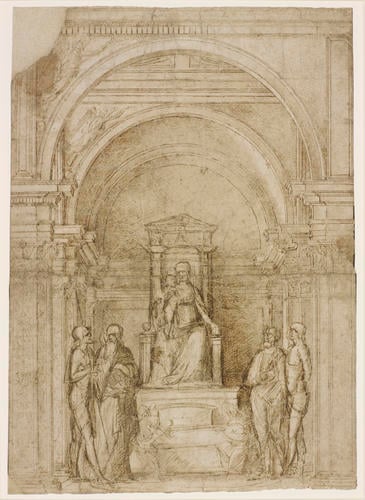
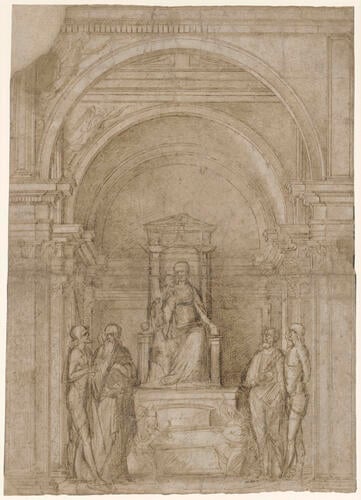
The Virgin and Child with saints and angels c.1490-1500
Stylus lines, pen and ink with wash and touches of white | 34.7 x 24.9 cm (sheet of paper) | RCIN 990069
-
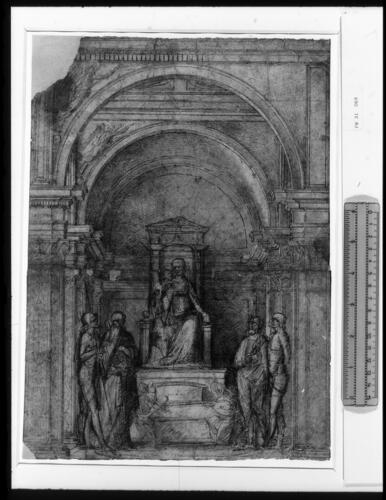
A compositional study for a monumental altarpiece: the Virgin and Child enthroned, flanked by four standing saints and two kneeling angels playing musical instruments. The identification for the saints is unclear: possibly St. John the Baptist, St Jerome, St Mark and St Sebastian.
No related work is known, but Popham (in P&W) pointed to parallels with Vivarini's two altarpieces in Berlin (with six saints and four saints respectively), and in the architecture with his later altarpiece in the Frari, Venice.
Whilst the figures are sketched freely, with heavy hatching used to build up their forms, the architectural forms are precisely and meticulously modelled. Vivarini first ruled the sheet with a stylus, creating a grid in which to position the architectural forms, and marked a vanishing point beneath the Virgin’s throne with the point of brush. The receding columns, arch and barrel vault were then added in pen and ink, after which finer decorative architectural details were drawn. There is a differing level of finish for these details: Vivarini incorporates delicate panels on the pilasters and sketches figures on the spandrels to the left of the sheet. The right hand side was presumably to be a mirror image of the right, and therefore did not require the same level of detailing. The drawing likely contains the design for the outer frame in which the altarpiece would have been set. Intended to further blur the break between actual and fictive architecture, it is difficult to tell where the design for frame ends and the design for painting begins. (F. Ames-Lewis, J. Wright, Drawing in the Italian Renaissance Workshop, p.276).A member of a family of artists, Vivarini was influenced by the work of his father, Antonio Vivarini (fl. 1440–c.1476), and his uncle, Bartolomeo Vivarini (fl.1440–c.1500). Vivarini also drew on Giovanni Bellini’s treatment of light, and volume and weight found in Antonello da Messina’s work. Praised by Giorgio Vasari for his paintings of architecture ‘wrought most beautifully in perspective,’ Vivarini painted altarpieces similar to the present sheet throughout his career. Particularly close is an altarpiece depicting the Madonna enthroned with Saints, produced by Vivarini for San Cristoforo, near Murano (now held in the Staatliche Musuem, Berlin) and an altarpiece depicting the Madonna with six Saints, originally in San Maria dei Battuti, Belluno (now destroyed).
Provenance
Royal collection by 1810, listed in George III’s ‘Inventory A,’ c.1800-1820, pp.16-17: ‘Diverso Maestri Antichi’
-
Creator(s)
-
Medium and techniques
Stylus lines, pen and ink with wash and touches of white
Measurements
34.7 x 24.9 cm (sheet of paper)
Other number(s)
Alternative title(s)
The Virgin and Child enthroned in a chapel


