

-
1 of 253523 objects
Sydney Prior Hall (1842-1922)
Ardirol Nabbi c.1875-6
Pencil | 11.1 x 8.4 cm (whole object) | RCIN 931198
Sydney Prior Hall (1842-1922)
Ardirol Nabbi c.1875-6
-
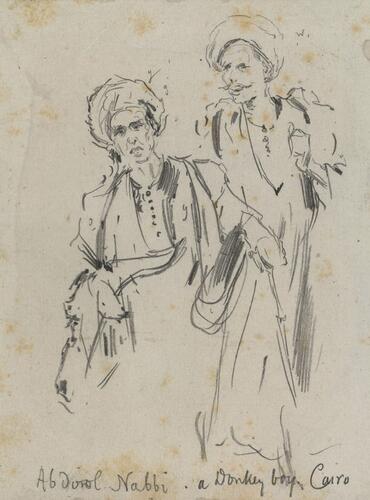
Two half-length pencil studies of a man wearing robes and a turban, one facing front, the other facing three-quarters-left. Inscribed below: Ardirol Nabbi. a Donkey boy Cairo.
In October 1875, Albert Edward, Prince of Wales, the eldest son of Queen Victoria and Prince Albert and later King Edward VII (r.1901-10), embarked on an extensive tour of the Indian subcontinent, travelling on HMS Serapis. The Prince of Wales visited more than 21 towns and cities across parts of modern-day India, Sri Lanka, Pakistan and Nepal before returning to England in May 1876. Both on their way to and back from India the prince and his party spent several days in Cairo, staying at the royal palace of Gezira at the invitation of the Khedive (Viceroy) Isma'il Pasha. These sketches may have been made by Hall on 25 October 1875, when Albert Edward visited bazaars in the city and 'managed to do a good deal in the way of shopping, and purchases' according to the account of the tour published by William Russell. The term 'donkey boy' was used by Western tourists in Egypt to refer to men and boys who offered guided tours of the city or transport around it by donkey; the 1878 edition of the popular Baedeker travel guide to the country recommended such an activity, stating that 'Lovers of the picturesque will find such rides very enjoyable.' (Egypt. Handbook for Travellers, I, 1878, p. 244).
Albert Edward’s tour of India was envisaged as a way of forging diplomatic links between the Indian rulers and the British Crown. The tour was extensively covered in the British press pictorially as well as in the form of descriptive accounts of the royal engagements undertaken by Albert Edward and the entertainments and activities he enjoyed. Though there were controversies before the tour began about its expense and purpose, ultimately from the British perspective it was considered successful and the prince received a warm reception in the places he visited. The response on the Indian subcontinent to Albert Edward's tour, and what it symbolised in terms of imperial rule and colonial relations, was more mixed.
Gift-giving was an important aspect of Indian diplomacy, and thus while on tour the prince exchanged gifts with the rulers he met. However, the monetary value of the gifts given by Albert Edward was not always commensurate with that of the objects presented to him. Some of the most significant Indian works of art in the Royal Collection today were acquired during this tour. On his return to England, Albert Edward arranged for these to be exhibited to the wider public, first at the South Kensington Museum (now the Victoria & Albert Museum) and then at nine further venues across England, Scotland and Europe. In England and Scotland alone, more than 2.5 million visitors saw the Indian works of art.
Sydney Prior Hall was a draughtsman and illustrator who worked for the Graphic newspaper, as well as a portrait painter. He was invited to accompany the tour of India made by the Prince of Wales as Special Artist, and his watercolours of India were exhibited in 1876 at the South Kensington Museum along with some of the gifts given to Albert Edward. Many of the drawings Hall made during the tour were also reproduced as illustrations to The Prince of Wales's Tour. A Diary in India (1877) by William Russell, a reporter for The Times newspaper who travelled with the prince to India in the capacity of his Honourable Private Secretary. Sydney Prior Hall maintained a friendship with the prince after the tour, and Albert Edward often visited his studio in London.
This drawing is housed in one of three albums containing sketches relating to the Prince of Wales's tour in India.
Provenance
Acquired by King Edward VII when Albert Edward, Prince of Wales
-
Creator(s)
Acquirer(s)
-
Medium and techniques
Pencil
Measurements
11.1 x 8.4 cm (whole object)
Other number(s)
RL 31198


