


-
1 of 253523 objects
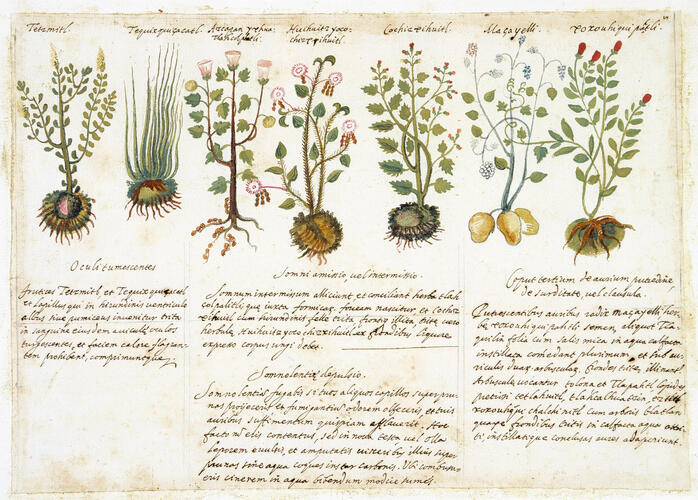
'Aztec Herbal' folio 7: seven medicinal plants 1626
Watercolour and body colour over black chalk; grid outlines in black chalk. The inscriptions in pen and ink. | 23.7 x 33.4 cm (sheet of paper) | RCIN 927905
-
A drawing from the ‘Aztec Herbal’ album in the Paper Museum of Cassiano dal Pozzo (1588–1657), depicting seven medicinal plants with their Nahuatl names above and the remedies in Latin below. That album is Cassiano’s copy of the Codex Cruz-Badianus (Biblioteca Nacional de Antropología e Historia, Mexico City), an Aztec herbal prepared for the son of the Viceroy of Mexico in 1552 and the earliest medical text to have survived from the New World. The remedies were written in Nahuatl by the native convert Martín de la Cruz, a practising physician at the College of Santa Cruz in Tlatelolco, and translated into Latin by Juan Badiano, another native convert and student at the college.
The original codex was presented to Cassiano’s patron, Cardinal Francesco Barberini, during a papal legation to Spain in 1626, and was copied on the Cardinal’s return to Rome for Cassiano’s fellow members of the Accademia dei Lincei, an early scientific society engaged at that time in completing a vast illustrated natural history of Central America based on the material gathered in New Spain in the 1570s by Philip II’s physician, Francisco Hernández (Rerum medicarum Novae Hispaniae thesaurus, Rome 1627–51).
The present sheet is dedicated to remedies for ‘swelling eyes’ (Oculi tumescentes), ‘loss of sleep’ (Somni amissio, vel intermissio), ‘repulsion of drowsiness’ (Somnolentiae depulsio), ‘purulence of the ears’ (de aurium putredine), ‘deafness or obstruction of the ears’ (de surditate, vel clausula), combining the text and images from folios 13r–v, 14r–v and part of fol. 15r of the Codex Cruz-Badianus. The plants are named, from left: a. Tetzmitl; b. Tequixquiçacatl; c. Azcapan yxhua Tlahcolphatli; d. Huihuitz yoco chizxihuitl; e. Cochizxihuitl; f. Maçayelli; g. Xoxouhiquipahtli. The drawing is numbered 8 in pen and ink at top right, and inlaid on folio 7 of the ‘Aztec Herbal’ album (see RCIN 970335). For the texts and more information see M. Clayton, Luigi Guerrini and Alejandro de Ávila, Flora; The Aztec Herbal, Part B.VIII of The Paper Museum of Cassiano dal Pozzo: A Catalogue Raisonné, London 2009, cat. 7.
a. Tetzmitl. Hernández described several tetzmitl, all Sedum spp. (Hernández 1651, p. 171, not illustrated), and plants of the genus are still known locally as tetzmitl. Here the erect stalk and small yellow inflorescences suggest the tree stonecrop, Sedum dendroideum Moç. & Sessé, still used in American traditional medicine for gastric and inflammatory disorders.
b. Tequixquiçacatl (Te-quīx-qui-zacatl, ‘soda grass’). Tequīxquitl, known as tequesquite in Mexico today, is an alkaline mineral composed mainly of sodium bicarbonate and sodium chloride. Possibly the saltgrass Distichlis spicata (L.) Greene, which thrives in salty, sandy soils and forms saline crystals on its rigid, sharp-tipped leaves, or alternatively a Sporobolus sp. (taking account of the absence of a rhizomatous root in the drawing).
c. Azcapan yxhua tlahcolphatli (Āzca-pan ixhua tla-hzol-pahtli, ‘rubbish-dump remedy that comes up around anthills’). In the text the plant is called only tlahçolpahtli, ‘rubbish-dump remedy’; āzcapōtzalli is the term for anthill, and āzcapan would refer to a wider expanse of terrain around anthills. This is one of four similar illustrations of Datura spp. (which flourish in ruderal habitats), along with the tolo(h)uaxihuitl at RCIN 927911d and 927914a and the nexehuac at 927914b. Datura spp. contain potent alkaloids and were used in some Native American cultures (including Aztec) for their narcotic and hallucinogenic properties. The flowers shown as pink here, are white in the Cruz-Badianus. Ants are depicted at the roots, and indeed the seeds of Datura spp. are commonly dispersed by ants. The form of the leaves suggest the thorn-apple, stinkweed or Jimson weed, Datura stramonium L.
d. Huihuitz yocochizxihuitl (Huī-huitz-yoh cochī-z-xihuitl, ‘thorny sleep herb’). The spiny stems and ball-like flower heads with pendent fruit pods may indicate a Mimosa sp., though the drawing does not show the pinnate leaves typical of that genus. Cognates of cochīz-xihuitl and its Spanish equivalent dormilona still designate Mimosa pudica L., which folds up its leaflets at night or in response to touch and is widely used as a medicinal plant in Mexico.
e. Cochizxihuitl (Cochī-z-xihuitl, ‘sleep herb’). Though the name is related to that of plant (d), the drawing does not allow an identification.
f. Maçayelli (Mazā-yēlli, ‘deer liver’). This climbing plant with tuberous roots is probably a Smilax sp.
g. Xoxouhiquipahtli (Xoxōuh-qui pahtli, ‘blue/green remedy’, see RCIN 927904c). A tendril of the plant entwines the maçayelli beside it. The drawing in the Cruz-Badianus shows large primary leaves and secondary leaflets, a distinction that is lost here, and the copyist split up the three plants illustrated on fol. 14v of the original codex that were used together in the treatment of ear infections (tlaquilin is now found at 927906a). The plant cannot be identified from the illustration.
Text adapted from Clayton et al. 2009, cat. 7 [M. Clayton and A. de Ávila].
Provenance
From the ‘Paper Museum’ of Cassiano dal Pozzo (1588–1657) and his brother Carlo Antonio dal Pozzo (1606–89). Sold by Carlo Antonio's grandson to Clement XI Albani, 1703; acquired by Alessandro Albani in 1714, from whom purchased by George III in 1762.
-
Creator(s)
(collector)Acquirer(s)
-
Medium and techniques
Watercolour and body colour over black chalk; grid outlines in black chalk. The inscriptions in pen and ink.
Measurements
23.7 x 33.4 cm (sheet of paper)
Category
Object type(s)
Other number(s)
RL 27905


