


-
1 of 253523 objects
Watercolour and bodycolour over black chalk or graphite. Watermark: eagle in circle, surmounted by crown (Paper Museum Eagle 18). | 42.2 x 27.5 cm (folio dimensions) | RCIN 927713
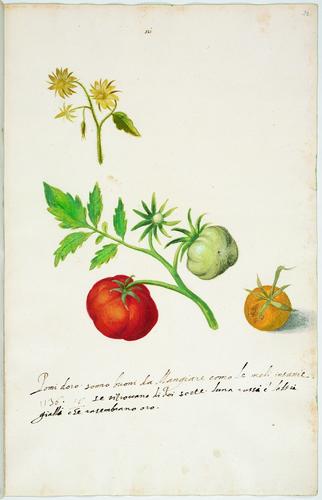
Italian School, early 17th century
A sprig of a tomato plant c.1600-20
-
Folio 23 of the Erbario Miniato, an early seventeenth-century Italian herbal commissioned by Federico Cesi (1585–1630), founder in 1603 of the Accademia dei Lincei in Rome, an early scientific organisation. The herbal (on which see RCIN 970382) was acquired after Cesi’s death in 1630 by Cassiano dal Pozzo, a fellow member of the academy, for his ‘Paper Museum’. The drawings in the herbal are accompanied by notes in Cesi's hand, sometimes just providing the name of the plant but usually also their medicinal properties – information which Cesi drew from Pietro Andrea Mattioli’s 1568 edition of Dioscorides’ De materia medica (I Discorsi di M. Pietro Andrea Matthioli . . . nelli sei libri di Pedacio Dioscoride Anazarbeo della materia medicinale, Venice 1568).
The tomato is a herbaceous annual of the family Solanaceae. Native to the Americas, it was one of the most important food plants brought back to Europe following the Spanish conquest and is now cultivated all over the world. Its English name is derived from the Nahuatl tumatl or tumal; Mattioli first recorded the name pomodoro or ‘golden apple’ in his chapter on the mandrake (where he also discusses the aubergine), but he did not illustrate the plant. The Cinque libri di piante by Pietro Antonio Michiel (1510–76) lists the tomato’s names as ‘Licopersicon Galeni oppure Pomodoro da volgari, oppure melongiana da Latini oppure poma amoris da alcuni et del Perù’ (Venice, Biblioteca Marciana, MS Marc.It.ii, 29, ch. 46.). The name poma amoris was found in English as ‘love apple’, a term that was current until the early nineteenth century.
Though the tomato was a staple food of the people of central and southern America, it was regarded as only an ornamental plant when it was introduced to Europe – in 1523 in Spain, in 1544 in Italy and later in the sixteenth century in England – and indeed the immature fruit, as well as the stem and leaves, are toxic because they contain solanine, the same alkaloid found in the potato and aubergine. One of the first images of this plant appears in the ‘Drake Manuscript’ or Histoire naturelle des Indes of the late sixteenth century (New York, Morgan Library, MA 3900, fol. 7v); the inscription accompanying that drawing states that it was a ‘Tomates – a delicious fruit which grows in the woods and can be eaten with fish or meat’. Of its medicinal properties the sixteenth-century French physician and botanist Jacques Daléchamps wrote that ‘these apples, as indeed the entire plant, have a cooling faculty at least as great as that of the
mandrake’ (Historia generalis plantarum, Lyons 1586, p. 628). The first Europeans to exploit the tomato as a food were the Italians – as demonstrated by the inscription on this folio. It was rarely eaten in northern Europe or England until the beginning of the nineteenth century, and its popularity grew with the development of the canning industry, the first large factory in Italy being opened by Francesco Cirio in 1875.
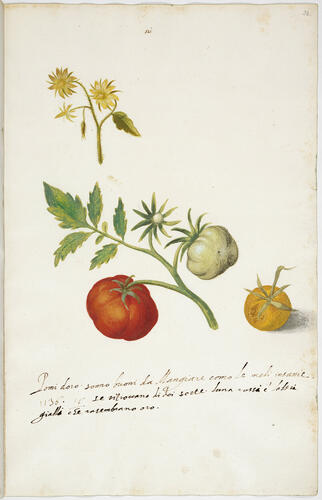
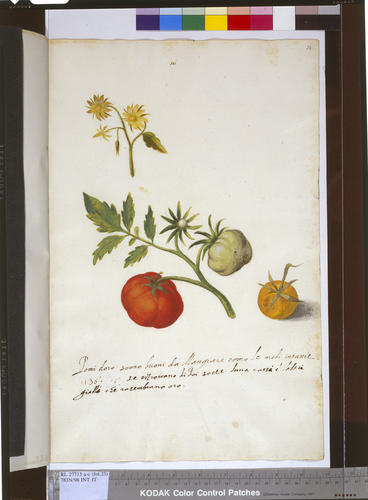
Shown here are the end of a fruiting branch, a smaller flowering branch and a single mature fruit. The branch in the centre of the drawing bears three fruits at various stages of ripening. The lower one hangs from a long, slightly bowed peduncle and has a persistent calyx; its fine red colour indicates that it is ripe. The two smaller fruits are green and immature. The branch ends in a pinnate leaf made up of five leaflets alternating with tiny lobes. The flowering branch has a thin hairy stem with three yellow flowers and an unopened bud, all on long peduncles. Each flower is composed of eight lanceolate petals that spread open completely and bend backwards slightly at their extremities when in full bloom. The calyx consists of eight to ten linear sepals which are longer than the petals. The androecium is erect and clearly visible.
Annotation: Pomi doro. sonno buoni da Mangiare como le meli insanie./ 1136. 56 se ritrovano di doi sorte. Luna rossi e’ laltri / gialli che rasembrano oro. (‘Pomi d’oro [golden apples]. They are good to eat like aubergines. [Page] 1136, [line] 56. There are two types, one red and the other yellow, resembling gold.’). [From Mattioli 1568, p. 1136]
Erbario Miniato, folio 23, drawing numbered ‘521’.
Text adapted from Fabio Garbari and Lucia Tongiorgi Tomasi, Flora: The Erbario Miniato and other Drawings, Part B.VI of The Paper Museum of Cassiano dal Pozzo: A Catalogue Raisonné, 2 vols, London 2007, cat. 23.
Provenance
Commissioned by Federico Cesi (1585-1630), from whose widow acquired by Cassiano dal Pozzo (1588-1657) for his 'Paper Museum'. Sold by Cassiano's great nephew to Clement XI Albani, 1703; acquired by Cardinal Alessandro Albani in 1714, from whom purchased by George III in 1762. Bound in the album Erbario Miniato, fol. 23.
-
Creator(s)
(collector)Acquirer(s)
-
Medium and techniques
Watercolour and bodycolour over black chalk or graphite. Watermark: eagle in circle, surmounted by crown (Paper Museum Eagle 18).
Measurements
42.2 x 27.5 cm (folio dimensions)
Markings
watermark: Eagle 18 [folio]
Other number(s)
RL 27713


