


-
1 of 253523 objects
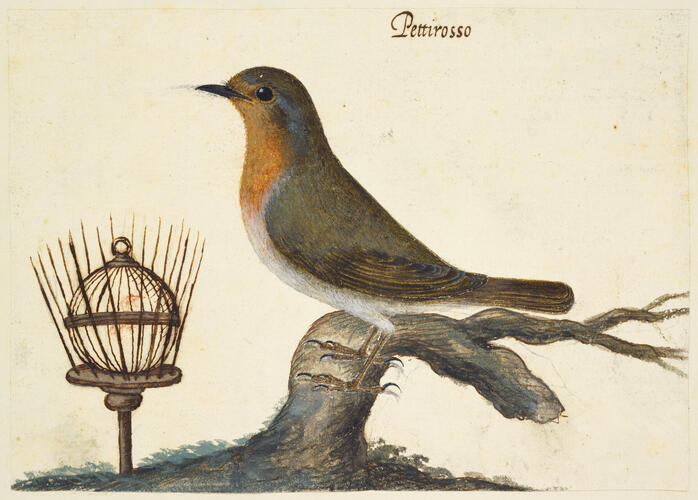
European robin (Erithacus rubecula L. 1758) c. 1619–22
Watercolour and bodycolour over black chalk; the outlined incised. Brush and ink (cage and background); red chalk (bird in cage). | 13.6 x 19.2 cm (sheet of paper) | RCIN 927626
-
This natural history drawing from the 'Paper Museum' of Cassiano dal Pozzo (1588–1657) is clearly done from the life; it shows the robin (Muscicapidae), with a lively eye, in its characteristic upright posture and with accurate colouring. Details such as the bluish rim around the red breast and the bristles around the bill, the pink-grey legs and long black nails are observed correctly. The drawing is life size (bird 12.5–14 cm; drawing 12.2 cm).
The sheet belongs to a group of bird drawings commissioned by Cassiano from the artist Vincenzo Leonardi to illustrate a 1622 treatise on birds by Giovanni Pietro Olina titled L'Uccelliera, ovvero discorso della natura e proprietà di diversi uccelli ('The Aviary, or Discourse on the Nature and Characteristics of Diverse Birds'). Borrowing material from a popular treatise on fowling, Antonio Valli da Todi’s Il canto degl’augelli (1601), Olina selectively combined its practical instructions on how to hunt, catch and care for birds with learned scientific descriptions of birds in Renaissance natural histories such as Ulisse Aldrovandi’s Ornithologiae (1599–1603), and added Cassiano’s personal observations on birds without attribution.
The shadows under the nails indicate that Leonardi had originally intended to show the bird on the ground; the branch was then painted around the bird’s feet, and the cage added by Leonardi’s master Antonio Tempesta (1555–1630) (see Birds, Other Animals and Natural Curiosities 2017, p. 62).
The drawing was the model for the engraving (signed by Jerome David) in the Uccelliera. There the tree stump is replaced with a rocky outcrop, which provides a flat surface on which the bird stands. The image of the spherical cage with limed twigs was reused from Tempesta’s plate in Valli (1601, fol. 15). A variant plate, in which the bird’s feet have been altered to show it perching convincingly on a tree branch, is included in extra-illustrated copies of the Uccelliera (see the modern facsimile with additional illustrations from four extra-illustrated copies, published as vol. 1 of F. Solinas, L’uccelliera: un libro di arte e di scienza nella Roma dei primi lincei, 2 vols, Florence 2000, p. 54).
Olina, following Valli (1601, fol. 16), describes the robin as uccello gentilissimo (‘a very friendly bird’). The subtle details of its colouring are observed accurately:
‘Above the bird’s bill the chin and breast are a reddish colour, tending towards orange or stained with rust; the belly is white, while the head, neck, back and the part above the wings are brown inclining to green’ (Olina 1622, fol. 16).
Olina also advises how to catch the robin in a cage with a decoy bird and limed sticks as shown in the illustration. The method employed was to use a round cage, probably made of willow, in which a captive robin was placed as a decoy. The cage, then encircled with a barrier of limed twigs, would be placed in an exposed area (not near trees, where there would be alternative perches). Other robins would be attracted to the caged bird for territorial reasons, and would thereby get stuck on the lime. Olina also describes alternative methods of catching robins either by using a little owl (civetta) as a decoy, which would attract mobbing birds as described at length on fol. 64, or by making the sound of a robin.
The robin is widespread across Europe, its range extending east to western Siberia and south to north Africa. The species is sedentary in its range apart from the most northerly regions.
Annotations: Pettirosso
Engraved: Olina 1622, fol. 15v
Natural History of Birds album (RCIN 970381), fol. 28; laid down on a late eighteenth-century mount sheet (dal Pozzo ‘type G’ mount). Drawing sheet trimmed at bottom and right; water damage.
Text adapted from Birds, Other Animals and Natural Curiosities, Parts B.IV–V of The Paper Museum of Cassiano dal Pozzo: A Catalogue Raisonné, 2 vols, London 2017, cat. 81 [Henrietta McBurney with Carlo Violani].
Provenance
From the ‘Paper Museum’ of Cassiano dal Pozzo (1588–1657) and his brother Carlo Antonio dal Pozzo (1606–89). Sold by Carlo Antonio's grandson to Clement XI Albani, 1703; acquired by Alessandro Albani in 1714, from whom purchased by George III in 1762.
-
Creator(s)
(collector)Acquirer(s)
-
Medium and techniques
Watercolour and bodycolour over black chalk; the outlined incised. Brush and ink (cage and background); red chalk (bird in cage).
Measurements
13.6 x 19.2 cm (sheet of paper)
Category
Object type(s)
Other number(s)
RL 27626


