


-
1 of 253523 objects
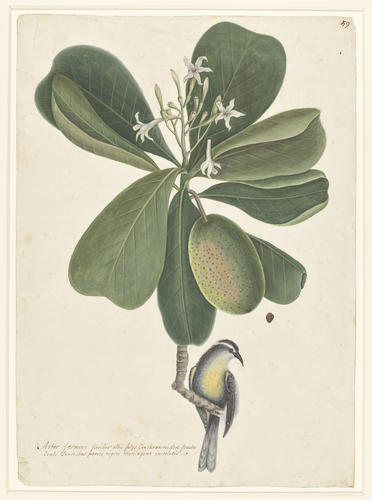
The Bahama Titmouse and the Seven Years Apple c.1722-6
Watercolour and bodycolour with gum arabic over pen and ink | 37.8 x 26.7 cm (sheet of paper) | RCIN 925894
-
A watercolour of a Bahama bananaquit (Coereba flaveola bahamensis (Reichenbach)) on a branch of sevenyear-apple (Casasia clusiifolia (Jacq.) Urb.). The drawing shows a small bird perched, body facing front, head to right. It has black, grey and white plumage and a yellow breast. The plant it sits on has wide, dark green, fleshy leaves, small white blossom, oval green/yellow fruit. Inscribed in pen and ink: (top right) '59', (bottom left) 'Arbor Jasmini floribus albis folijs Cenchran mideæ fructu coali seminibus parvis nigris mucilagine in volutis'.
Mark Catesby was born in Suffolk and was interested in natural history from an early age. In 1712, he travelled to the east coast of America with his sister Elizabeth, who had married a doctor who practised in Williamsburg, Virginia. Catesby spent seven years in Virginia collecting specimens and seeds for London buyers before returning to Britain. In London his drawings of birds and plants met with praise and a group of benefactors paid for his travel to Carolina in 1722. There, he made numerous drawings of the flora and fauna, working hard to ensure that his depictions were as helpful for an understanding of their subjects as possible. On his return to Britain, his drawings were reproduced in The Natural History of Carolina, Florida and the Bahama Islands, which appeared in a series of volumes between 1729 and 1747. The first volume was dedicated to Queen Caroline, the second to Augusta, Princess of Wales. The original drawings from the volumes, which had been in the possession of Catesby’s widow until her death, were purchased by George III from the London bookseller Thomas Cadell in 1768.
The watercolour was used as the basis for plate 59 in the first volume of the Natural History ('The Bahama Titmouse' and 'The Seven Years Apple'). In the accompanying text, Catesby noted of the plant that 'I know not the reason that the Inhabitants of the Bahama Islands (where it grows) call it the Seven Years Apple.'
For identification of the species depicted see James L. Reveal, 'Identification of the plants and animals illustrated by Mark Catesby for his Natural History of Carolina, Florida, and the Bahama Islands' in Phytoneuron 2013 and revised online version.Provenance
Thomas Cadell; from whom bought by George III, 1768
-
Creator(s)
Acquirer(s)
-
Medium and techniques
Watercolour and bodycolour with gum arabic over pen and ink
Measurements
37.8 x 26.7 cm (sheet of paper)
Other number(s)
RL 25894Alternative title(s)
Parus Bahamiensis; Arbor Jasmini, floribus albis, foliis Cenchranmideae, fructu ovali, seminibus parvis nigris mucilagine iInvolutis


