


-
1 of 253523 objects
Nainsukh family workshop
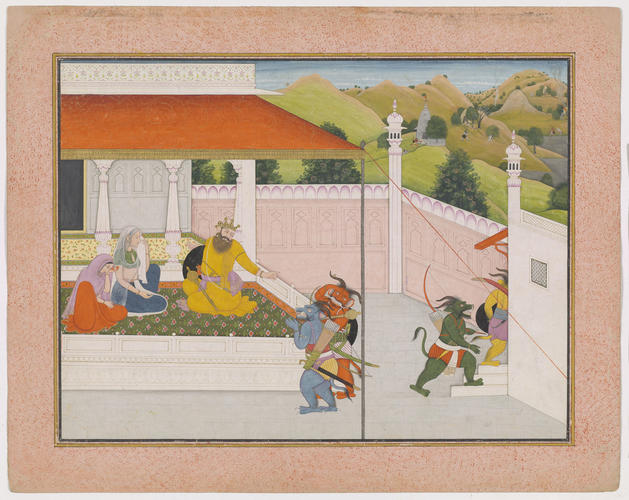
Hiranyakashipu consoles his mother and sister-in-law c. 1775-90
38.5 x 30.5 cm (folio dimensions) | RCIN 925237
Nainsukh family workshop
Hiranyakashipu consoles his mother and sister-in-law c. 1775-90
-
The Bhagavata Purana is a Hindu epic text that narrates stories of the avatars of Vishnu. The sixteen paintings in the Royal Collection depict Vishnu first in his boar avatar (Varaha) rescuing the earth from the bottom of the cosmic ocean. He later returns in his half-man half-lion avatar (Narasimha) to kill the demon king Hiranyakashipu. The narrative focuses on the story of Hiranyakashipu’s son Prahlada, whom Vishnu protects from the demons’ attacks. The paintings are numbered between 6 and 37 suggesting that there were at least 21 others in this series, although this figure is likely to have been larger.
The series is attributed to the family workshop of Nainsukh, an artist active throughout the mid-eighteenth century in the hill states of the Punjab. Nainsukh’s four sons and two nephews were also all painters and their work is stylistically attributed to the ‘first generation after Nainsukh’, and it is to them that this series is assigned. This family of artists are known to have worked for patrons across the Pahari states of Chamba, Guler, Kangra, Mandi, Nurpur and others. The scale of the series suggest it was a royal commission. Their paintings were not usually bound into albums but kept loose, each protected by a cover sheet. Series such as this were habitually broken up and dispersed in the early twentieth century, thus it is rare for one collection to have so many paintings from a single sequence.
This painting is an illustration to Book 7 of the Bhagavata Purana, Chapter 2: Having sent his demons to terrorise the surrounding towns and villages, Hiranyakashipu tries to console his mother and sister-in-law as they lament his brother’s death.
For the entire series, see RCINs 925226-925241.
Provenance
Queen Mary acquired many Pahari paintings, including several later presented the Victoria and Albert Museum, and it is likely that it was she who acquired this set.
-
Creator(s)
Acquirer(s)
-
Measurements
38.5 x 30.5 cm (folio dimensions)
31.5 x 24 cm (image)
Category
Object type(s)
Other number(s)
RL 25237


