


-
1 of 253523 objects
Mark Catesby (1682-1749)
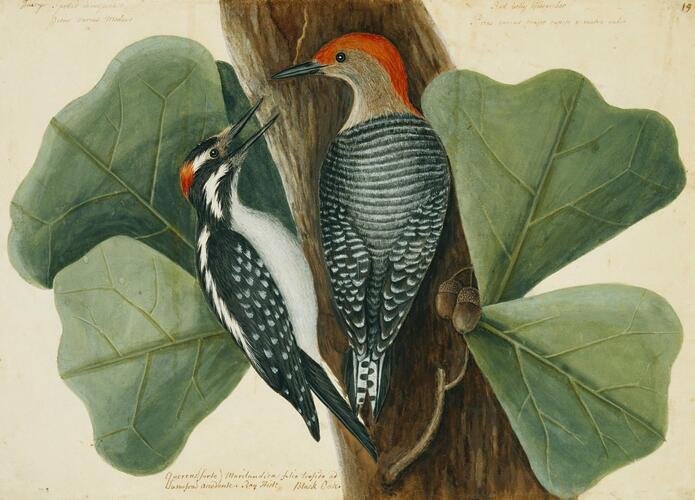
The Red-bellied Wood-pecker, the Hairy Wood-pecker and the Black Oak c.1722-26
Watercolour and bodycolour with white heightening | 26.5 x 37.1 cm (sheet of paper) | RCIN 924832
Mark Catesby (1682-1749)
The Red-bellied Wood-pecker, the Hairy Wood-pecker and the Black Oak c.1722-26
-
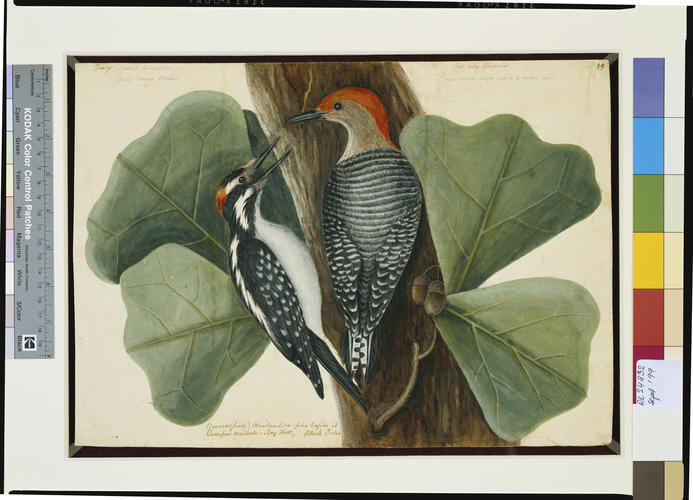
A watercolour of a red-bellied woodpecker (right, Melanerpes carolinus (Linnaeus)) and a hairy woodpecker (left, Picoides villosus (Linnaeus)) on blackjack oak (Quercus marilandica Münchh.) The drawing shows two birds on a tree trunk from which sprouts large, flat deep-green leaves. The bird to the left has a white breast, black and white feathers, and an open black beak. The second bird is seen from behind, with its head in profile to left. Inscribed in ink: (top left) 'Hairy Spotted Woodpecker Picus varius medius'; (top right) 'Red belly Woodpecker Picus varius major capite & ventre rubro' and '19'; (at bottom) 'Quercus (forte) Marilandica folio trefido ad Sassafras accedente. Ray Hist. Black Oak'. The reference is to John Ray's Historia Plantarum, published in three volumes between 1686 and 1704.
There is a slight pencil sketch of a bird on the verso of the sheet.
The paper bears half of a watermark of a shield with a fleur-de-lys (Type A in Henrietta McBurney, Illuminating Natural History. The Art and Science of Mark Catesby, New Haven and London, 2021, p. 225-6).
Mark Catesby was born in Suffolk and was interested in natural history from an early age. In 1712, he travelled to the east coast of America with his sister Elizabeth, who had married a doctor who practised in Williamsburg, Virginia. Catesby spent seven years in Virginia collecting specimens and seeds for London buyers before returning to Britain. In London his drawings of birds and plants met with praise and a group of benefactors paid for his travel to Carolina in 1722. There, he made numerous drawings of the flora and fauna, working hard to ensure that his depictions were as helpful for an understanding of their subjects as possible. On his return to Britain, his drawings were reproduced in The Natural History of Carolina, Florida and the Bahama Islands, which appeared in a series of volumes between 1729 and 1747. The first volume was dedicated to Queen Caroline, the second to Augusta, Princess of Wales. The original drawings from the volumes, which had been in the possession of Catesby’s widow until her death, were purchased by George III from the London bookseller Thomas Cadell in 1768.
The watercolour was used as the basis for plate 19 in the first volume of the Natural History ('The Red-bellied Wood-pecker', 'The Hairy Wood-pecker' and 'The Black Oak'). In the accompanying text, Catesby noted of the blackjack oak that it 'usually grows on the poorest land, and is small; the colour of the Bark black, the Grain course; and the Wood of little use but to burn: some of these Oaks produce leaves ten inches wide.'
For identification of the species depicted see James L. Reveal, 'Identification of the plants and animals illustrated by Mark Catesby for his Natural History of Carolina, Florida, and the Bahama Islands' in Phytoneuron 2013 and revised online version.
Provenance
Thomas Cadell; from whom bought by George III, 1768
-
Medium and techniques
Watercolour and bodycolour with white heightening
Measurements
26.5 x 37.1 cm (sheet of paper)
Other number(s)
RL 24832Alternative title(s)
Pica Ventre rubro; Picus medius quasi villosus; Quercus (forte) Marilandica, folia trifido ad sassasras accedente


