


-
1 of 253523 objects
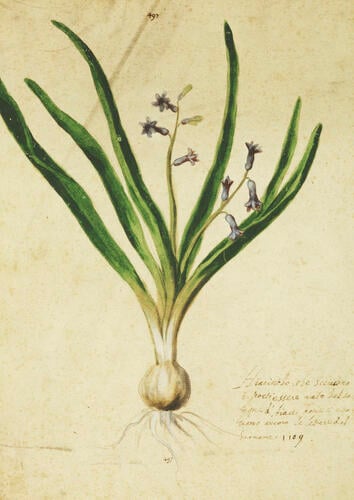
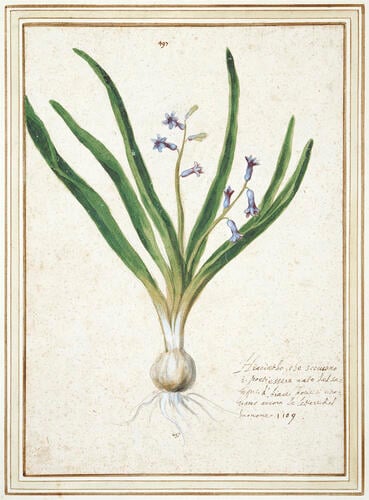
Hyacinth (Hyacinthus Orientalis L.) c.1600-25
Watercolour and bodycolour over black chalk or graphite. Watermark: fleur de lys on hills, in circle, with surmounting letter M (Paper Museum Fleur de lys 53). | 36.9 x 26.1 cm (sheet of paper) | RCIN 919414
-
This natural history drawing from the 'Paper Museum' of Cassiano dal Pozzo (1588–1657) shows the hyacinth, a bulbous herbaceous perennial of the family Hyacinthaceae; originally from the Near East, it was introduced to Italy during the middle of the sixteenth century and is now cultivated and naturalized all over the world. The drawing shows an entire plant complete with its round bulb, whitish tunic and fasciculate roots. It has six linear leaves which are bent into a broad V along the blade’s central furrow. The two scapes each carry four or five bell-shaped flowers, whose corollas are blue streaked with red and terminate in six long lobes. The stamens and the pistil are not visible.
In Greek mythology the birth of the hyacinth flower was associated with the blood spilt by both Hyacinth, the youth beloved of Apollo and accidentally slain by him in a game of discus, and Ajax, the Homeric hero who killed himself from shame after having slaughtered a group of sheep (mistaken in a fit of mad rage for Trojans and for Odysseus, who had been awarded Achilles’ armour in his stead). The letters ‘Ai’ were said to be imprinted on the leaves of the flower, interpreted as the first letters of Ajax’s name (as noted in the annotation here) or as Apollo’s lament (‘ai ai’ being Greek for ‘alas’ or ‘woe’).
The sheet originally formed part of a companion second volume to the Erbario Miniato, an early seventeenth-century Italian herbal commissioned by Federico Cesi (1585–1630), founder in 1603 of the Accademia dei Lincei in Rome, an early scientific society. The herbal was acquired after Cesi’s death by Cassiano, a fellow member of the academy, under whom the drawings were numbered. Most of the drawings are accompanied by notes in Cesi's hand, sometimes providing only the name of the plant but often also their medicinal properties – information that was drawn largely from Pietro Andrea Mattioli’s 1568 edition of Dioscorides’ De materia medica, the first-century AD treatise used as the basis for pharmaceutical and herbal knowledge for more than 1,500 years (I Discorsi di M. Pietro Andrea Matthioli . . . nelli sei libri di Pedacio Dioscoride Anazarbeo della materia medicinale, Venice 1568).
The annotation here refers to p. 1109 of Mattioli’s Discorsi, although the illustration on that page (captioned ‘Hiacintho’) shows a tassel hyacinth, Leopoldia comosa, a species quite different from the plant shown here. A hyacinth instead appears on p. 1110 (‘Hiacintho orientale’). Mattioli also recounts that a hyacinth specimen was sent to him from Padua by Giacomo Antonio Cortuso, who was to serve as prefetto of the city’s botanical garden from 1590 to 1603.
Of the two companion volumes to the Erbario Miniato (see Garbari and Tongiorgi Tomasi 2007, p. 36), the first is untraced and the drawings from the second, bearing ‘Pozzo’ numbers in the range 279 (circa) to 498, were cut down and remounted with wash borders in the eighteenth century. Most were sold from the Royal Library in the 1920s and sixty-seven have since been identified (ibid., cats 212–277).
Annotation: Hiacintho, che scriuono / i poeti essere nato del sa= / ngue d’Aiace, dove si ritro= / vano ancora le lettere del / suo nome 1109. (‘Hyacinth, of which the poets write that it was born from the blood of Ajax, and in which the letters of his name can still be found. 1109.’) [From Mattioli 1568, p. 1109]
‘Pozzo’ number 497 (twice); laid down on a George III two-ply mount with wash borders (‘type D’ mount).
Text adapted from Fabio Garbari and Lucia Tongiorgi Tomasi, Flora: The Erbario Miniato and other Drawings, Part B.VI of The Paper Museum of Cassiano dal Pozzo: A Catalogue Raisonné, 2 vols, London 2007, cat. 276 and p. 446.
Provenance
Commissioned by Federico Cesi (1585–1630), from whose widow acquired by Cassiano dal Pozzo (1588–1657) for his 'Paper Museum' in 1633. Sold by Cassiano's great nephew to Clement XI Albani, 1703; acquired by Cardinal Alessandro Albani in 1714, from whom purchased by George III in 1762; by descent to George V (reg. 1910–36); art market (?Jacob Mendelson, London); Rex Nan Kivell (Redfern Gallery, London), by whom presented to Queen Elizabeth II in 1976.
As part of ongoing provenance research, this work has been identified as having uncertain or incomplete provenance for the years 1933–45. Royal Collection Trust welcomes information and assistance in the investigation and clarification of the provenance of all works during that era. -
Creator(s)
(collector)Acquirer(s)
-
Medium and techniques
Watercolour and bodycolour over black chalk or graphite. Watermark: fleur de lys on hills, in circle, with surmounting letter M (Paper Museum Fleur de lys 53).
Measurements
36.9 x 26.1 cm (sheet of paper)
58.5 x 43.5 cm (mount)
Markings
watermark: Fleur de lys 53 [sheet]
Other number(s)
RL 19414


