


-
1 of 253523 objects
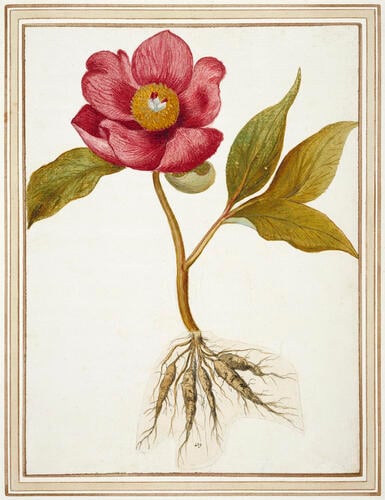
Peony (Paeonia mascula (L.) Mill.) with the root of (Paeonia officinalis L.) c. 1600-25
Watercolour and bodycolour over black chalk or graphite | 36.2 x 27.0 cm (sheet of paper) | RCIN 919401
-
This natural history drawing from the 'Paper Museum' of Cassiano dal Pozzo (1588–1657) shows the peony, a flowering plant of the family Ranunculaceae. Peonies are found throughout southern Europe and are depicted in another two drawings from the same group (see Garbari and Tongiorgi Tomasi 2007, cats 254–255). The present illustration is a composite of two species of peony, a flowering branch of Paeonia mascula to which has been pasted the root of Paeonia officinalis. The stem is thick, smooth and brownish. The leaf grows from a long petiole and is composed of a blade divided into lanceolate lobes with pointed tips, entire margins and brown veins. The flower is made up of rounded petals, pale red with a fine network of darker veins. The blossom has a large number of stamens carrying brownish-yellow anthers; at its centre can be glimpsed silky, pubescent pistils with red stigmas. Five elongated tubers grow from the distinctive root of Paeonia officinalis.
The peony may have been named after Paion, the physician of the gods to whom Pliny the Elder attributed the discovery of the curative properties of this plant. The Greeks used it to treat asthma, gout, madness and epilepsy in children. Theophrastus warned herbalists to gather the plant at night to avoid being seen and attacked by the woodpecker, to whom the plant was sacred. The use of the plant for medicinal purposes was gradually abandoned because it also contains toxic substances.
The sheet originally formed part of a companion second volume to the Erbario Miniato, an early seventeenth-century Italian herbal commissioned by Federico Cesi (1585–1630), founder in 1603 of the Accademia dei Lincei in Rome, an early scientific society. The herbal was acquired after Cesi’s death by Cassiano, a fellow member of the academy, under whom the drawings were numbered. Of the two companion volumes to the Erbario Miniato (see Garbari and Tongiorgi Tomasi 2007, p. 36), the first is untraced and the drawings from the second, bearing ‘Pozzo’ numbers in the range 279 (circa) to 498, were cut down and remounted with wash borders in the eighteenth century. Most were sold from the Royal Library in the 1920s and sixty-seven have since been identified (ibid., cats 212–277).
‘Pozzo’ number 419; the roots of the flower are cut from another sheet and inlaid in the main drawing sheet, which is in turn laid down on a George III two-ply mount with wash borders (‘type D’ mount).
Text adapted from Fabio Garbari and Lucia Tongiorgi Tomasi, Flora: The Erbario Miniato and other Drawings, Part B.VI of The Paper Museum of Cassiano dal Pozzo: A Catalogue Raisonné, 2 vols, London 2007, cat. 253 and p. 446.
Provenance
Commissioned by Federico Cesi (1585–1630), from whose widow acquired by Cassiano dal Pozzo (1588–1657) for his 'Paper Museum' in 1633. Sold by Cassiano's great nephew to Clement XI Albani, 1703; acquired by Cardinal Alessandro Albani in 1714, from whom purchased by George III in 1762; by descent to George V (reg. 1910–36); art market (?Jacob Mendelson, London); Rex Nan Kivell (Redfern Gallery, London), by whom presented to Queen Elizabeth II in 1976.
As part of ongoing provenance research, this work has been identified as having uncertain or incomplete provenance for the years 1933–45. Royal Collection Trust welcomes information and assistance in the investigation and clarification of the provenance of all works during that era. -
Creator(s)
(collector)Acquirer(s)
-
Medium and techniques
Watercolour and bodycolour over black chalk or graphite
Measurements
36.2 x 27.0 cm (sheet of paper)
Category
Object type(s)
Other number(s)
RL 19401Alternative title(s)
Peony
Peony


