


-
1 of 253523 objects
Paul Sandby (1731-1809)
The Great Bridge over the Virginia River c. 1754
Pencil, pen and ink, watercolour and bodycolour | 31.2 x 57.5 cm (sheet of paper) | RCIN 914647

-
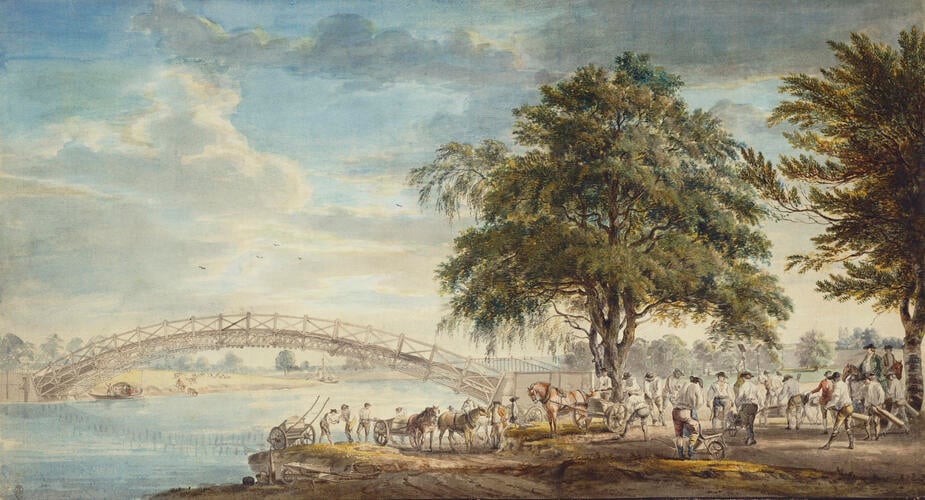
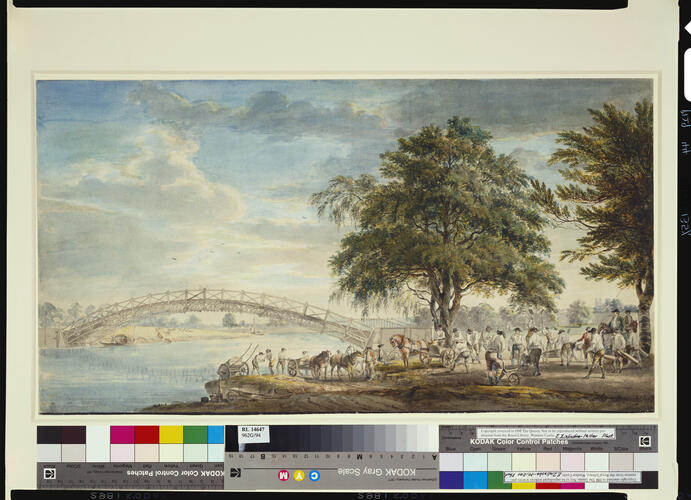
A watercolour drawing of a wooden bridge over Virginia Water. Two large trees on the right, with many workmen in the right foreground. At the far right is William Augustus, Duke of Cumberland, then Ranger of the Great Park, in a green coat on horseback. Fort Belvedere is visible in the distance. Only one balustrade of the bridge has been filled in, the other marked out in pencil. Some figures on the bridge in pencil. A ruler has been used to draw some lines. Inscribed on the verso 'Windsor Great Park'.
The sheet of paper has a black border at the bottom, and was previously mounted on a wash line bordered mount, probably Sandby's own, associated with drawings sold at his estate sale in 1811, although no lot is identifiable for this drawing in that sale. Inscribed in ink on the back of this old mount in Paul Sandby's handwriting, 'View of the great Wooden Bridge over the Virginia River in Windsor Great Park built for His Royal Higness [sic] William Duke of Cumberland, by Mr Fleetcroft in the year 1760, which went soon to decay, and an elegant Stone Bridge was afterwards Erected by T. Sandby Esqr - This drawing was made by the two Brothers T. and P. Sandby Esqrs' and at the right 'Wrote by Paul Sandby 1807'. Inscribed on the mount at the bottom, 'The Late Duke of Cumberland' and 'Sandby', in a hand associated with the dealer Colnaghi.
The drawing was engraved as part of a set of Eight Views of Windsor Great Park by the Sandby brothers in 1754 (for example, RCIN 814831). The set was dedicated to the Duke of Cumberland, for whom Thomas Sandby worked from 1746, becoming Deputy Ranger of Windsor Great Park in 1764. The wooden bridge built by Henry Flitcroft (1697-1769, Comptroller of Works from 1758) was intended to carry the main carriage route that ran through the Park from north to south, without preventing the Duke of Cumberland’s pleasure boats from sailing beneath it. The Duke is shown in this watercolour on horseback at far right. The wooden bridge was damaged by a storm, possibly on 1 September 1768, and had been removed by 1783. The five arch stone bridge that replaced it was designed by Thomas Sandby and erected by 1791. The bridge still survives on the northern arm of Virginia Water between Virginia Water and China Creek. Paul Sandby's own inscriptions often contain inconsistencies of date: the wooden bridge must have been erected earlier than 1760 as it appears in his own print in 1754.
A preparatory study is also in the Royal Collection (RCIN 917851). Another related watercolour is in the British Museum (1904,0819.428). Several figure studies relating to the workmen in the foreground are in the British Museum (L.B. 138), and in the Royal Collection relating to the figure of the Duke and his groom (RCIN 917549). Another version of this drawing, in which George II is depicted inspecting the building of the bridge, appeared at Sotheby's, 8 July 2015, lot 223.Provenance
Paul Sandby; Royal Collection by 1884
-
Creator(s)
-
Medium and techniques
Pencil, pen and ink, watercolour and bodycolour
Measurements
31.2 x 57.5 cm (sheet of paper)
Other number(s)
RL 14647


