


-
1 of 253523 objects
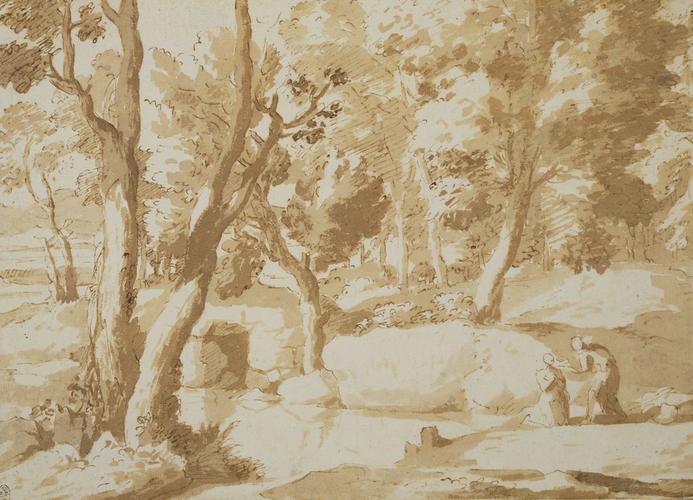
St Mary of Egypt receiving Communion from St Zosimus c.1634-36
Pen and brown ink, brown wash | 22.5 x 31.0 cm (sheet of paper) | RCIN 911925
-
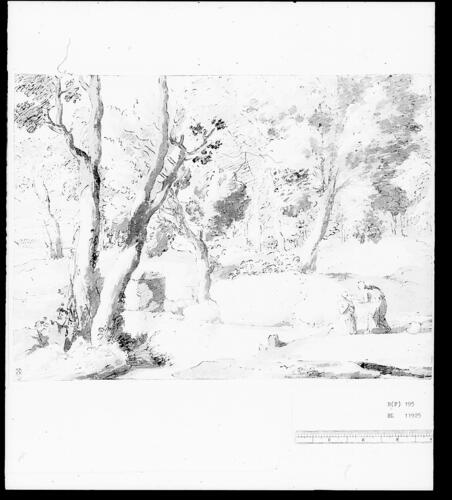
A drawing of a wooded landscape with a pool; two figures lower right, one kneeling before the other, who offers the Sacrament.
St Mary of Egypt was a fifth-century prostitute who was converted to Christianity while in Jerusalem, living as a hermit in the wilderness for the rest of her days. In her old age she was discovered by the abbot Zosimus, who gave her communion. Poussin's depiction of the scene appears at first glance merely an excuse to portray a wooded landscape and the dappling of light through the trees. The sheet is in excellent condition, and the combination of white paper with an equal area of liquid pale wash, and patches of darker wash dragged over the surface, gives the drawing an unrivalled freshness and luminosity.
The open composition and the wash are handled with a freedom typical of Poussin's sheets of the mid-1630s, when landscape was beginning to play a greater role in his paintings. The question of Poussin's landscape drawings has been hotly debated over the last thirty years, and the present sheet is invaluable in being certainly autograph and fairly accurately datable.
The drawing was related by Blunt (Burlington Magazine, 1959, pp. 389f) to a series of paintings of hermits, commissioned in the 1630s by Philip IV of Spain for his palace of Buen Retiro. Three paintings from this series now in the Prado carry traditional attributions to Poussin, only one of which - St Jerome in the Wilderness - appears to be autograph. Also in the Prado are three paintings by Claude of similar dimensions and complementary subjects, noted at Buen Retiro in an inventory of 1700, and a further two by Jan Both. No painting of the present subject from the series is known, but the 1700 inventory recorded a landscape 'with St Mary of Egypt and the Abbot Zosimus, when she ascended to heaven' ('con Santa Maria Egipciaca y el Abad Socimas, quande la vió subir al cielo'). We therefore have a series of paintings of hermits to which Poussin contributed, which included a representation of St Mary of Egypt and St Zosimus, and which was predominantly painted in the mid to late 1630s. The proportions of the paintings are a little different from the drawing, but it is quite possible that the present sheet is connected with the Buen Retiro commissions - perhaps as a modello for the approval of the patron's agent.
Shearman (in Actes du Colloque International de Nicolas Poussin, 1960, pp. 179-88) suggested an alternative scenario, that the drawing was supplied by Poussin as a model for a painting of the subject by Gaspard Dughet (his brother-in-law), now in the Galleria Doria-Pamphilj in Rome; but the painting is very different in composition from the drawing.Provenance
Cardinal Camillo Massimi (1620-1677); from whose heirs bought in 1739, for 300 scudi, by Richard Mead (1673-1754); probably presented to Frederick, Prince of Wales, by 1750.
-
Medium and techniques
Pen and brown ink, brown wash
Measurements
22.5 x 31.0 cm (sheet of paper)
Category
Object type(s)
Other number(s)
RL 11925Alternative title(s)
S. Maria Egittiaca nel Deserto


