


-
1 of 253523 objects
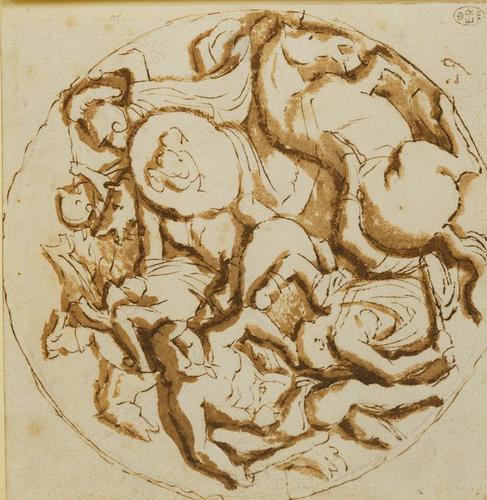
Hercules and Theseus fighting the Amazons c.1641-42
Circle traced with stylus, slight black chalk underdrawing, pen and brown ink, brown wash | 13.2 x 13.4 cm (sheet of paper) | RCIN 911920

-
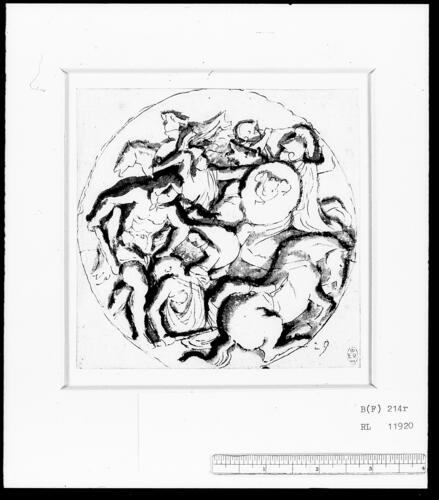
A drawing of a circular composition with Hercules to the left, holding a fallen Amazon by the hair; other helmeted figures and a fallen horse to the right. A study for the decoration of the Grande Galerie of the Louvre.
The drawing depicts the ninth of Hercules’ Twelve Labours. Admete, the daughter of King Eurystheus, desired the girdle of Hippolyte, Queen of the Amazons, and Hercules was sent to secure it. At first he was welcomed by the Amazons, but the goddess Hera soured relations, and in an ensuing battle Hercules – in some accounts aided by Theseus and other Greeks, as probably depicted here – killed Hippolyte and took her girdle.
The drawing is preparatory for Poussin's decoration of the Grande Galerie, a wide corridor four hundred metres long connecting the Louvre with the Tuileries, the biggest project forced upon him during his unhappy two years in Paris (and this despite a promise from François Sublet de Noyers in a letter to Poussin of 14 January 1639 that "you will not have to paint on ceilings nor on vaults"). In March 1641 he was given control over the decoration of all the royal palaces in France, and began by destroying the scheme that the architect Jacques Lemercier had begun in the Louvre. But Poussin carried out very little work, and what he completed was in turn destroyed the following century.
It would be hard to conceive of an enterprise less suited to Poussin's temperament than this, requiring him to devise an extensive decorative scheme for painting on a barrel vault, and involving the supervision of a large number of assistants. Probably the only aspect that appealed to him was the erudition required to spin out a mythological theme into dozens of episodes; the life of Hercules was chosen as a subject, having been treated at length by several classical authors. Poussin's main source was Natale Conti's widely used mythographic handbook Mythologiae sive explicationis fabularum, which went through several French editions between 1599 and 1627.
Many drawings for the project survive, mostly finished working drawings (eg RCIN 911969-73) executed by Poussin's assistants, including Jean Lemaire, who apparently took over practical responsibility for the project in 1642 and continued the work for several months after Poussin left for Rome. Of the few sheets by Poussin himself, two contain sketches of first thoughts for the compositions, annotated by Poussin with an identification of the scene and a sequence number (Rosenberg & Prat 1994, nos. 212-13). Of the next stage, where the first sketch is worked up into a full composition, only the present drawing survives, showing the change from the essentially pictorial conception of the first sketches to the emulation of relief sculpture apparent in all the finished sheets. Poussin abhorred spatial illusionism: he wrote in a letter to Sublet that "everything I have placed on this vault should be understood as being attached to it in the manner of a relief, without pretending that there is any object which breaks through, or which lies beyond and at a greater distance than, the surface of the vault, but that everything follows its curvature and shape."
In this drawing he dragged long lines of dark wash around the contours of the figures to give the effect of shadows cast by high relief onto a plain ground, but the composition is somewhat incoherent compared to the workshop fair copies, all of which have a definite "up" if not a solid horizon. It appears that the design was simplified into a depiction of Hercules stuggling with a single mounted Amazon, known through studio sheets in the Hermitage and the Prado (R&P, nos. A56-57).
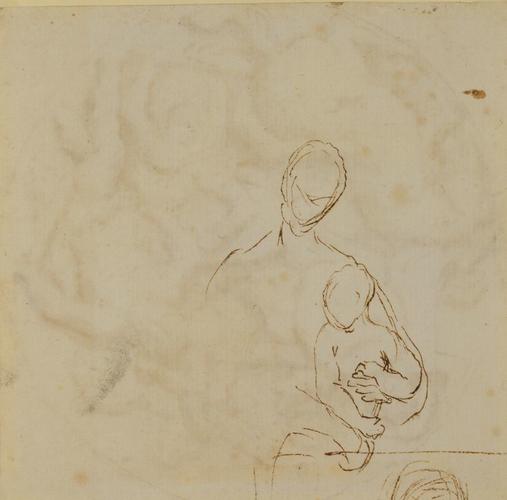
On the verso are fragmentary drawings for a composition of the Madonna and Child, probably to be connected with RCIN 911988.Provenance
Probably Cassiano dal Pozzo (1583-1657); from whose heirs bought by Pope Clement XI, 1703; passed to his nephew, Cardinal Alessandro Albani, 1714; from whom acquired by George III, 1762
-
Creator(s)
Acquirer(s)
-
Medium and techniques
Circle traced with stylus, slight black chalk underdrawing, pen and brown ink, brown wash
Measurements
13.2 x 13.4 cm (sheet of paper)
Other number(s)
RL 11920


