


-
1 of 253523 objects
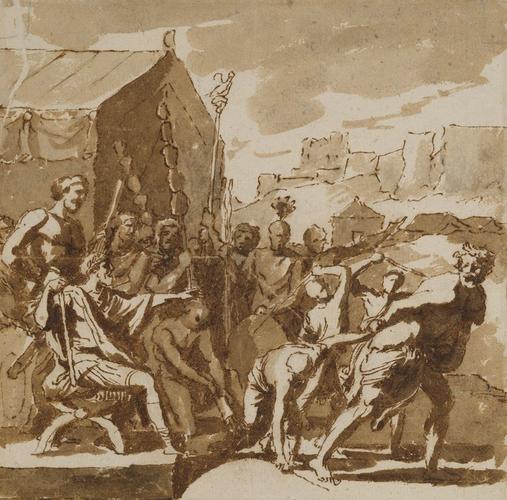
Camillus and the schoolmaster of Falerii c.1637
Stylus lines, graphite underdrawing, pen and brown ink, brown wash | 17.9 x 18.0 cm (sheet of paper) | RCIN 911913

-
A drawing of the Roman general Furius Camillus ordering a schoolmaster to be beaten by his pupils.
Furius Camillus was besieging the town of Falerii, when a schoolmaster offered his pupils as hostages to raise the seige. Camillus instead turned the schoolmaster over to be beaten by his pupils (Plutarch, Life of Camillus, 10; Livy, V, 27; Valerius Maximus, VI, 5, 1). This tale was only rarely depicted, but Poussin treated it on at least two separate occasions.
The drawing is a study for a large painting in the Louvre, painted in 1637 for Louis Phélypeaux de la Vrillière to hang alongside paintings by Guercino, Pietro da Cortona and others in the gallery of his hôtel in Paris, begun by Mansart in 1636. Félibien (Entretiens sur les vies…, 1725, IV, p.25) stated that Poussin had painted a smaller version of the subject "some years earlier" than that for de la Vrillière: that painting oblong in format and much smaller but of very similar figuration, is in the Norton Simon Museum in Pasadena, California.
There are few differences in the figuration of the two paintings, and the sketchy landscape here is closer to the Pasadena version, but a constructional stylus line from lower left to upper right corners, and a perspective grid extending to the lower right corner, show that the drawing has not been cut down, and is preparatory for a painting square in format. The main changes in figuration between drawing and painting are the increased scale of the boys beating the schoolmaster, and the introduction of three more figures at the right to contain the flow of the composition.
Another drawing for the Louvre painting, in the Fogg Art Museum in Cambridge, Massachussetts (Rosenberg & Prat 1994, no. 126), is partly traced by Poussin from the present sheet. In the Louvre painting the three central boys are on the same scale with respect to the schoolmaster as in the Fogg drawing, but two boys turning backwards, added to the Fogg drawing, have been left out. These two are seen at the right of the Pasadena version, but make little narrative sense on the Fogg sheet; as with the landscape in the Windsor drawing, Poussin must have been simply reusing motifs from his earlier version as he devised a new composition.
In the British Museum is a large, carefully drawn panoramic drawing of the same subject (R&P, no. 127; the authenticity of that sheet has been questioned, but it is certainly by Poussin himself. It is not close in figuration to the paintings, and the degree of finish has led some scholars to propose that it was produced as an independent work of art. But the proportions are very close to those of the Pasadena painting (357 x 497 mm, a ratio of 1:1.39, against 100 x 137 cm), which might suggest that it was a rejected modello, produced for the patron before the painting was begun. Such drawings are difficult to date on stylistic grounds alone, but the London sheet must be of the mid-1630s.Provenance
Cardinal Camillo Massimi (1620-1677); from whose heirs bought in 1739, for 300 scudi, by Richard Mead (1673-1754); probably presented to Frederick, Prince of Wales, by 1750.
-
Medium and techniques
Stylus lines, graphite underdrawing, pen and brown ink, brown wash
Measurements
17.9 x 18.0 cm (sheet of paper)
Object type(s)
Other number(s)
RL 11913Alternative title(s)
Furio Camillo


