


-
1 of 253523 objects
The Sacrifice of Polyxena (?) c.1650
Red chalk underdrawing, pen and brown ink, brown wash, on buff paper | 17.3 x 35.3 cm (sheet of paper) | RCIN 911906

-
A drawing of an ancient sacrifice: a young woman kneeling before a man with an axe, warriors standing to the left, priests and an altar to the left. This drawing could represent one of two scenes from ancient history with a very similar iconography. Agamemnon had incurred the wrath of Artemis, who becalmed the Greek fleet ready to sail for Troy; only the sacrifice of his daughter Iphigeneia would appease her. At the last minute Artemis relented and substituted a deer for Iphigeneia (Ovid, Metamorphoses, XII, 25ff). In the later episode, the ghost of Achilles appeared to the other Greeks after the taking of Troy, demanding that Polyxena, daughter of the defeated King Priam, be sacrificed on his tomb. She went to her fate heroically, and the watching crowd shed the tears that she held back (Metamorphoses, XIII, 439ff).
Neither episode satisfactorily explains all the features of the present drawing. The drawing is identified as the Sacrifice of Polyxena in the manuscript catalogue of Massimi’s collection, where G.B. Marinella refers to the obscure legend that the manner of Achilles's death was the cause of his malice towards Polyxena beyond the grave. He had fallen in love with Polyxena, and was offered her hand to raise the seige. But this was a plot, and Polyxena's brother shot Achilles in his one vulnerable spot, his heel. This version of events is not recounted by Homer or Ovid, who both have Achilles dying on the battlefield, and the obscurity of the sources (Dares Phrygius; Dictys Cretensis) might suggest that Marinella was getting carried away with his own erudition in describing the scene.
In favour of the alternative identification, it has been noted that Poussin borrowed narrative details from the descriptions by several classical authors of Timanthes's Iphigeneia. That long-lost painting was the most celebrated exemplar in antiquity of the expression of the emotions, but it was said that Timanthes had exhausted his skills in depicting the anguish of the bystanders and could not portray the extreme grief of Agamemnon, so he painted him covering his face, leaving his emotions to be imagined. The prominent figure in this attitude at the centre of the drawing is undoubtedly a reference to these accounts of Timanthes's painting. Further, the basic composition and several details were taken from Domenichino's fresco of the Sacrifice of Iphigeneia of 1609 in Palazzo Giustiniani-Odescalchi in Bassano Romano, but this is hardly conclusive.
No painting by Poussin of either subject is known, and the literary connotations of the Iphigeneia episode are so consonant with Poussin's interest in facial expression at this time that it is likely that he made the drawing independently of any commission. It is typical of the highly charged dramatic scenes around 1650, with mask-like, almost grotesque faces.
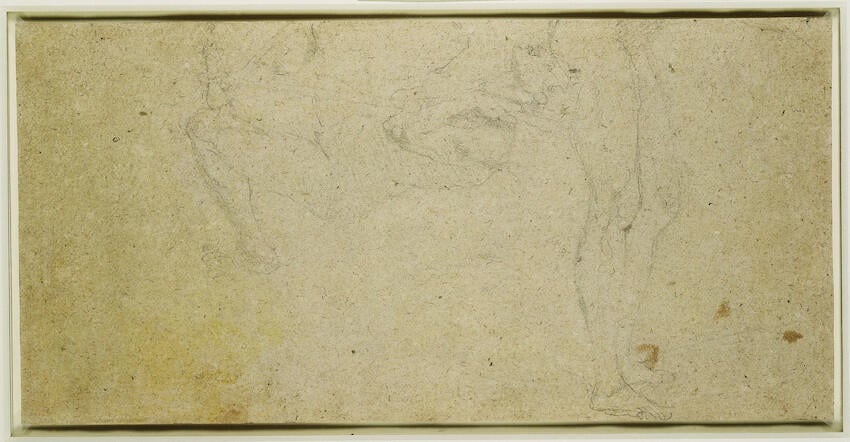
On the verso are two studies in faint black chalk, of a pair of legs from the side and (with the sheet turned through ninety degrees) a man dropped on one knee, holding a staff and looking up. The latter study is evidently for the Louvre painting of Christ Healing the Blind (see RCIN 911902). The surviving compositional studies for that painting show that Poussin found the pose of the principal blind man very hard to establish, on one knee or both knees, facing to left or to right, supporting himself with a stick or crutches, or unaided, and the present drawing is another variant.
This verso is possibly related to another page of life studies in the British Museum (1895.9.15.925 verso). Although in a much softer chalk they are apparently by the same hand, with nervous outlines, an emphasis on the bony articulation of the joints, and the shading added in small areas of parallel hatching. They too are for Christ Healing the Blind: the full-length figure is a study for the disciple who restrains the second blind man, leaning forward on his right leg, twisting at the waist and dropping the right shoulder - although the arms are in a different position, at the centre right of the sheet is a drawing of his left hand exactly as painted. The hand at the lower left is presumably for the hand of Christ touching the eyes of the blind man, which again goes through several variants in the compositional studies (and is here of the rigidly pointing type found in contemporary paintings such as Christ and the Adulteress or the Death of Sapphira). Turning the sheet around, there is a study of legs from the side very close to that on the verso of 911906, and, most conclusively, a study for the shoulder and bent arm of a man holding a staff. The forearm is drawn in two different positions; that with the arm more bent is almost identical to the figure of the first blind man as painted.Provenance
Cardinal Camillo Massimi (1620-1677); from whose heirs bought in 1739, for 300 scudi, by Richard Mead (1673-1754); probably presented to Frederick, Prince of Wales, by 1750.
-
Creator(s)
Acquirer(s)
-
Medium and techniques
Red chalk underdrawing, pen and brown ink, brown wash, on buff paper
Measurements
17.3 x 35.3 cm (sheet of paper)
Other number(s)
RL 11906Alternative title(s)
The Sacrifice of Iphigeneia (?)
Sacrificio di Pollisena


