


-
1 of 253523 objects
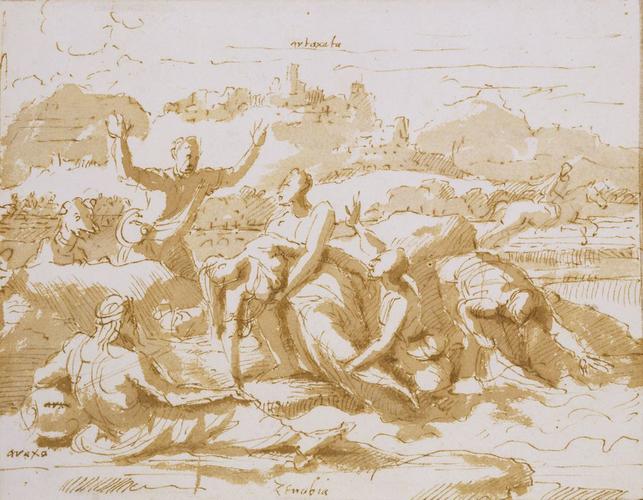
The Finding of Queen Zenobia c.1634-36
Pen and brown ink, brown wash | 15.8 x 20.0 cm (sheet of paper) | RCIN 911895
-
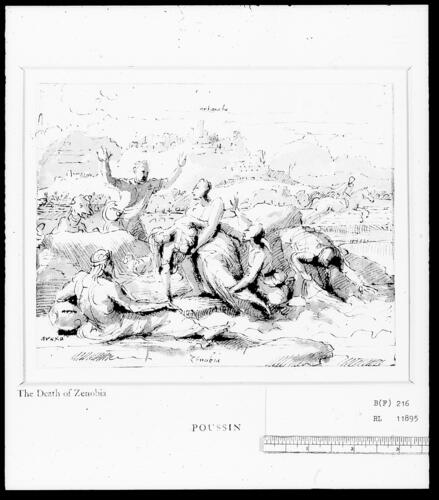
A drawing of a group of figures pulling a woman out of the water, before a distant city.
In ancient legend, King Rhadamistus and his wife Zenobia fled Artaxata, the capital of Armenia, after an uprising. The pains of childbirth came upon Zenobia during their flight, and she pleaded with her husband to kill her rather than let her fall into the hands of their pursuers. Stabbing her, he threw her into the river Araxes, but she was discovered by shepherds and revived (Tacitus, Annals, XII, 51). Poussin shows the moment of the recovery of the queen from the river, indicated by the reclining river-god with araxo written by his urn; in the background Rhadamistus gallops to the right followed by his pursuers, with the city of Artaxata on the hill in the distance. The drawing belongs to the group of free and luminous sheets of the mid-1630s.
Several other depictions of the episode by or attributed to Poussin are known. A drawing at Chantilly (Rosenberg & Prat 1994, no. 119) is of closely the same date, with the figure of Zenobia in the same pose as Virginia in RCIN 911888. A peculiar drawing in the Hermitage (R&P, no. 121), may be a pastiche of Poussin - the background is close in style to that of 911884, the figure of Zenobia is taken from the antique Sleeping Ariadne sculpture, and a shepherd is in the pose of Perseus in the drawing of the Origin of Coral (RCIN 911984); the drawing seems too feeble to be by Poussin, but is just conceivably an original of around 1630. A scribbly drawing in Stockholm from the perplexing Crozat group (R&P, no. 120) seems rather weakly structured, but is similar in its abbreviations to some sheets of the late 1630s, and may well be autograph. The composition of the Stockholm study is close to a painting in the Hermitage that has been claimed for Poussin himself (as unfinished, or damaged and overpainted); it is difficult to judge, but it looks too cumbersome to be autograph. Finally, from later in Poussin’s career are two further drawings of the episode, one on the verso of a landscape drawing of around 1650 in Düsseldorf (R&P, no. 348v), the other in Poussin's agitated style of the late 1640s, in a private collection (R&P, no. 347).Provenance
Provenance unknown, but probably Cassiano dal Pozzo (1583-1657); from whose heirs bought by Pope Clement XI, 1703; passed to his nephew, Cardinal Alessandro Albani, 1714; from whom acquired by George III, 1762
-
Creator(s)
Acquirer(s)
-
Medium and techniques
Pen and brown ink, brown wash
Measurements
15.8 x 20.0 cm (sheet of paper)
Object type(s)
Other number(s)
RL 11895


