


-
1 of 253523 objects
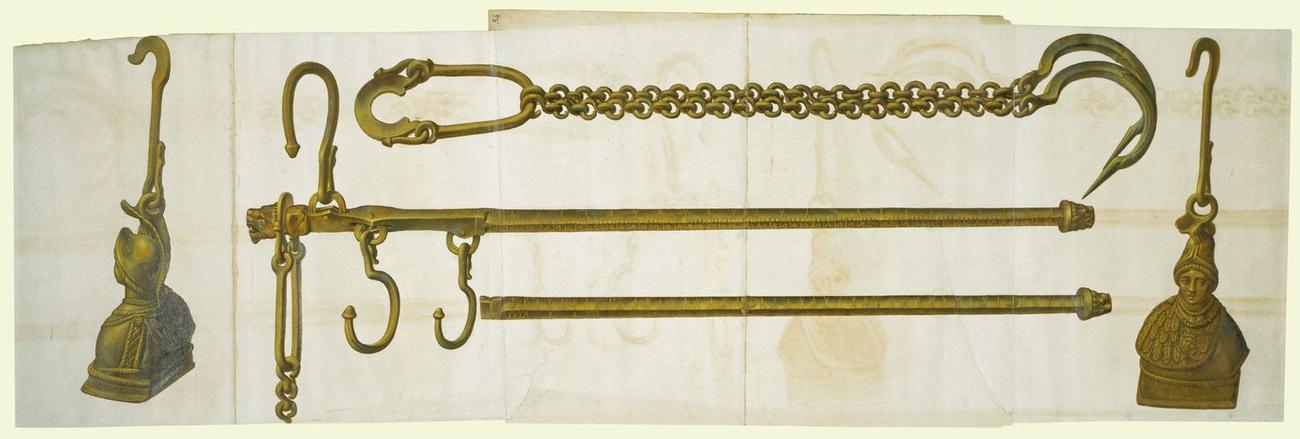
A Roman bronze steelyard balance (statera), Barberini collection c.1645
Watercolour and bodycolour over black chalk and pen and ink. Watermark: crown surmounted by star (Paper Museum Crown 31). | 40.8 x 126 cm (sheet of paper) | RCIN 911186
-
A drawing after the antique from the 'Paper Museum' of Cassiano dal Pozzo (1588–1657). The Roman bronze steelyard balance (statera) depicted here actual size across three sheets has not been traced. The object to be weighed (meat, sacks of produce and so on) was suspended from the hooks shown along the top of the drawing and hung from the left end of the balance. One of the three different suspension points (fulcra) was chosen, depending on the weight of the object; the counterweight was moved down the arm of the steelyard to achieve a balance. The weight of the object was then read off a scale marked on the relevant face of the arm. Because of the different fulcra, this apparatus allowed a wide range of weights to be measured quickly and accurately, and steelyards are still in use across the world.
The two views of the arm at centre and lower centre measure 835 mm and 623 mm long respectively (as drawn), while the counterweight in the shape of a bust of Minerva – also shown in two views, at left and right – measures 360/364 mm high; the chain stretched out across the top of the drawing with its suspension hooks is 790 mm long. The size of this balance is not unheard of among examples known today: one made of iron in the Antiquarium Comunale in Rome measures some 140 cm in length (N. Lazzarini, ‘Le bilance romane del Museo Nazionale e dell’Antiquarium comunale di Roma’, Rendiconti dell’Accademia dei Lincei, ser. 8 (3), 1948, pp. 221–54, at pp. 237, 244).The drawing demonstrates the interest of seventeenth-century antiquarians in Roman daily life, of which ancient systems of weight and measure were a particular fascination (see Vaiani, Rodinò and Whitehouse 2018, p. 198). This particular balance can be identified with one which entered the collection of Cardinal Francesco Barberini – Cassiano’s employer – in February 1645. It is mentioned in the Stracciafoglio di guardaroba in the Barberini archive as having been received from Leonardo Agostini (1593–1676) – antiquary to the Barberini from 1639 – and described as a ‘metal steelyard balance, [for] bearing large weights, [up to] 330 [pounds?]’ (stadera di metallo, tira peso grosso, [libbre?] 330; Biblioteca Apostolica Vaticana, Arch. Barb., Computisteria 154, fol. 28, 25 February 1645). Agostini himself received 25 crowns for the restoration of the balance (ibid., fol. 315v). It may have been found in the horti or gardens of the church of San Bernardo, according to a letter (6 December 1670) from the abbot Ottavio Falconieri (1636–75), adviser to Leopoldo de’ Medici on his purchases of antiquities in Rome, in which he offers to sell the counterweight (romano) of a steelyard balance that he recognised as such, for ‘another like [it] is to be found in the museum of Cardinal Barberino, to be used with a large ancient steelyard that was found some years since in the garden of San Bernardo’ (il trovarsene un altro simile nel museo del Signor Cardinal Barberino, che serve ad una stadera grande antica, che fu trovata alcuni anni sono nell’horto di San Bernardo; Florence, Archivio di Stato, Carteggio d’artisti xi, fol. 293; L. Giovannini, ‘Notizie sulla medaglie della collezione Agostini acquistate dal Cardinale Leopoldo dei Medici’, Rivista Italiana di Numismatica 81, 1979, pp. 155–76, at p. 170).
The Barberini balance is described in another letter (15 April 1645) from the mathematician Michelangelo Ricci (1619–82) to Cassiano, who had evidently instructed him to examine it in order to check how much it could weigh (A. Fabroni (ed.), Lettere inedite di uomini illustri, 2 vols, Florence 1773–5, ii, pp. 54–6, no. 7; with English translation in Vaiani, Rodinò and Whtehouse 2018, pp. 848–50). Ricci writes that the arm of the balance is square in cross-section and graduated on three faces; according to him the measures (not clearly legible on the drawing, except for ‘XXXV’ at the left-hand end), are 1–53 pounds on one face, 35–155 pounds on the next and 105–330 pounds on the third. In order to ascertain the difference in weight between contemporary and ancient pounds, Ricci weighed a seventeenth-century 10-pound marble weight which the balance measured at 10.5 pounds; he loaded the scale with another 30 pounds and the balance read 42.5 (instead of 40.5) pounds. Ricci then tried using the other two graduated faces of the arm, but found far less correspondence between modern and ancient weights; he concluded that the balance was completely unreliable for any measurement.
Given the exceptional nature of the piece, this drawing must have been executed not long after its discovery. A tentative initial attribution to Bernardino Capitelli (1589/90–1640) by Nicholas Turner (The Paper Museum of Cassiano dal Pozzo, exhib. cat., British Museum, London: Milan 1993, p. 87, no. 42) has since been superseded by Martin Clayton’s confident and definitive attribution to Vincenzo Leonardi (1589/90–1646), whose period of activity for the Paper Museum is also compatible with the date proposed for the drawing, around 1645 (Clayton and Whitaker 2007, p. 357). While many of the drawings in the Paper Museum cannot be attributed to individual artists, a large group of elaborate sheets seem to be by Leonardi, who worked for Cassiano from at least 1621 until 1646 (see A. Claridge and E. Dodero, Sarcophagi and Other Reliefs, Part A.III of The Paper Museum of Cassiano dal Pozzo: A Catalogue Raisonné, 4 vols, London 2022, pp. 101–3). Most of these are of natural history subjects and use the sophisticated layering of watercolour and bodycolour that is also in evidence here.
Three sheets joined vertically (left 384 [max.] × 219 mm, trimmed at bottom; middle 408 [max.] × 504 mm; right 404 [max.] × 537 mm). Two central vertical fold lines on middle and right sheets. The drawing was previously mounted sideways in the Nettuno album (see RCIN 970354), fol. 34, and folded at left and right to fit the album; dal Pozzo 'type B' inlay mount; now lifted and framed.
Text adapted from Elena Vaiani, Simonetta Prosperi Valenti Rodinò and Helen Whitehouse, Egyptian and Roman Antiquities and Renaissance Decorative Arts, 2 vols, Part A.VIII of The Paper Museum of Cassiano dal Pozzo: A Catalogue Raisonné, London 2018, cat. 72 [E. Vaiani]; and from Martin Clayton and Lucy Whitaker, The Art of Italy in the Royal Collection, exhib. cat., Queen’s Gallery, Buckingham Palace, London 2007, pp. 356–7.
Provenance
From the ‘Paper Museum’ of Cassiano dal Pozzo (1588–1657) and his brother Carlo Antonio dal Pozzo (1606–89). Sold by Carlo Antonio's grandson to Clement XI Albani, 1703; acquired by Cardinal Alessandro Albani in 1714, from whom purchased by George III in 1762.
-
Creator(s)
(collector)Acquirer(s)
-
Medium and techniques
Watercolour and bodycolour over black chalk and pen and ink. Watermark: crown surmounted by star (Paper Museum Crown 31).
Measurements
40.8 x 126 cm (sheet of paper)
Category
Object type(s)
Subject(s)
Other number(s)
RL 11186


