


-
1 of 253523 objects
A design for a wall tomb c.1540
Pen and ink with wash over black chalk. Watermark of crossed arrows with six-pointed star | 23.5 x 32.7 cm (sheet of paper) | RCIN 910895
-
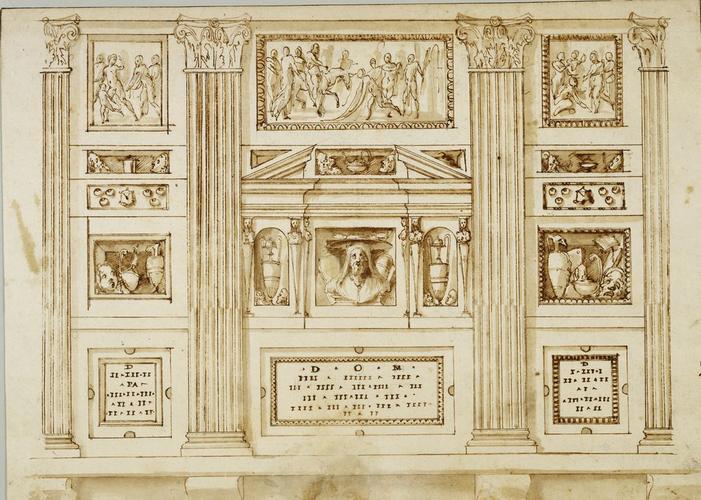
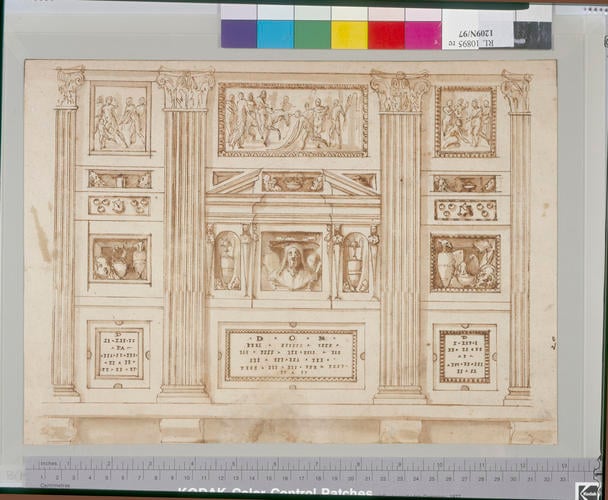
This design is for a wall tomb for a cardinal, and bears the devices of the Giacobacci coat of arms (per pale, a wallet and six crescents) on the central panels of the two flanking fields. Two members of the Giacobacci family attained the status of Cardinal in the first half of the sixteenth century, Domenico (d.1527) and Cristoforo (d.1540). This is more likely to be the design for Cristoforo's tomb, given the style of the decoration, in “the antiquarian 'Pirro Ligorian' taste... with its mélange of classical bric-à-brac" (P. Pouncey and G. Gere, Italian Drawings … in the British Museum: Raphael and his Circle, 1962, p. 95). The bust of the cardinal is bearded, a penitential fashion among ecclesiastics in the years after the Sack of Rome in 1527. No such tomb survives. Funerary monuments could be ordered during a client's lifetime or years later by his heirs, and while a date for the design around the death of Cristoforo Giacobacci would be reasonable, this is by no means certain.
The principal storiated field of the tomb represents Christ's entry into Jerusalem, and the panel to the right probably Christ and the Adulterous woman; that to the left is unclear. With no reference to salvation or resurrection, or any biographical connotation, these are unusual scenes for a tomb and would seem appropriate only as part of a more extensive programme of scenes from the Passion.
The drawing style, with its formulaic abbreviations and elongated figures, is that of the stucco-worker and painter of grotesques Luzio Romano (or Luzio Luzzi), Perino del Vaga's collaborator on much of his decorative work from his early Genoese period onwards. Luzio soon fell into a slick and no doubt popular decorative mode, and carried on working in the same vein long after Perino's death, executing countless schemes in Roman palaces. Many designs for ceiling and wall decorations and metalwork in a Perinesque style survive, most numerously at Windsor. Some of these can be firmly attributed to Luzio, but his style approached Perino's very closely at times and can be hard to distinguish from Perino's most mechanical decorative sheets. Luzio's role in this drawing was presumably that of secretary, providing a tidy version of the design on the basis of sketches made by Perino.
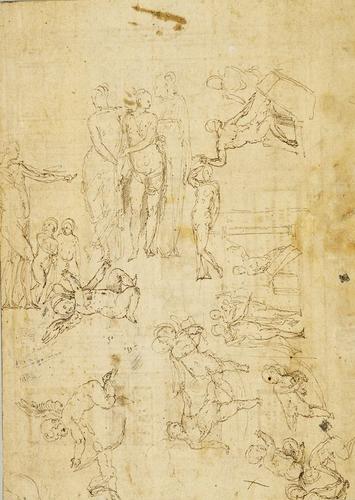
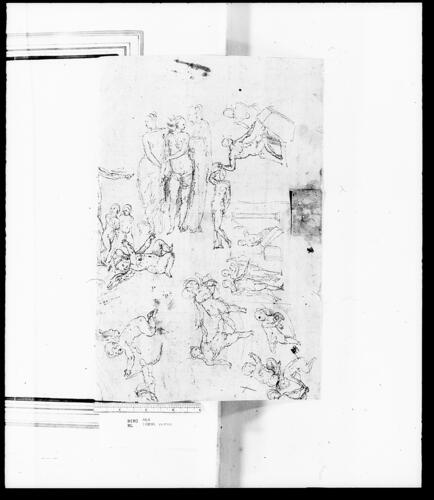
The sketches on the verso of the sheet are similarly Perinesque but too clumsy to be by the master, and it is reasonable to attribute these too to Luzio, who is hardly known outside the context of formal decorative designs. The three studies of a Christ Child with the infant Baptist are indebted to Michelangelo's Taddei Tondo (Royal Academy, London). At lower centre are two compositions apparently featuring a stonemason, with one of the figures studied again at upper centre, the other way of paper. The group of standing figures may be spectators in a companion scene. None of these studies can be associated with any project.
Recto, inscribed at lower right in pen and ink: 20; verso, inscribed by the artist towards the centre in pen and ink: 30, 33 1/1.Provenance
From an album in George III's library: volume A18, Architectural Ornaments, f. 49
-
Creator(s)
-
Medium and techniques
Pen and ink with wash over black chalk. Watermark of crossed arrows with six-pointed star
Measurements
23.5 x 32.7 cm (sheet of paper)
Markings
watermark: crossed arrows with six-pointed star
Other number(s)


