


-
1 of 253523 objects
Sangallo copyist (active 1625-35)
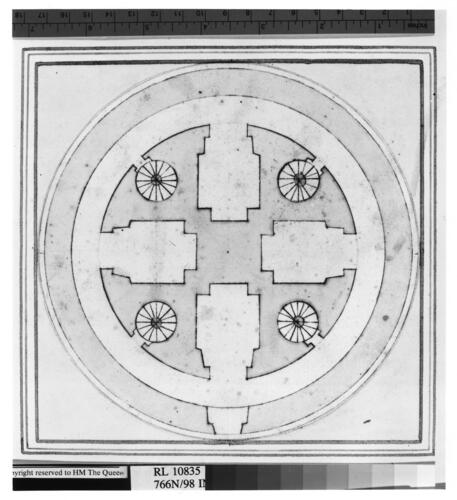
Tomb of L. Munatius Plancus, Gaeta: plan c.1629
Pen and dark brown ink and grey-brown wash over graphite and stylus and compass lines; silhouetted | 16.8 x 16.9 cm (sheet of paper) | RCIN 910835
-
Ground plan of the Tomb of Munatius Plancus, Gaeta. Mounted with RCIN 910834.
The drawing is a copy of the Sangallo original in the Barberini Codex (Rome, Vatican, Biblioteca Apostolica Vaticana, Barb. lat. 4424, fol.2), and is one of 54 copies of architectural drawings from the Barberini Codex extant in the Paper Museum (see dal Pozzo A.IX, pp. 479-482). The copies were produced by two draughtsmen, identified in dal Pozzo A.IX as the Codex Ursinianus Copyist and the Sangallo Copyist 2. Virtually all the copies are mechanical 1:1 replicas, probably traced. Annotations and measurements are usually omitted. For further, see A.IX, pp. 479-482.
The copy reproduces exactly the original, which is broadly accurate apart from the addition of the four spiral stairs. The presence of the stairs in P.S. Bartoli’s engraved plan suggests he copied either this drawing or the Sangallo original (Bartoli, Sepolcri, pl. LXXXVII)
The circular tumulus tomb is still a prominent landmark on the coast between Rome and Naples. Faced in travertine, it was clearly modelled on that of Augustus in Rome. Plancus was consul in 42 BC and censor in 22 BC. The date of his death is not known but is likely to have been in the last two decades BC, to which the tomb may also be dated (see G. Jacopi, L. Munazio Planco e il suo mausoleo a Gaeta, n.d..; R. Fellmann, Das Grab des Lucius Munacius Plancus bei Gaeta,1957; F. Coarelli, Lazio,1982, pp. 357–9; M. Wilson Jones, ‘Principles of design in Roman architecture: the setting out of centralised buildings’, Papers of the British School at Rome, XLIV, 1989, p. 140).
Text adapted from Ian Campbell, The Paper Museum of Cassiano dal Pozzo: A Catalogue Raisonné. A.IX: Ancient Roman Topography, London 2004, cat. 172.
Provenance
From the ‘Paper Museum’ of Cassiano dal Pozzo (1588-1657) and his brother Carlo Antonio dal Pozzo (1606-1689); dal Pozzo ‘type D’ mount. Sold by Carlo Antonio's grandson to Clement XI Albani, 1703; acquired by Cardinal Alessandro Albani in 1714, from whom purchased by George III in 1762. Mounted in the album Ancient Roman Architecture, fol. 42(ii).
-
Creator(s)
(collector) -
Medium and techniques
Pen and dark brown ink and grey-brown wash over graphite and stylus and compass lines; silhouetted
Measurements
16.8 x 16.9 cm (sheet of paper)
Other number(s)
RL 10835


