


-
1 of 253523 objects
Codex Ursinianus Copyist (active c. 1625)
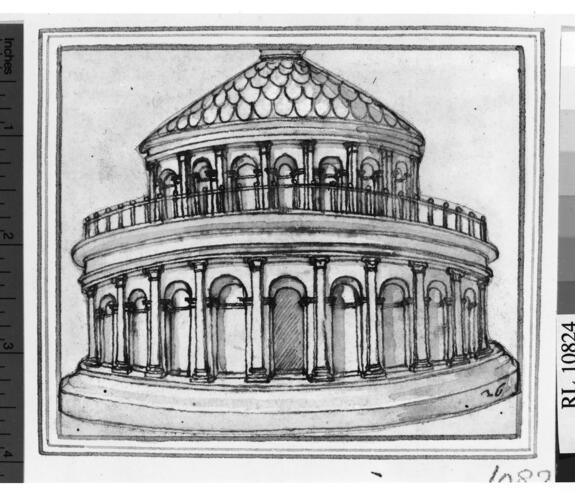
Carceri vecchie, Santa Maria Capua Vetere: elevation c.1625-35
Pen and brown ink and brown wash over black chalk; silhouetted | 9.1 x 10.9 cm (sheet of paper) | RCIN 910824
Codex Ursinianus Copyist (active c. 1625)
Carceri vecchie, Santa Maria Capua Vetere: elevation c.1625-35
-
A reconstruction of the largest Roman tomb in Campania called 'Carceri vecchie' at Santa Maria Capua Vetere, after Sangallo's drawing in the Barberini Codex (Rome, Vatican, Biblioteca Apostolica Vaticana, Barb. lat. 4424, fol. 8; for more on copies from the Barberini Codex in the Paper Museum see dal Pozzo A.IX, pp. 479-482). Mounted with RCIN 910825 and 910823. The extant Paper Museum contains a total of 54 copies of architectural drawings from the Barberini Codex. The copies were produced by two draughtsmen, identified in dal Pozzo A.IX as the Codex Ursinianus Copyist and the Sangallo Copyist 2. Virtually all the copies are mechanical 1:1 replicas, probably traced. Annotations and measurements are usually omitted. For further, see A.IX, pp. 479-482.
The drawing is faithful in every respect to Sangallo’s original, which is a reconstruction of the largest extant Roman tomb in Campania (the name Carceri vecchie derives from the old belief that it was a barracks (carceres) for enslaved gladiators, for which Capua was famed in antiquity). He shows fairly correctly the front side of the building, the lower stage with arched niches, alternately semicircular and rectangular in plan, with a continuous impost moulding and framed by engaged half-columns. Only the addition of the balustrade and the Corinthian capitals depart from reality (they should be Tuscan). He reconstructs the narrower upper drum in the same manner except that all the niches are rectangular in plan.
Opinions differ as to whether this is a reasonable conjecture or not. S. De Caro and A. Greco believe it is (Campania (Guide archeologiche Laterza 10), 2nd edn, 1993, p. 212); others interpret the surviving evidence more cautiously, giving the upper stage niches that are rectangular in elevation, separated by squat piers, and point to Ligorio’s reconstruction in the Naples codices (Naples, Biblioteca Nazionale, MS XIII.B.10, fol. 95) – which correctly shows Tuscan columns – and to the circular church in the famous painting in Urbino by Lucio Laurana (c. 1420–79) of the ideal city, which may be modelled on the tomb (A. de Franciscis and R. Pane, Mausolei romani in Campania, 1957, p. 98; C. Hülsen, Il libro di Giuliano da Sangallo..., 1910, I, p. 16, fig. 17). Sangallo’s low conical roof is not unlike one Pompeian tomb, but Ligorio’s Pantheon-like dome is probably more likely (De Franciscis/Pane, p. 98). Sangallo’s central oculus is fantasy, since four narrow circular light wells survive, penetrating the centre of the cruciform chamber (De Franciscis/Pane, figs 80, 82). Cassiano would have known the copy of Ligorio’s drawing in the Codex Ursinianus (I. Herklotz, Cassiano dal Pozzo und die Archäologie des 17. Jahrhunderts, 1999, p. 406).
For the tomb, see RCIN 910838.
Numbering: 26
Text adapted from Ian Campbell, The Paper Museum of Cassiano dal Pozzo: A Catalogue Raisonné. A.IX: Ancient Roman Topography, London 2004, cat. 176.Provenance
From the ‘Paper Museum’ of Cassiano dal Pozzo (1588-1657) and his brother Carlo Antonio dal Pozzo (1606-1689); dal Pozzo ‘type D’ mount. Sold by Carlo Antonio's grandson to Clement XI Albani, 1703; acquired by Cardinal Alessandro Albani in 1714, from whom purchased by George III in 1762. Mounted in the album Ancient Roman Architecture, fol. 36(ii).
-
Creator(s)
(collector) -
Medium and techniques
Pen and brown ink and brown wash over black chalk; silhouetted
Measurements
9.1 x 10.9 cm (sheet of paper)
Other number(s)
RL 10824


