


-
1 of 253523 objects
Giovanni Antonio Dosio (1533-after 1609)
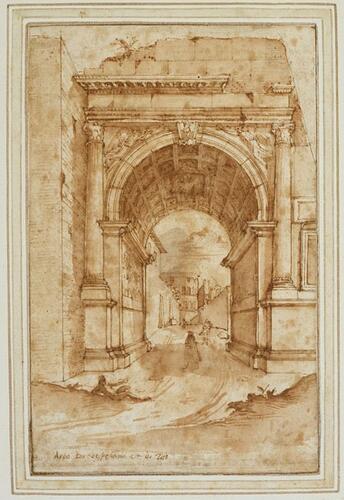
Arch of Titus, Rome 1550 - 1609
Pen and brown ink and brown wash over black chalk | 20.1 x 12.9 cm (sheet of paper) | RCIN 910785
-
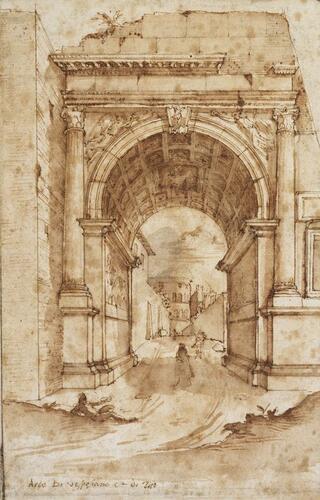
The Arch of Titus, still immured in the Palatine defences erected by the Frangipane family in the twelfth century, is viewed from the west (Roman Forum) side, with the Colosseum visible in the distance. One of twenty-eight sheets attributed to Giovanni Antonio Dosio in the Paper Museum (for further see RCIN 910780; dal Pozzo A.IX, pp. 236-7), this drawing, like most of those in this series, was apparently executed after a sketch done in front of the object and records faithfully the facade of the arch, with the aid of ruler and compasses. It is complemented by a further sheet by Dosio in the Uffizi, Florence (3995A; A. Bartoli, I Monumenti antichi di Roma nei disegni degli Uffizi di Firenze, 1914–22, V, fig. 777; VI, p. 133; C. Acidini, ‘Roma antica’, in Roma Antica e i disegni di architettura agli Uffizi di Giovanni Antonio Dosio, 1976, p. 52, no. 27), which shows the arch viewed from the other side, with the three columns of the Temple of Castor and Pollux in the Roman Forum in the background. The two drawings provide an excellent record of the Arch of Titus in Dosio’s time, illustrating the damage on both sides.
Uffizi 3995A was obviously the model for the engraving in De Cavalieri’s Urbis, pl. XXVII. It cannot, however, have served (as proposed by Bartoli, VI, p. 133) as a model for Gamucci’s woodcut in Antichità (fol.40v), for that shows the western facade and so must be executed after the drawing in Windsor.
The Arch of Titus was erected where the Sacra via met the road leading up from the Colosseum, and was dedicated shortly after Titus’ death in AD 81, since its inscription refers to him as divus (‘deified’). It is a single arch, 14.04m wide, 6.2m deep and 14.44m high, excluding the completely restored upper cornice of the attic. The concrete core is clad in Pentelic marble (apart from the travertine plinth) up to the composite column capitals, where the marble becomes Italian. The four columns on each side (the outer ones were invisible in Dosio’s day) frame blind aedicules between them. Inside the arch two relief panels, 3.9m long by 2m high, show scenes of the triumph celebrated by Titus after the Jewish War. The original inscription survives on the east front. After its use as a fortress in the Middle Ages, the arch was left in a very fragmentary state until liberated and restored by Stern and Valadier between 1817 and 1824.
The Paper Museum had a detail of the entablature in Architectura Civile (910418), and drawings of the keystone of the passageway vault and the two panel reliefs (908181 and 908184), as well as a reconstruction and details in Serlio’s Architettura, fols 99–100 (Serlio, V. Hart and P. Hicks, Sebastiano Serlio on Architecture, I. Books I–V of ‘Tutte l’opere d’architettura et prospettiva’, 1996–2001, I, pp. 195–7).. An elevation of the arch and details in the 'Codex Coner' (T. Ashby, ‘Sixteenth-century drawings of Roman buildings attributed to Andreas Coner’, Papers of the British School at Rome II, 1904, p. 36, no. 56; p. 49, no. 97; p. 66, no. 134c; p. 68, no. 137f., and possibly p. 70, no. 144c; p. 71, no. 147b).
Annotations: [bottom left] Arco Di Vespasiano et di Tito (‘Arch of Vespasian and Titus’).
Text adapted from Johannes Röll and Ian Campbell, The Paper Museum of Cassiano dal Pozzo: A Catalogue Raisonné. A.IX: Ancient Roman Topography, London 2004, cat.78.Provenance
From the ‘Paper Museum’ of Cassiano dal Pozzo (1588-1657) and his brother Carlo Antonio dal Pozzo (1606-1689); dal Pozzo ‘type D’ mount. Sold by Carlo Antonio's grandson to Clement XI Albani, 1703; acquired by Cardinal Alessandro Albani in 1714, from whom purchased by George III in 1762. Mounted in the album Ancient Roman Architecture, fol. 3 (ii)
-
Creator(s)
(collector) -
Medium and techniques
Pen and brown ink and brown wash over black chalk
Measurements
20.1 x 12.9 cm (sheet of paper)
Category
Object type(s)
Other number(s)
RL 10785


