


-
1 of 253523 objects
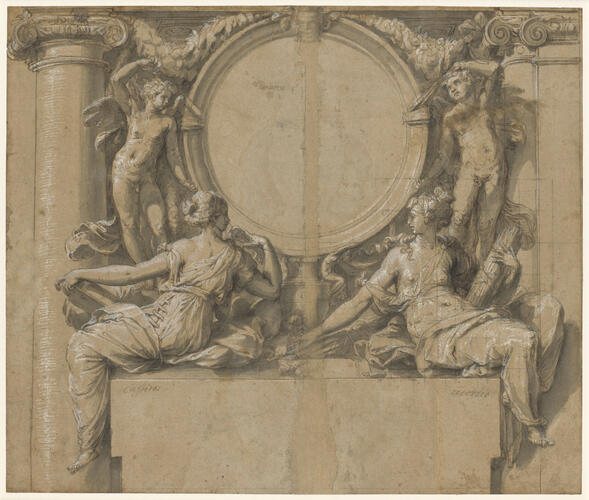
A design for an overdoor c.1546-47
Pen and ink, grey wash, white heightening, on paper washed buff; the right figure squared twice in black chalk | 30.7 x 36.2 cm (sheet of paper) | RCIN 910761
-
This is a study for a fresco in the Sala Paolina, the principal room of the Castel Sant'Angelo decorated by Perino del Vaga and his workshop for Pope Paul III (Alessandro Farnese, r.1534-49). The vault of the room incorporates six small scenes from the life of Farnese's namesake, Alexander the Great. Around the walls are densely figurated frescoes in imitation of bronze relief continuing the Alexandrine theme, interspersed with the Temporal Virtues and figures of the Emperor Hadrian (whose mausoleum is the Castel Sant'Angelo) and of St Michael (after whom it is now named). Over the doors are Muses and Virtues with roundels containing scenes from the life of St Paul, also in bronze monochrome.
Payments for the Sala Paolina are recorded from 14 June 1545, and by September of the following year the beautifully stuccoed and gilded vault was probably complete. It is likely that work on the walls began in late 1546, and on 31 July 1547 a payment was made to dismantle the scaffolding , probably signifying the completion of the upper parts of the walls. The room had not been finished by Perino's death on 20 October 1547, and though the lower zone was probably continued largely to his designs, a study by Pellegrino Tibaldi, one of Perino's assistants, for an illusionistic door in the room (RCIN 905488) perhaps indicates that Perino's intentions were modified. (For the documents see E. Gaudioso, ‘I lavori farnesiani a Castel Sant’Angelo’, Bollettino d’Arte, 1976, pp. 7-127.)
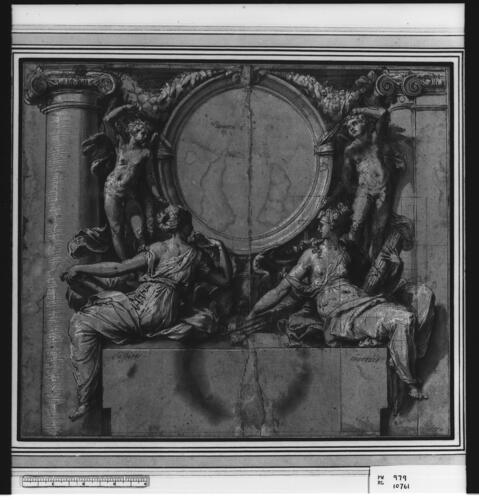
This study corresponds with the upper right portion of the north wall. It had been folded, stained and damaged along the fold at an early stage, with the loss of a strip down the centre of the drawing (now restored). Inscriptions on the drawing, not in Perino's hand, name the Virtues as, on the right, Concord, bearing the fasces (bundle of rods or arrows) that signify strength through unity; and, mistakenly, as Chastity. The figure on the left holds a bible and a papal key and rests her right arm on a papal tiara – she is in fact Ecclesia, the personification of the Church. An inscription in the blank tondo, conuersi s, may identify the intended scene as the Conversion of St Paul, whereas it was his preaching that was painted in the fresco.
Despite the carefully finished nature of the drawing, it is not the final design. In the fresco the poses of the putti were adjusted, the relative size of the Virtues was increased, and the proportions of Concord were elongated horizontally; she is the only part of the drawing to be squared, and this elongation might have been effected by transferring the squared design to a oblong grid. By contrast a drawing on the same scale and in the same media in the Uffizi (inv. 66-O), for the overdoor with the Muses Calliope and Euterpe, is fully squared and agrees perfectly in proportion with the fresco. These two attractively finished drawings may have been executed specifically for the approval of the patron, for the combination of wash and heightening captures something of the pictorial richness of the frescoes. A second sheet in the Uffizi (inv. 95310-F) for another of the overdoors corresponds just as closely to its fresco, but is drawn in the much less time-consuming technique of black chalk alone, squared in red chalk.
A drawing by Tibaldi at Chatsworth (Jaffé 354), corresponding with yet another of the overdoors, combines exactitude in the proportions with looseness in the details and is probably a copy after a drawing by Perino. A variant on these designs at Christ Church (Byam Shaw 880, as ‘Niccoló dell’Abate?’) arranges the motifs in a way that could not possibly fit into the Sala and must presumably be a later derivation.Provenance
From an album in George III's library, volume A.16, Buildings and Architectural Ornaments, f. 22
-
Creator(s)
-
Medium and techniques
Pen and ink, grey wash, white heightening, on paper washed buff; the right figure squared twice in black chalk
Measurements
30.7 x 36.2 cm (sheet of paper)
Markings
watermark: crossed arrows with six-pointed star
Category
Object type(s)
Other number(s)
Alternative title(s)
A design for an overdoor with figures of Ecclesia and Concordia


