


-
1 of 253523 objects
Anonymous Portuguese (active 1568–70)
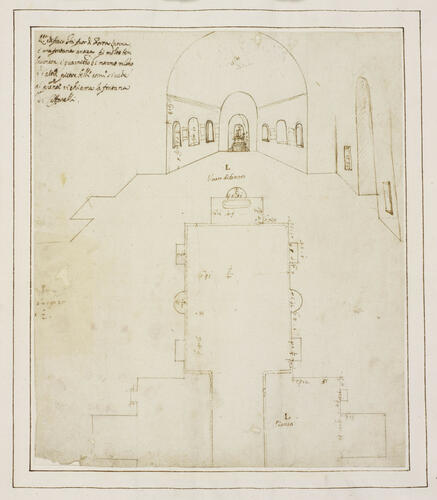
Fountain of Egeria, Valle della Caffarella: interior view and plan c.1568-70
Pen and brown ink over traces of black chalk | 24.4 x 21.2 cm (sheet of paper) | RCIN 910373
-
Nymphaeum, elevation and ground plan with measurements and annotations. Refers to the so-called Fountain of Egeria in the Valle della Caffarella. The drawing sheet was cut out of its original inlay in the mid twentieth century and backed on to modern laid paper before being reinlaid into the album folio sheet.
Twenty-five folios by an unidentified Portuguese hand are found in the first part of the album Architectura Civile (RCIN 910354-60, 910364-76, 910378-80, 910427, 910440). Three groups of drawings are keyed to form series: the first, in which this sheet falls, distinguishes monuments by a single letter, running discontinuously from A to S (RCIN 910354, 910357, 910360, 910364, 910367-70, 910372-3). For further discussion of the series and the wider group of twenty-five folios, see dal Pozzo A.IX, pp. 312-317.
The sheet is much smaller than typical amongst the group of twenty-five drawings, and has been cut down on the left, apparently losing a drawing keyed P. The Doric nymphaeum near Castelgandolfo is keyed both 3.C and P on RCIN 910359 and 910374, suggesting a possible link between the single-letter and the series keyed with letter-and-number, also by the unidentified Portuguese hand (see dal Pozzo A.IX, p. 313).
As T. Ashby pointed out, the legend at the top left is in a different, later hand, with noticeably more correct Italian (unpublished notes, British School at Rome, POZ-405). It was possibly copied from an original legend when the sheet was cut down. The trimming probably also accounted for the missing top part of the circle of the vault. The perspectival view and plan both refer to the nymphaeum or so-called Fountain of Egeria in the Valle della Caffarella, which lies between the Via Appia Pignatelli and the Via Appia Nuova, a mile outside the Porta Latina. The nymphaeum was built in opus mixtum in the mid second century AD, making use of a natural spring. The outer parts have collapsed but the inner chamber is still extant. As the annotation says, it was originally clad in marbles and also stucco, virtually all trace of which has now gone.
Both drawings include measurements and are very accurate records, showing the basically T-shaped nymphaeum, the outer part forming the cross bar. The barrel-vaulted inner chamber has three niches on each side, the outer pairs rectangular in plan and the middle one semicircular, all round-headed.
At the end opens a wide rectangular alcove with a smaller semicircular one at its back, both again round-headed. The identity of the missing drawing P is unknown but obvious candidates would be the tomb converted into the church of S. Urbano alla Caffarella or the Tempio di Dio Ridicolo (now thought to be the tomb of Annia Regilla), both of which lie in the close vicinity (see 919248).
Key Lettering: [on elevation and plan] L; [left margin] P
Annotations: measurements all over in palmi; [top left corner, possibly seventeenth-century hand, dark brown ink] Q(ues)to edificio sta fuor di Porta Latina; / e una fontana antica fu molto ben/ lavorata e guarnita de marmo mistio/ e d’altre pietre belli come si vede/ al pre(se)nte si chiama la fontana/ de Caffarelli (‘This building stands outside the Porta Latina; it is an ancient fountain, was very well wrought and decorated with varied marble and other fine stones as can be seen. Nowadays it is called the Fountain of the Caffarelli’); [on elevation] l’vato di dentro (interior elevation’); [on plan] Pianta (‘Plan’); [left margin] .P. a largeza/ 1½ (‘width of P 1½’)
Text adapted from Ian Campbell, The Paper Museum of Cassiano dal Pozzo: A Catalogue Raisonné. A.IX: Ancient Roman Topography, London 2004, cat.112.Provenance
From the ‘Paper Museum’ of Cassiano dal Pozzo (1588-1657) and his brother Carlo Antonio dal Pozzo (1606-1689), mounted in the album Architectura Civile, fol. 20; dal Pozzo ‘type A’ mount. Sold by Carlo Antonio's grandson to Clement XI Albani, 1703; acquired by Cardinal Alessandro Albani in 1714, from whom purchased by George III in 1762.
-
Creator(s)
(collector) -
Medium and techniques
Pen and brown ink over traces of black chalk
Measurements
24.4 x 21.2 cm (sheet of paper)
Other number(s)
RL 10373


