

-
1 of 253523 objects
Pier Francesco Mola (1612-66)
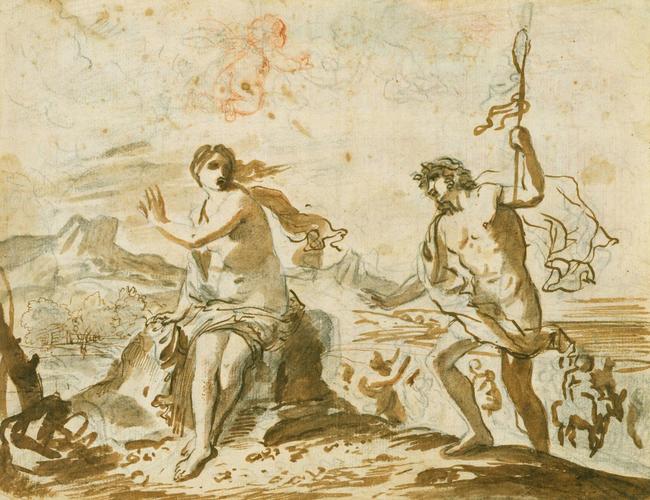
Bacchus and Ariadne c.1647-8
Pen and ink, brush and ink, brown wash, over red and black chalk | 20.0 x 26.1 cm (sheet of paper) | RCIN 906799
-
A drawing of Bacchus finding Ariadne on the island of Naxos; the retinue following in the background.
After training in Rome, Mola spent much of his early career in Venice and then Bologna. This is a study for one of the first paintings that Mola executed on his return to Rome in 1647, a fresco in Palazzo Costaguti, depicting the god Bacchus greeting Ariadne on the island of Naxos after she had been abandoned by Theseus.
This drawing is a study for one of the first paintings that Mola executed on his return to Rome in 1647, a fresco of Bacchus and Ariadne in the Palazzo Costaguti, depicting the god greeting Ariadne on the island of Naxos after she had been abandoned by Theseus. The echoes of Bolognese classicism to which Mola was exposed during his spell with Albani are still strong, with the protagonists arranged in a frontal plane and the landscape as a backdrop, like Ludovico Carracci’s St Ursula.
The commission is not documented, but the biographer Giovanni Battista Passeri, who knew Mola, stated that he painted the fresco for Giovanni Battista Costaguti. Sutherland Harris pointed out that Giovanni Battista Costaguti (1636-1704) was too young to be commissioning such decorations in his family palace in the late 1640s, and proposed, probably correctly, that the paintings in the palazzo were commissioned instead by Giovanni Battista’s elder brother, Vincenzo (1611-60), who was created a cardinal in 1643 and who left Rome as the papal legate to Urbino in 1649.
The study corresponds with the fresco in the principal figures, but lacks the airborne putti and differs in the background, where Silenus on his ass, for instance, is on the right of the drawing and on the left of the painting. The drawing is executed in a technique typical of Mola, a substantial underdrawing of both red and black chalks and only a few strokes of the pen, with much more extensive drawing and shading with the brush. Two further drawings for the composition are known, a rapid pen sketch in the Louvre, and a squared final study in red chalk in the Teyler Museum, Haarlem.
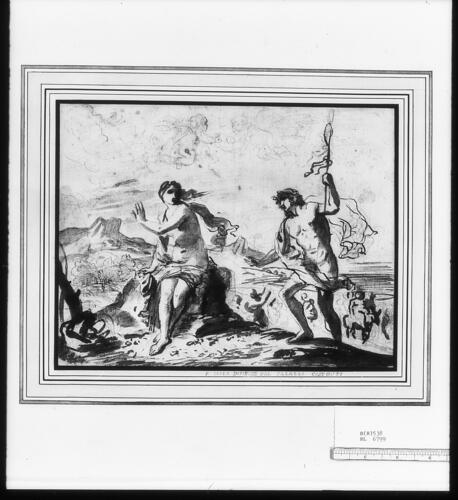
Inscribed on the old mount, pencil: F. MOLA DIPINSE DEL PALAZZO COSTGUTI
Catalogue entry adapted from The Art of Italy in the Royal Collection: Renaissance and Baroque, London, 2007Provenance
Probably acquired by George III in 1762 as part of the collection of Cardinal Alessandro Albani; first recorded in a Royal Collection inventory of c. 1800-1820 (Inv. A, p. 128: amongst twenty six drawings of which 'The last Drawing but one is of Mola.')
-
Creator(s)
Acquirer(s)
-
Medium and techniques
Pen and ink, brush and ink, brown wash, over red and black chalk
Measurements
20.0 x 26.1 cm (sheet of paper)
Category
Object type(s)


