


-
1 of 253523 objects
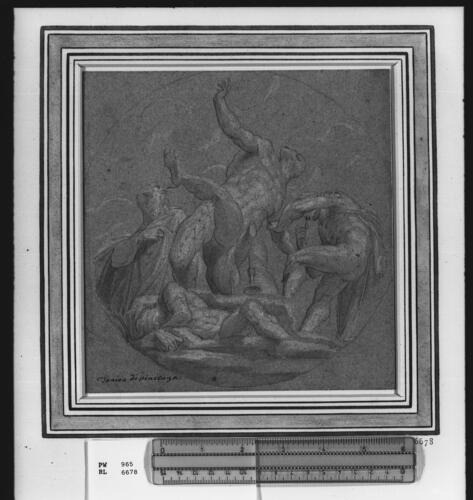
Apollo flaying Marsyas c. 1560-75
Pen and ink, brown wash and white heightening on blue paper | 20.0 x 19.4 cm (sheet of paper) | RCIN 906678
-
A design for a tondo, possibly of Apollo flaying Marsyas, executed in pen, ink and wash with discoloured white heightening on blue paper. The drawing is stamped at lower centre with the five-point star mark associated with Nicholas Lanier (Lugt 2886) and the stamp of George V. Inscribed in a mid-eighteenth-century hand at lower left: ‘Tonion di Vincenza’.
The figures are seen from below, steeply foreshortened, suggesting that the drawing could relate to a scheme to decorate a ceiling. A similar drawing by Antonio Vicentino, depicting the Judgement of Midas, can be found in the National Galleries of Scotland (RSA 156). Keith Andrews suggests that the two drawing were made in connection with the same project (Italian Drawings in Scotland, v.1, 1968, p.128.)In Italian drawings of the XV and XVI centuries at Windsor Castle (1949), Popham and Wilde identify the subject as Apollo Flaying Marsyas. However, there are none of the clear distinguishing features that are traditionally associated with this subject, such as Apollo’s lyre or Marsyas’ pipe. There is also a lack of physical features that would clearly distinguish Marsyas as a satyr, such as small horns. Given these omissions, this identification is uncertain.
The artist Antonio Vicentino was active in the Veneto region of Italy. He had a short artistic career, lasting from roughly 1560–75, which he abandoned to become a soldier. A pupil of Battista Zelotti (1526–78), Vicentino seems to have specialised in mural and ceiling designs, although none have survived. Zelotti’s influence can be seen in this design, which is comparable both in terms of composition and style to Zelotti’s roundels for the ceiling of the Biblioteca Marciana in Venice.
The presence of Nicholas Lanier’s star indicates that the sheet was in England in the seventeenth century and possibly entered the Royal Collection during the reign of Charles II.
Provenance
Nicholas Lanier (his five-pointed star, Lugt 2886); probably acquired by Charles II, listed in George III's 'Inventory A,' c.1800-20, p.59: ‘Antonio di Vicenza.’
-
Medium and techniques
Pen and ink, brown wash and white heightening on blue paper
Measurements
20.0 x 19.4 cm (sheet of paper)


