


-
1 of 253523 objects
The Descent of the Holy Spirit on the Virgin & the Apostles c. 1586
Pen and ink and wash, heightened with white, over black chalk or charcoal on blue paper | 35.5 x 26.0 cm (sheet of paper) | RCIN 906015
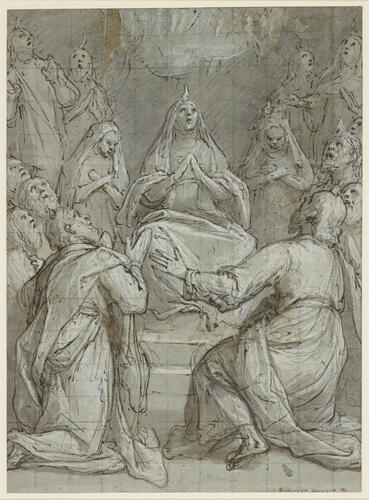
Federico Zuccaro (c. 1542-1609)
The Descent of the Holy Spirit on the Virgin & the Apostles c. 1586
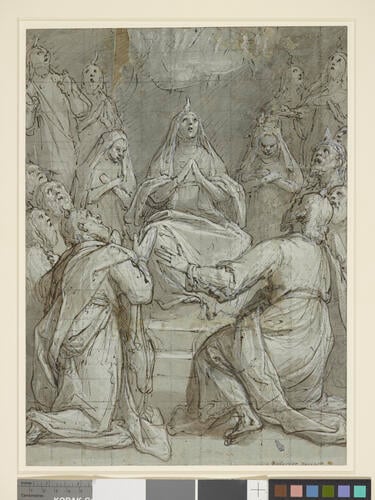
Federico Zuccaro (c. 1542-1609)
The Descent of the Holy Spirit on the Virgin & the Apostles c. 1586
-
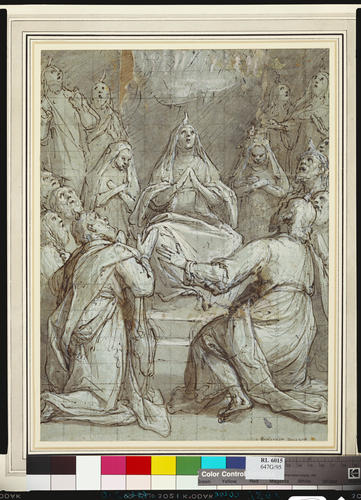
A pen and ink drawing, squared, for the painting of the Descent of the Holy Spirit in the Basilica of San Lorenzo de El Escorial, Madrid. Inscribed in pen and ink at lower right: ‘Federigo Zuccaro’.
This drawing is a preparatory study by Federico Zuccaro for one of the eight paintings of the high altarpiece known as Retablo Major, commissioned by the King of Spain Philip II.
Federico Zuccaro was one of the most distinguished of the Italian painters who carried out work on the ambitious decorations for San Lorenzo. The King had already commissioned a Martyrdom of St Lawrence firstly from Titian and later Tintoretto and Veronese, but not fully satisfied with their works, in 1583 he invited the Genoese painter Luca Cambiaso (1527-85) to his court. Cambiaso produced two frescoes on the vault above the mail altars, the Coronation and the Adoration of the Trinity, later completed by Romolo Cincinnato.
Federico arrived at the Escorial in December 1585, accompanied by five assistants, with a considerable reputation and with the recommendation of several important patrons. During the three years he spent in Spain, from 1585 to 1588, Federico painted the eight panels for the Retablo Major, two reliquary altars on either side of it and frescoes in the great cloister. By 1586, Federico had executed the modelli (presentation drawings) for all the eight paintings in the Retablo Major and proudly showed them to the King, as described in a letter to Giulio Veterani: ‘disi a S.M.tà l’altro giorno nel mostrarli i disegni di dette instorie che qui uo prochurar uincer me stesso, in tuto quello ch’e necessario al servitio e honor di dio prima e honore e Gloria di S.M.tà e mia, e poi non potendo far cosa magiore pore i me penelli da parte. Rise di questo S.M.tà e mostrò piacerli la mia deliberatione [...]’.
This letter testifies that Federico intended the works in the Escorial as the highpoint of his career. The present drawing was likely among the eight modelli presented to King and displays the artist’s ideas for the painting at the top right of the altarpiece featuring the Descent of the Holy Spirit or Pentecost.
The miraculous episode is taken from the Acts of the Apostles (2: 1-4). Forty days after Easter, the Apostles were all together in one room when ‘suddenly a sound like the blowing of a violent wind came from heaven and filled the whole house where they were sitting. They saw what seemed to be tongues of fire that separated and came to rest on each of them. All of them were filled with the Holy Spirit and began to speak in other tongues as the Spirit enabled them’. The event commemorates the birth of early Church and the beginning of their preaching across the world. The Virgin, at the centre of the composition, accompanied by two women, personifies the Church itself. She occupies a sacred space as she is on a higher level than the twelve apostles. In the painting, Federico altered the staircase on which the Virgin is seated, placing her on a higher pedestal, and inserted wooden stools before the two apostles in the foreground, perhaps to reflect the story as it is recounted in the Scriptures. The prodigious light irradiated by the Holy Spirit appears to be overwhelming, if not oppressing, in the painting. The figure of the Virgin is now different from how Federico intended it and as it is documented in a print by Pierre Perret (published in Juan de Herrera 1589, no. 8).
Shortly after the departure of Federico from Spain, Juan Gomez repainted some of the paintings made by Federico, which did not fully reflect the austerity of the decorative scheme conceived by Philip II. Gomez painted over the face of the Virgin with her gaze looking down, in a more devotional pose. The present drawing testifies the initial idea, with the Virgin looking up towards the miraculous light happening before her. The same correction appears in the internal panel painting of the Assumption at the centre in the Retablo Major and Annunciation in the Reliquary altar. A study for the figure of the Virgin in the Assumption in the Ashmolean Museum, Oxford (755 B) shows the Virgin gazing towards the heavens with her arms opened, while in the painting, altered by Gomez, she looks downward. In the preparatory drawing for the Annunciation, now in the Louvre (Inv. 11237), Federico portrays the Virgin in an attitude of surprise, with her head turned towards the angel, whereas in the painting she timidly retreats from the appearance of the divine messenger. Federico’s original version with the Virgin’s arms wide open survives in a later painting for the Church of Santo Spirito in Urbino, dated 1603-7.
Federico was highly compensated for his services, being given 2,000 ducats, a noble title, a medal and a gold chain. However, a few months after his departure, three of the paintings in in the Retablo Major were substituted with works by Pellegrino Tibaldi, including the Martyrdom of Saint Lawrence, which finally satisfied the requests of the king. The present drawing is therefore an important records of Federico Zuccaro’s design for the original composition.
Provenance
Probably acquired by George III
-
Creator(s)
-
Medium and techniques
Pen and ink and wash, heightened with white, over black chalk or charcoal on blue paper
Measurements
35.5 x 26.0 cm (sheet of paper)
Category
Object type(s)


