


-
1 of 253523 objects
Prospero Fontana (c. 1510-97)
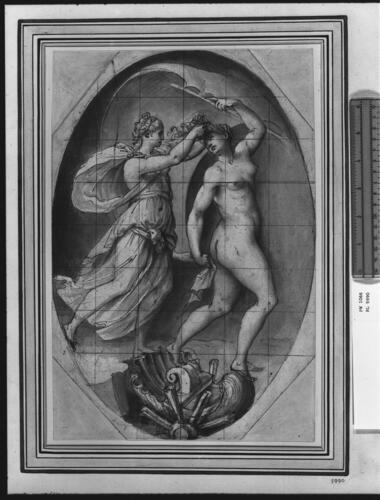
Virtue subduing Fortune c.1553
Pen and ink with wash over black chalk | 36.0 x 24.0 cm (sheet of paper) | RCIN 905990

-
Prospero Fontana worked on several projects for Pope Julius III between 1550 and 1555, including the decoration of the Pope’s private residence, the Villa Giulia in Rome. The villa was built in a vineyard given by Giovanni Poggi to the Pope when Poggi was created a cardinal in January 1551, and was still incomplete when Julius died in March 1555.
The motif of Virtue subduing Fortune was Julius’s personal device (impresa), and this drawing is a study for a stucco oval relief, at the centre of the vault of one of the two principal ground-floor chambers of the villa (now the ticket office for the Museo Etrusco). The same design is also painted on the ceiling of one of the smaller ground-floor rooms of the villa.
In his life of Taddeo Zuccaro, Vasari (who knew Fontana well and worked with him on several occasions) stated that:
‘in 1551 Stefano Veltroni of Monte Sansovino [Vasari’s cousin and assistant] was commanded by the Pope and by Vasari to decorate with grotesques the rooms of the villa which had belonged to Cardinal Poggi, outside the Porta del Popolo on a hill. He called in Taddeo to help, and caused him to paint, as the central feature of the decoration, one of the pope’s devices, that of Occasion seizing Fortune by the hair and making as if to cut it off with her shears.’
Vasari’s identification of the figures in the impresa is a little garbled: Occasion and Fortune were often conflated during the Renaissance; the figure to the left here is Virtue, who subdues Fortune, meaning that the conduct of a virtuous life can overcome the whims of chance. Thus the drawing had been attributed to Taddeo, but it has been pointed out that Vasari’s account - which refers to a painting, not a stucco - describes Poggi’s old villa and not the Villa Giulia. Julius apparently used the old villa as a residence while the new one was being built, and presumably commissioned his impresa to be painted in the old villa to signify the change of ownership. On completion of the Villa Giulia, Poggi’s old villa was torn down.
Vasari went on to state that Prospero Fontana painted ‘many things’ in the new villa with the assistance of Taddeo Zuccaro. Dividing responsibility for the paintings in the rooms on either side of the vestibule is very problematic. Some art historians have assigned the paintings in the left room to Fontana and those in the right to Taddeo, while others have attributed all the ground-floor rooms to Fontana with the exception of the vault of the atrium. Fontana, then in his early forties, was more experienced than Taddeo, in his early twenties; he seems from the documentation to have been in control of the project, and it must have been he who provided the designs from which the stuccoists worked. Payments to the stuccoists in the villa do not go beyond the summer of 1553, and on the basis of these documents the stuccoes have been attributed to Federico Brandani. The stuccoes would probably have been the first part of the decoration to be executed, and it may be assumed that Fontana had provided designs for the stuccoists shortly after his engagement on the project in early 1553.
Fontana's large sketch for the composition is in the Uffizi. (109066-F) The present sheet was based directly on that sketch as a final refinement of the composition, adding the sail and shell-boat of Fortune, correcting the position of Virtue’s right foot, and adjusting the relative heights of the figures so that Virtue stands slightly taller than Fortune and more comfortably grasps her hair. Angelamaria Aceto cautiously attributed the present drawing to Brandani, as his working drawing based on Fontana's design in the Uffizi ('On some late Renaissance ornament drawings in the Ashmolean Museum', Studi di Memofonte, 29 (2022), pp. 1-24, p. 7 n. 33).Provenance
Listed in George III's Inventory A, c.1810, p. 54, 'Pellegrino Tibaldi, Primaticcio, Procaccini &c.', among '38 to 49. Various Lombard Masters, contemporaries with the above'.
-
Creator(s)
-
Medium and techniques
Pen and ink with wash over black chalk
Measurements
36.0 x 24.0 cm (sheet of paper)
Category
Object type(s)
Other number(s)


