


-
1 of 253523 objects
Pellegrino Tibaldi (1527-96)
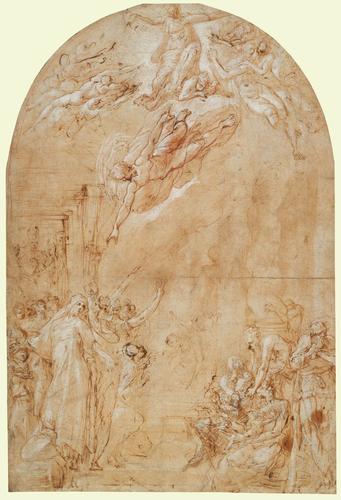
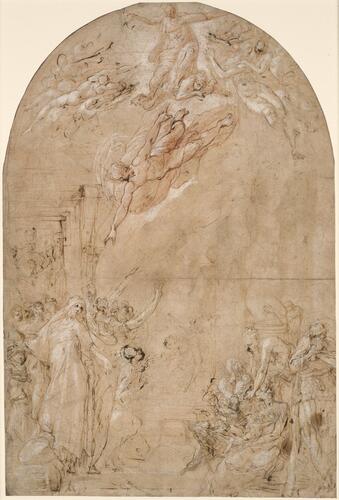
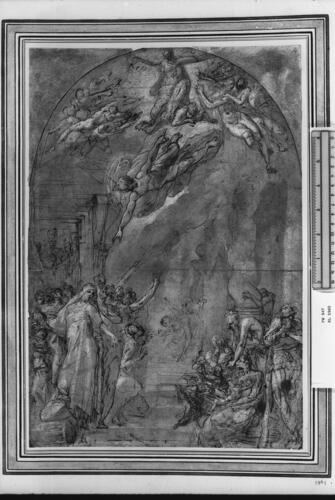
The Annunciation of the Conception of the Baptist c.1550-55
Red chalk, pen and ink, wash and white heightening, on buff paper | 42.3 x 28.4 cm (sheet of paper) | RCIN 905965
-
A scene in a crowded temple, with God the Father above, the angel Gabriel descending to announce to Elizabeth that she will give birth to John the Baptist. This is a study for a fresco on the right wall of the Poggi chapel of San Giacomo Maggiore, Bologna, commissioned by Giovanni (later Cardinal) Poggi, who was buried in the chapel in February 1556. Tibaldi's work in the chapel is not documented, and his activity during the 1550s is far from clear. He is sometimes though to have returned to Bologna from Rome around 1550, but he is documented in Rome working in Palazzo Sacchetti in 1553; between that year and 1561 he seems to have been peripatetic, working concurrently in Bologna, Loreto and Ancona, and the frescoes in the Poggi chapel were probably finished around 1560.
Although the drawing is rapidly sketched, the composition is close to its final form. Tibaldi’s treatment of the subject differs from the account in the Gospel of St Luke (1: 5-25). The biblical text relates that the priest Zacharias was burning incense in the temple when the angel Gabriel appeared beside him, telling him that his elderly wife Elizabeth would bear him a son, to be called John, and that Zacharias would be struck dumb until this came to pass. Here the angel lunges down from the heavens to announce the news to Elizabeth herself, who rests one knee on a fallen temple column indicating the passing of the old order. In the left background of the drawing is an enthroned priest, presumably Zacharias, under an aedicule: that feature is barely visible in the fresco (only a shadowy and apparently incidental priest remains, gesturing in astonishment at the apparition), and the figures to the right have been reduced to a saturnine old man, presumably now Zacharias, leaning on a staff, with a mother at his feet suckling her child. It has been suggested that the mother might be St Elizabeth again, looking up as she waits for Zacharias to break his dumbness by revealing the name of the child. Such a conflation of episodes and repetition of a figure in a single scene would be unusual in the sixteenth century (though had been common in the fifteenth).
The Roman influence has been noted in Tibaldi’s paintings in the Poggi chapel, in particular Raphael’s Transfiguration, Salviati’s Visitation, and Michelangelo’s Conversion of St Paul in the Cappella Paolina of the Vatican. In his drawings of individual figures Tibaldi was indebted to Michelangelo, but the style of the present sheet owes nothing to that artist; the wandering lines might betray Tibaldi’s exposure in Rome to the drawings of Perino del Vaga and Taddeo Zuccaro, and the painterly use of red chalk and white heightening are more akin to his Emilian forerunner, Correggio.
Text adapted from The Art of Italy in the Royal Collection: Renaissance and Baroque, London, 2007Provenance
Royal Collection by c.1810: Inventory A, p. 54, Pellegrino Tibaldi, Primaticcio, Procaccini &c, '3 to 7...And the large emblematical composition (a slight Sketch). These are painted by Pelegrino Tibaldi, in the Palazzo Poggi.'
-
Creator(s)
-
Medium and techniques
Red chalk, pen and ink, wash and white heightening, on buff paper
Measurements
42.3 x 28.4 cm (sheet of paper)
Category
Object type(s)
Other number(s)
Alternative title(s)
A miracle of St Mark(?)


