


-
1 of 253523 objects
Giovanni Paolo Schor (1615-1674)
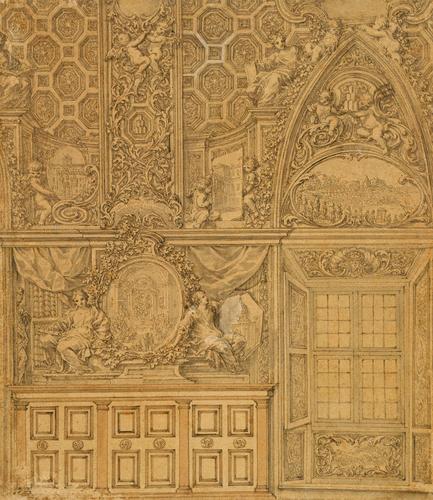
An interior design for Pope Alexander VII c.1660-67
Pen and ink with grey and red-brown wash and white heightening, on discoloured and fly-specked paper | 42.4 x 36.7 cm (sheet of paper) | RCIN 904443
-
After training in his native Innsbruck, Schor settled in Rome where he specialised as a decorative designer, producing many drawings for theatrical ephemera, coaches, tableware and so on. This elaborate drawing must have been a design for Pope Alexander VII, for it features the Chigi family emblems of oak leaves, the six hills, and the eight-pointed star, and includes depictions of the Pope’s building projects at Castel Gandolfo outside Rome.
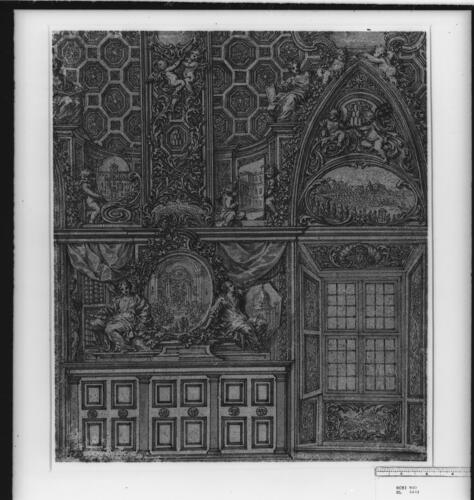
This elaborate drawing, together with two others in the Royal Collection offering alternatives, must have been a design for the decoration of a salone for Pope Alexander VII (Fabio Chigi; r.1655-67). The designs are replete with the Chigi emblems of oak leaves, the six monti, and the eight-pointed star, and the present sheet also includes a number of depictions of the Pope’s building projects. The figure at lower centre holds an octagonal tablet with an elevation and partial section of the church of San Tommaso di Villanova at Castel Gandolfo, built to Bernini’s designs in 1658-61. By her side is a larger oval panel with a view of the high altar of that church, and above the window is a painting of the Pope and his retinue in the countryside with Castel Gandolfo in the distance.
The drawing is rather hard to read, and it is difficult to separate illusionistic from real architectural forms. The cornice running through the centre of the sheet indicates that the wall surface is flat, with a window bay the full height of the wall, and a barrel vault arching over the viewer. The apparently apsidal space above the cornice, seen in all three studies, is presumably fictive; Schor has here made no attempt to construct a convincing perspectival effect for the octagonal coffering, though in the other two studies the ceiling is drawn as if it is domed.
It has been suggested that the drawings might be studies for a library or cabinet room, though the absence of furniture other than the large credenza at lower left argues against this proposal; the fictive books behind and on the lap of the figure at lower left may identify her simply as a personification of Learning. The repeated depiction in the cartouches of the papal villa at Castel Gandolfo would imply that the decoration was intended for an interior there, though Michel and more recently Morello have suggested that the drawings might instead be connected with Schor’s decorations in the Gallery of Urban VIII in the library of the Vatican, begun around 1662, left unfinished and later destroyed.
See also RCIN 904444, 904445
Catalogue entry adapted from The Art of Italy in the Royal Collection: Renaissance and Baroque, London, 2007Provenance
Probably acquired by George III in 1762 as part of the collection of Cardinal Alessandro Albani; first recorded in a Royal Collection inventory of c. 1800-1820 (Inv. A, p. 112, as by Pietro da Cortona: 'Martial and Religious or Popish Devices mix'd, The first a Design for a Clock and Ornaments for insides of Churches, Pallaces, and other Devices')
-
Creator(s)
Acquirer(s)
-
Medium and techniques
Pen and ink with grey and red-brown wash and white heightening, on discoloured and fly-specked paper
Measurements
42.4 x 36.7 cm (sheet of paper)
Category
Object type(s)


