


-
1 of 253523 objects
St Stephen c.1539-40
Black and white chalks on thin blue paper | 28.8 x 20.0 cm (sheet of paper) | RCIN 903365
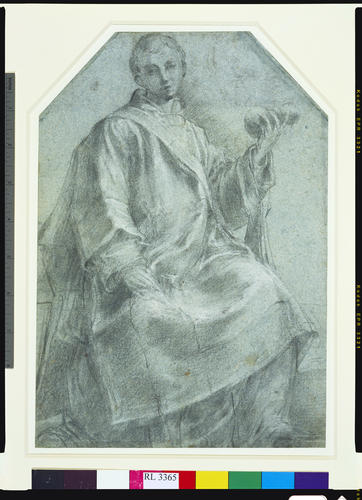
Parmigianino (Parma 1503-Casalmaggiore 1540)
St Stephen c.1539-40
Parmigianino (Parma 1503-Casalmaggiore 1540)
St Stephen c.1539-40
Parmigianino (Parma 1503-Casalmaggiore 1540)
St Stephen c.1539-40

-
A drawing of a seated young man in ecclesiastical robes, holding stones in his raised left hand. The drawing is a study for Parmigianino’s Madonna and Child with Sts Stephen and John the Baptist (Gemäldegalerie, Dresden), which according to the early biographer Giorgio Vasari was painted for the church of Santo Stefano in Casalmaggiore, the town on the Po north of Parma where Parmigianino spent the last year of his life, after his release from prison in 1539.
Several small sketches survive for the whole composition, and the pose of St Stephen is different in each one – standing, genuflecting, seated in half length, kneeling on one or both knees. Only here is he seen in his final form, seated in full length and holding the stones of his martyrdom. There is no sign here of the palm of martyrdom that in the painting he holds in his right hand, nor of the donor who rests his chin on the saint’s right knee. As usual, he is shown in the robes of a deacon, though in addition to the commonly depicted dalmatic he also has a stole correctly worn diagonally from shoulder to hip, and a maniple around his left wrist, suggesting that an attention to detail was particularly important to patron or painter.
The sheet has been badly rubbed, and traces of white chalk over most of the drapery indicate that this would have been a much more luminous drawing with greater contrasts when executed. Parmigianino’s use of black and white chalks may have been an attempt to capture the effect of strong lighting seen in the painting.
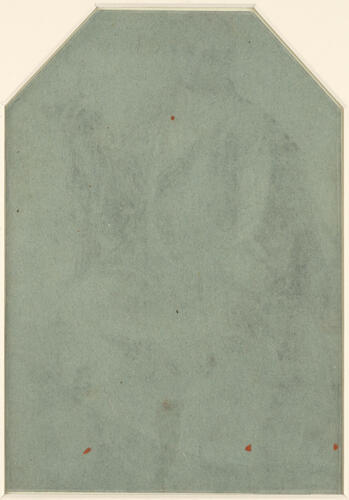
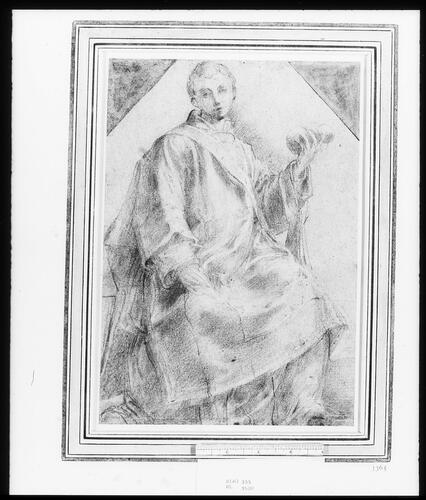
The drawing was known to be by Parmigianino in the seventeenth century, as attested by the inscription F. Parmigiano 2.3 on an old backing paper in the hand of the dealer William Gibson (the cut top corners also indicate an English seventeenth-century provenance). The drawing subsequently lost its attribution and was bound in George III’s library in an album of drawings by Guido Reni and his school. The correct attribution, and its connection to the Dresden painting, was made by F. Arcangeli in the 1960s (as recorded in Blunt 1971).
Provenance
From the collection of William Gibson (his inscription and price mark); probably acquired by Charles II. Listed in George III's Inventory A, p. 80, 'Guido &c Tom 4', among '18 Studies for Draperies'.
-
Creator(s)
Previously attributed to the school of (artist)Acquirer(s)
-
Medium and techniques
Black and white chalks on thin blue paper
Measurements
28.8 x 20.0 cm (sheet of paper)
Category
Object type(s)
Other number(s)


