


-
1 of 253523 objects
Domenichino (Bologna 1581-Naples 1641)
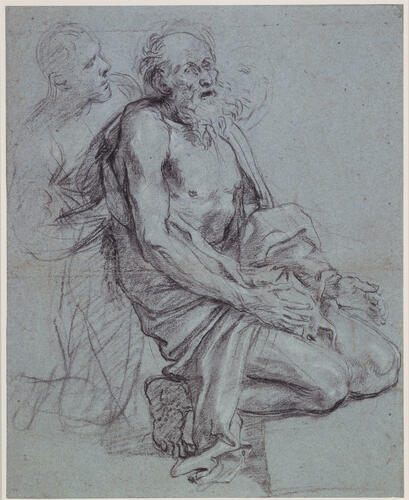
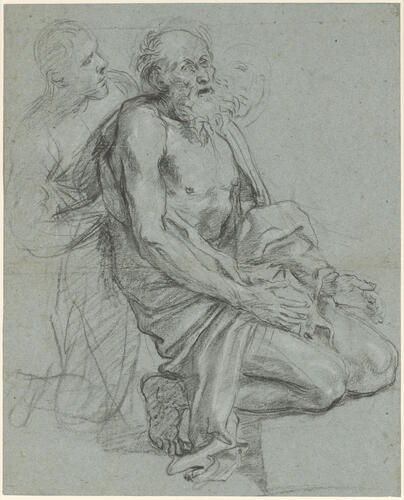
St Jerome c.1612
Black and white chalks on blue paper | 38.8 x 31.9 cm (sheet of paper) | RCIN 901732
-
A study of a kneeling male figure supported by two attendants for the figure of St Jerome in the Last Communion of St Jerome, now in the Pinacoteca Vaticana, Vatican City.
Domenichino trained with the Carracci in Bologna before moving to Rome, where his collaboration with Annibale Carracci positioned him as the leading classicist of his generation. This is one of many surviving life studies for perhaps Domenichino’s most celebrated work, the Last Communion of St Jerome (now in the Pinacoteca of the Vatican).
This drawing is one of many surviving life studies for the Last Communion of St Jerome. The painting was set up on the high altar of San Girolamo della Carità, Rome, in September 1614, as part of a renovation of the church that had begun in 1610-11. After being removed to Paris during the Napoleonic occupation, the painting was returned not to its church, but to the Pinacoteca Vaticana, where it remains.
Domenichino received a first advance for the painting in August 1612. Earlier that year he seems to have returned briefly to Bologna, where he must have taken the opportunity to study Agostino Carracci’s painting of this unusual subject (then in the Certosa, now in the Pinacoteca), and he found it hard to distance himself from Agostino’s elegant arrangement. Though Domenichino reversed the direction of the composition and allowed more space between the figures, the structure of the composition is essentially the same. As a result he was (a decade later) accused of plagiarism by Giovanni Lanfranco, who to prove his point sent his pupil François Perrier to Bologna to make an etching after Agostino’s painting, for distribution in Rome. This accusation was prompted by the rivalry of the two artists, who were then competing for the commission for the decoration of Sant’Andrea della Valle; but while the accusation was not without substance, subsequent debate centred not on whether Domenichino had followed a distinguished model - which was entirely normal, even laudable - but on whether he had done it well.
On his death Domenichino left the contents of his studio, including two thousand of his own drawings, to his pupil Francesco Raspantino. An inventory of 1664 lists the works then in Raspantino’s collection; some time afterwards, the bulk of the collection was acquired by Carlo Maratti, and from Maratti the drawings passed through the Albani collection to George III, for whom the 1,750 sheets by Domenichino were mounted in thirty-four albums.
Catalogue entry adapted from The Art of Italy in the Royal Collection: Renaissance and Baroque, London, 2007Provenance
Purchased by George III
-
Creator(s)
Acquirer(s)
-
Medium and techniques
Black and white chalks on blue paper
Measurements
38.8 x 31.9 cm (sheet of paper)
Category
Object type(s)
Other number(s)
RL 01732


