


-
1 of 253523 objects
Domenichino (Bologna 1581-Naples 1641)
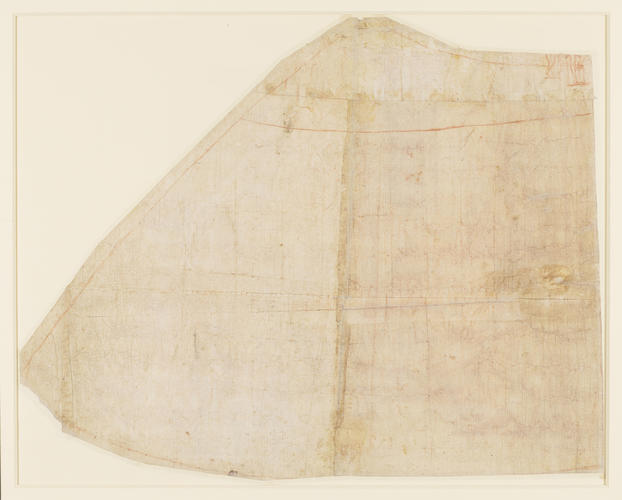
The Flagellation of St Andrew c.1622-5
Red chalk, squared, on several pieces of paper | 44.5 x 56.8 cm (sheet of paper) | RCIN 900387

Domenichino (Bologna 1581-Naples 1641)
The Flagellation of St Andrew c.1622-5
Domenichino (Bologna 1581-Naples 1641)
The Flagellation of St Andrew c.1622-5
-
Domenichino’s greatest work in Rome was his fresco cycle in the church of Sant’Andrea della Valle. This is the final design for the Flagellation of St Andrew, which occupies an irregular curved space in the vault. It was preceded by many individual life studies; here Domenichino arranged the figures in the perspectival space, before transferring the composition to a full-scale cartoon with the aid of the curving squared grid.
This is a final working drawing for Domenichino’s fresco of the Flagellation of St Andrew, part of his decoration of the church of Sant’Andrea della Valle, his greatest fresco cycle in Rome. Domenichino painted the entire vault of the choir with scenes from the life of St Andrew, set within elaborate stucco frameworks designed by the artist; he also painted four huge figures of the Evangelists in the pendentives below Giovanni Lanfranco’s fresco of the Assumption of the Virgin on the inside of the dome.
The first payment to Domenichino was made in December 1622, for work in the choir. The building of the dome was completed in 1623, at which point Domenichino moved on to the pendentives, working on them during 1624 and 1625 before moving back to the choir, for which a final payment was made in February 1628. Lanfranco’s first payment was in August 1625, and it is possible that Domenichino was initially assigned the whole project, as claimed by Bellori and Baldinucci, and that only after the death in 1623 of Cardinal Alessandro Peretti Montalto, the main patron of the new church, did Lanfranco succeed in winning a portion of the commission. Passeri stated, on the contrary, that Lanfranco first held the commission before Cardinal Ludovico Ludovisi persuaded Peretti Montalto to transfer it to Domenichino, and that the project was subsequently divided between the two artists, but this seems to be contradicted by the dates of the recorded payments.
The drawing is the culmination of Domenichino’s work on the composition of the Flagellation, as seen in another twenty sheets also in the Royal Collection. Having arrived at a satisfactory pose for each figure, he fitted them here into the framework of the architecture, then squared the sheet for enlargement to the full-size cartoon for the fresco. The painting occupies the upper left portion of the tribune, and (as indicated by the distorted ‘squaring’) is a complex shape, with the left half following the cylindrical curve of the barrel vault, and the right half the spherical curve of the semi-dome. (The equivalent space on the opposite side of the tribune was frescoed with St Andrew adoring the cross of his martyrdom, and the central portion of the semidome with the Calling of Sts Andrew and Peter.) This irregular surface presented a problem in the consistent perspectival depiction of fictional space, which Domenichino solved by dividing the composition in two such that there is little spatial relationship between the scourging to the left and the onlookers to the right. There are few resemblances of detail between this composition and the artist’s fresco of the same subject in the Oratorio di Sant’Andrea of San Gregorio Magno, Rome, executed c.1609, though he used the same simple organisational principles, with a bold architectural backdrop and the figures widely spaced in the uncluttered foreground.
Catalogue entry adapted from The Art of Italy in the Royal Collection: Renaissance and Baroque, London, 2007Provenance
Purchased by George III
-
Creator(s)
Acquirer(s)
-
Medium and techniques
Red chalk, squared, on several pieces of paper
Measurements
44.5 x 56.8 cm (sheet of paper)
Category
Object type(s)
Other number(s)
RL 00387Alternative title(s)
The Scourging of St Andrew


