


-
1 of 253523 objects
Shield (ishilunga) nineteenth century
Cow hide | 138.5 x 74.2 x 2.2 cm (whole object) | RCIN 83059
Zulu
Shield (ishilunga) nineteenth century
Royal Collection Trust/© His Majesty King Charles III 2022. Photograph: English Heritage
Zulu
Shield (ishilunga) nineteenth century
Royal Collection Trust/© His Majesty King Charles III 2022. Photograph: English Heritage
-
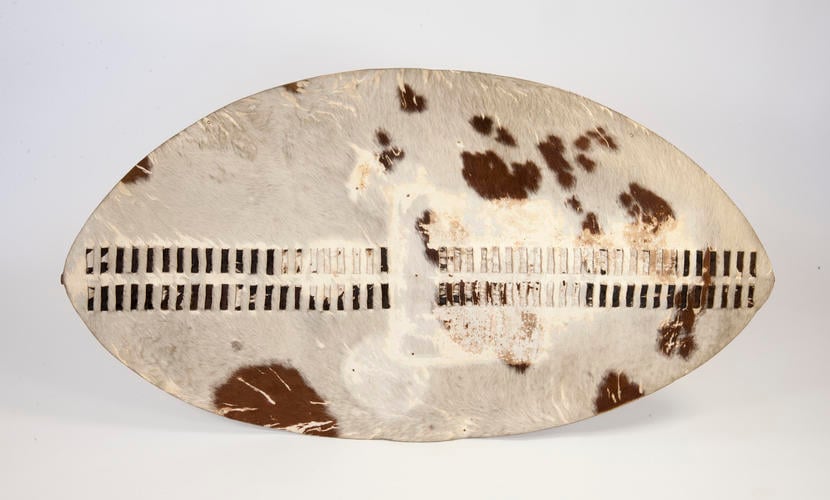
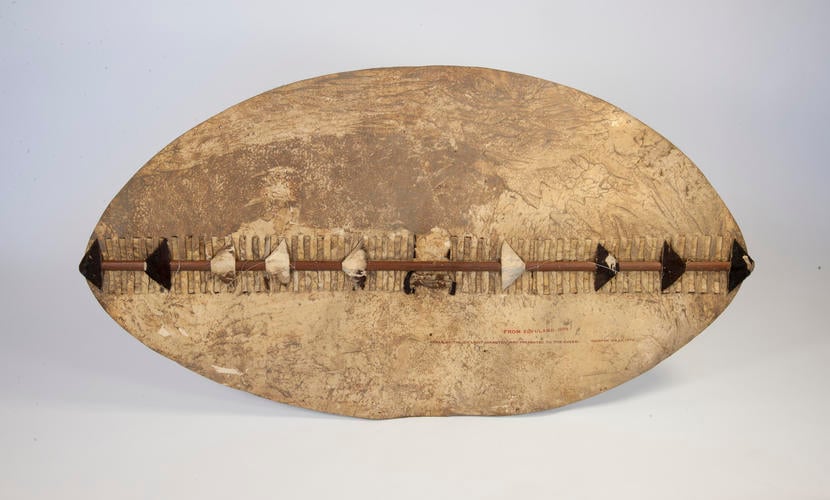
Oval Zulu shield (ishilunga) of white cowhide with brown patches, decorated with central vertical stripes.
Shields of this kind bore different patterns depending on the regiment (impi). The colours of the hide also indicated a warrior's marital status and battle maturity: the most inexperienced fighters typically used black shields, while white shields with minimal spots, like this one, were reserved for the most senior fighters.Provenance
Taken by the 13th Light Infantry at the military kraal, Nodwengu, near Ulundi, during the Anglo-Zulu War and presented to Queen Victoria, 1879.
This may be the shield given to the Queen by Lord Chelmsford on 3 September 1879, which she recorded in her Journal for that day: 'After luncheon, saw Ld Chelmsford, who brought me a Zulu shield, 4 ft. 6in by 2 ft. 4 1/2in, made of oxen hide, stiffened and prepared in a peculiar manner. This one, white, with a little black, belonged to the Regt of unmarried men and was taken out of the King's Shield House, in his Kraal, at Ulundi. Formerly, they always used to carry these large shields, and those who have no firearms, almost invariably do so still. But Cetewayo, finding them very inconvenient, in fighting with firearms, had them reduced to about 1 third of their size.' On 2 January 1880, the Queen recorded in her Journal that she had 'Walked with Beatrice by Barton & the Swiss Cottage [at Osborne House on the Isle of Wight], where we placed, in the museum, some of the assegais & shields, given to me from Zululand.' This shield may have been among them.
In 1879, British ambitions to create an imperial federation in southern Africa resulted in a series of armed conflicts with Cetewayo, King of the Zulu, whose territory lay between Natal and the Transvaal. Lieutenant-General Lord Chelmsford led the forces which invaded Zululand in January 1879 and who finally achieved victory at the Battle of Ulundi in July. Although shields of this kind were highly effective when used in close combat with stabbing spears, the 20,000 Zulu warriors who faced Chelmsford at Ulundi were unable to repel British firepower. Following the battle, Cetewayo was captured and sent into exile first in Cape Town and then in London. -
Creator(s)
(nationality)Acquirer(s)
-
Medium and techniques
Cow hide
Measurements
138.5 x 74.2 x 2.2 cm (whole object)
2300 g (Weight) (whole object)
Category
Object type(s)
Place of Production
South Africa


