


-
1 of 253523 objects
After White, G. F. (fl. 1848)
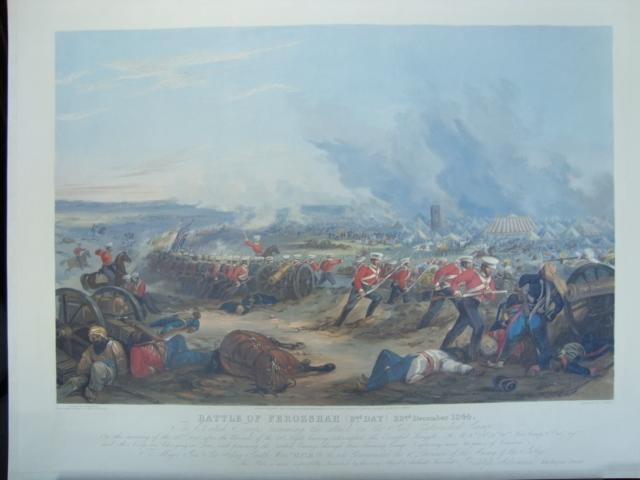
The Battle of Ferozshah (2nd day). 22nd December 1845 published 5 Apr 1849
Etching with aquatint and hand colouring | RCIN 750918
-
An etching with aquatint of a view over the battlefield at Ferozeshah in the Punjab on the morning of 22nd December 1845, during the First Anglo-Sikh War: massed ranks of British East India Company infantrymen close in on the Sikh camp at Ferozeshah, over which smoke billows. Sikh cannon and crews are overrun and bayoneted in the foreground, right; with casualties laying in the foreground. Lettered below.
The Maharaja Ranjit Singh had held sway over the Sikh Empire of the Punjab, in north west India, since 1799. He had upheld cordial relations with the East India Company, who held territories adjoining the Punjab, while maintaining the fearsome professionally trained Khalsa army of around 60,000 men. When he died in 1839, no statesman or military figure emerged to take his place and the Sikh empire became increasingly disordered. In September 1845 Sir Henry Hardinge, Governor-General of the Bengal Presidency, received reports that the Khalsa were preparing to invade British territory. He despatched 5,000 extra troops to the region south of the Sutlej river, the border between the Sikh and British territories. It was believed that the future of British India depended on the defeat of Raja Lal Singh's Khalsa army, the equal of the British in training, discipline and weaponry.
On 18 December 1845 the advance guard of Raja Lal Singh's Khalsa army had been defeated at the Battle of Mudki (see RCIN 750916). The Khalsa retreated and regrouped at Ferozeshah where they were sighted on 21 December by the British, commanded by General Sir Hugh Gough. An artillery duel ensued, with the heavier Sikh guns inflicting many casualties. Gough stuck to his habitual tactic in ordering persistent offensives, repeatedly storming the Ferozeshah defences at the cost of casualties unprecedented in any previous Indian campaign. As evening fell Sir Harry Smith's British batallions launched a renewed attack, penetrating the Sikh encampment, before being driven back by counter-attacks. The survivors of the offensive spent the bitterly cold night in the open, as shown in RCIN 750917. By dawn it became apparent that the British actually held most of the camp, and by noon Raja Lal Singh's army had been driven from the field. The Sikh General Tej Singh might have routed the depleted British force with a Khalsa counter-attack, but inexplicably, he retired and Gough's army could claim a costly British victory.
This etching was produced after a painting by Henry Martens, which was in turn based upon drawings by Major George Francis White. White served in India between 1825 and 1846, with the 31st Regiment of Foot. He was an amateur artist as well as author and illustrator of 'Views in India Chiefly among the Himalyas', 1886-7. The Tate Gallery hold some of his drawings.
-
Creator(s)
(etcher)Subject(s)
-
Medium and techniques
Etching with aquatint and hand colouring
Category
Object type(s)
Subject(s)


