


-
1 of 253523 objects
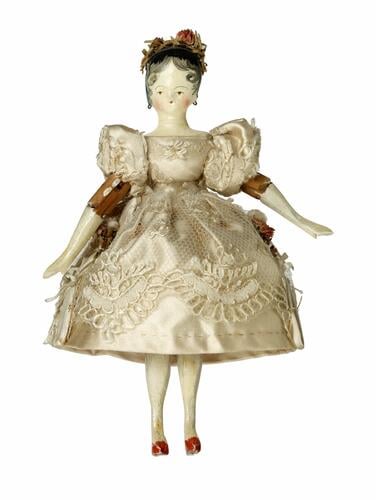
Mrs. Dudley (formerly Mlle Therese Heberlé) 1832
Wood, satin, wire, net | 17.0 cm (whole object) | RCIN 72341
Baroness Louise Lehzen
Mrs. Dudley (formerly Mlle Therese Heberlé) 1832
Royal Collection Trust/© His Majesty King Charles III 2024. Photograph: Museum of London
-
Female doll; wooden; jointed; wearing a gilt wire floral headdress and white silk satin dress embellished with net and cotton and wire flowers; ears with loop for rings.
Provenance
As a child, Princess Victoria (later Queen) made over one hundred dolls with the help of her governess Baroness Louise Lehzen. Most of these dolls survive in the Royal Collection today, after having been carefully packed away by the Princess once she reached her fourteenth birthday. Some dolls represent historic figures or friends of the Princess, but most represent characters from the ballet and from the opera, which Princess Victoria attended regularly, making notes on the various costumes worn, and drawing them once she returned to Kensington Palace. These drawings were then used to help design the dolls' outfits. The dancer Marie Taglioni (1804-84) is the one of the most commonly featured people, usually appearing dressed as a character from a ballet or opera, but she is not the only dancer amongst the collection of the dolls. This doll represents the famous ballerina Therese Herbelé as she appeared as 'Leontine' in the ballet, 'L'anneau magique' in 1832. Therese Herbelé was an Austrian dancer who had trained and performed since childhood with Friedrich Horschelt's Viennese Kinderballett. She danced extensively in Italy during the 1820s and early 1830s, often partnered by Jean Rozier. Princess Victoria's note states that she was first married to Mr Dudley, secondly to Monsieur Anathole.
-
Creator(s)
-
Medium and techniques
Wood, satin, wire, net
Measurements
17.0 cm (whole object)


