


-
1 of 253523 objects
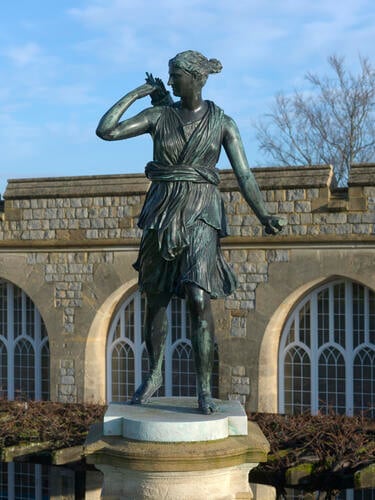
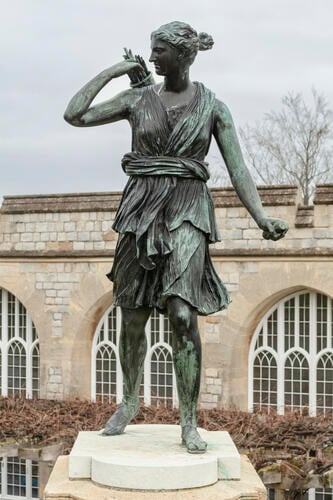
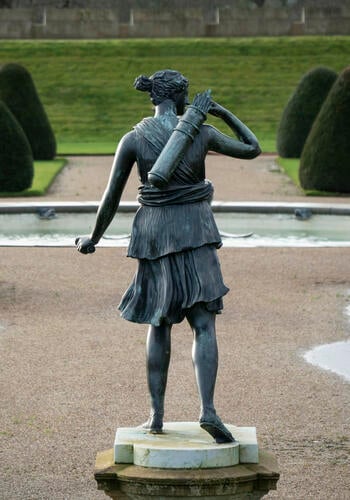
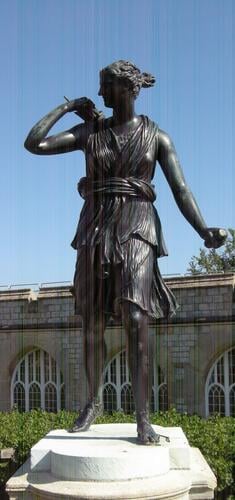
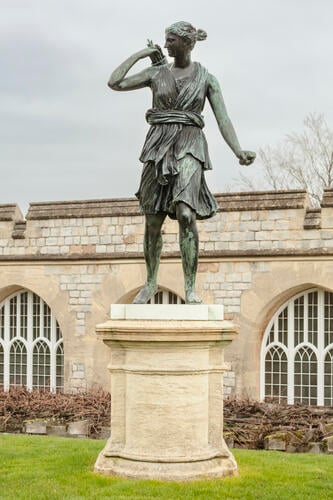
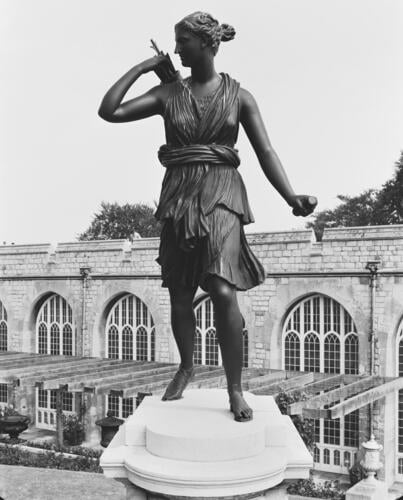
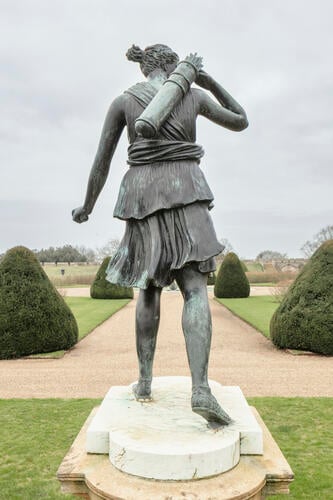
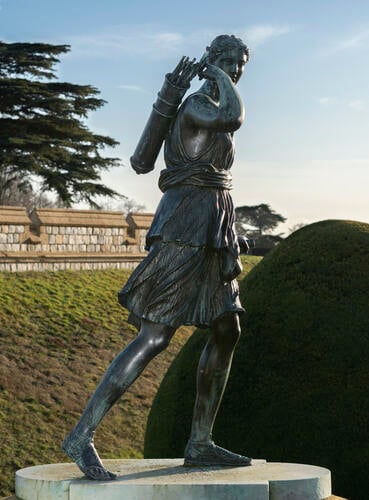
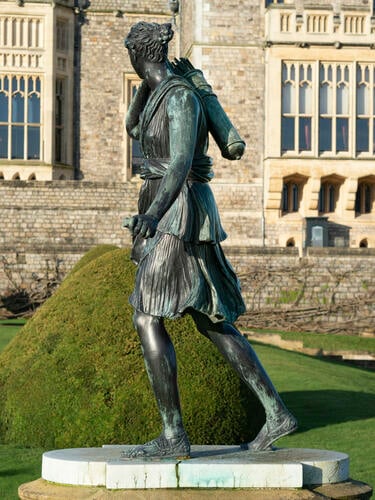
Diane de Versailles c. 1631-6
Bronze | 202.0 x 110.0 x 140.5 cm (whole object) | RCIN 71444
-
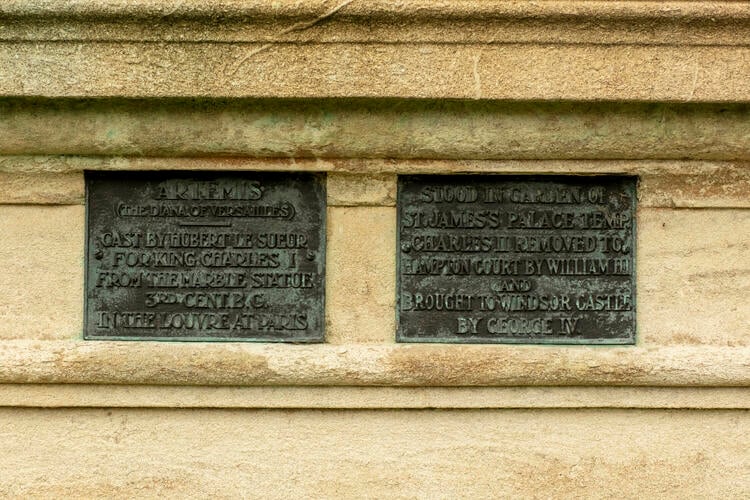
The three alternative French names of the Roman marble statue now in the Louvre from which Le Sueur made his
bronze – Diane chasseresse, Diane à la biche or Diane de Versailles – reflect its long residence on French soil, since at least 1586. In 1602 it was restored by the sculptor Bartélemy Prieur and set up in the new Salle des Antiques of the Louvre. Shortly afterwards, Prieur made a bronze cast for the fontaine de Diane at Fontainebleau. It is not clear whether Le Sueur made use of Prieur’s moulds or whether he acquired his own. Certainly his moulds,
like those for the Cleopatra that was probably also in the Salle des Antiques at this time, must have come from France and not from Italy, and yet there is no reference to Le Sueur having been sent expressly to France for this
purpose; perhaps he brought the moulds with him on his arrival in England in 1625. In 1648, five years after his return to France, he supplied two further casts of the Diana, for Nicolas de Neufville, marquis de Villeroy, and for Louis Phelypeaux de la Vrillière. One of these was subsequently acquired by the 10th Duke of Hamilton and appeared at the 1882 sale of Hamilton Palace as lot 2062. In 1922 this statue, which retains the stag, was acquired through Joseph Duveen by Henry E. Huntington. There is no specific record of a payment to Le Sueur for this cast, but in his account of St James’s in 1633, Henry Peacham states that ‘at this present the said Master Sueur hath divers other admirable molds to cast in brasse for his Majesty, and among the rest, that famous Diana of Ephesus, before named’.
Text adapted from Sculpture in the Collection of His Majesty The King (2025).Provenance
Cast for Charles I from moulds obtained in France, where the ancient statue had been since 1586 (now in the Louvre). Made for Charles I c. 1634 and first located at Greenwich Palace; sold 18 November 1651 to Emanuel de Critz and others; Whitehall Palace following the Restoration; Hampton Court Palace by 1699 and damaged there by the fires of 1691 and 1698, during which time it lost an accompanying stag.
The account of the ‘figure caster’ Richard Osgood for work at Hampton Court Palace in the period August to October 1700 includes the sizeable figure of £72: For casting 2 new leggs and 2 new Arms of Copper & great part of ye Drapery and a new Quiver of Arrows for ye Diana that stands in ye Quadrangle Court and burning altogether and mending sevll other parts. For rifeling and cleaning the figure with Aquafortis to make it look bright all alike.'
The statue was placed on a new Portland stone pedestal supplied by John Nost. There was more than one statue of Diana at Hampton Court at this time. In July 1702 John Nost submitted an account for ‘takeing down the Diana in the Green Court and setting up the Great Diana in the same place.’ In March 1701 the carpenter James Groves
was paid for ‘setting up a pair of Sheres to raise the figure of Diana & helping to raise the same.’
Moved to the East Terrace garden, Windsor Castle, September 1829. Repaired on many occasions. In 1856 the sculptor John Thomas estimated for making and fitting another new quiver (this is formed of copper sheet, with the arrows loose-fitted) and supplying a new marble base, as part of a general overhaul of the statuary in the East Terrace garden, and further repairs to various cracks were made by Parlanti in 1923. In 2004 with Rupert Harris. The right foot was badly distorted and had to be re-formed. Inside the figure was a rusted square iron armature enclosed in soft, brick-red plaster-like material. These were removed and a new armature formed. Alloy analysis carried out at the same time showed that the ‘English’ cast had a significantly greater lead component than that which Le Sueur made in France. -
Creator(s)
Acquirer(s)
-
Medium and techniques
Bronze
Measurements
202.0 x 110.0 x 140.5 cm (whole object)
Alternative title(s)
Diane chasseresse


