


-
1 of 253523 objects
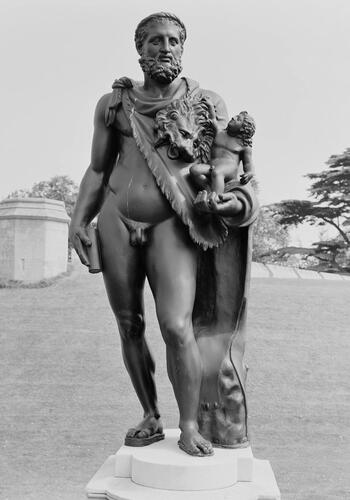
Hercules and Telephus 1631-32
Bronze | 205.0 x 107.0 x 93.0 cm (including base/stand) | RCIN 71442
-
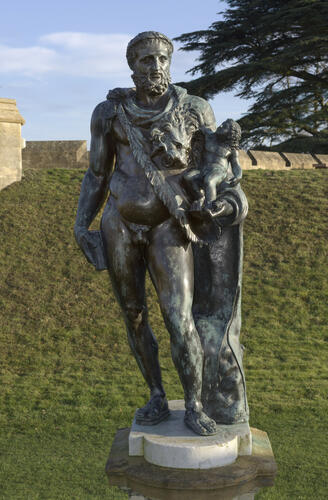
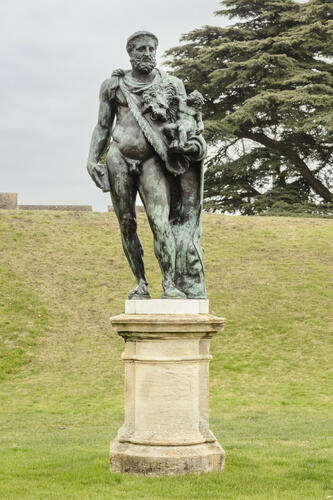
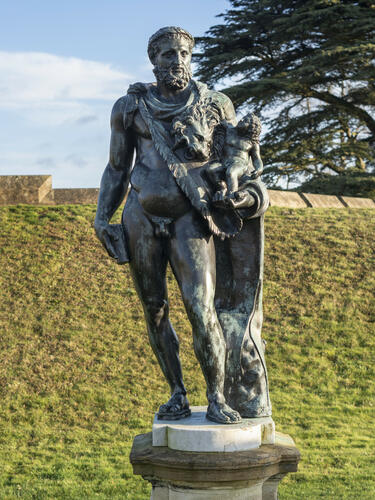
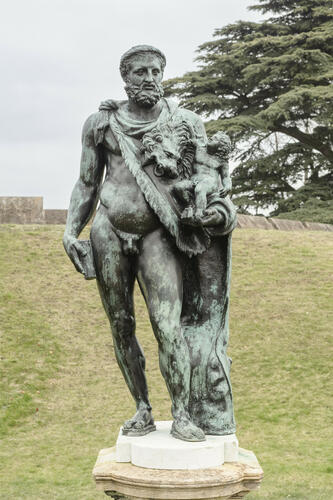
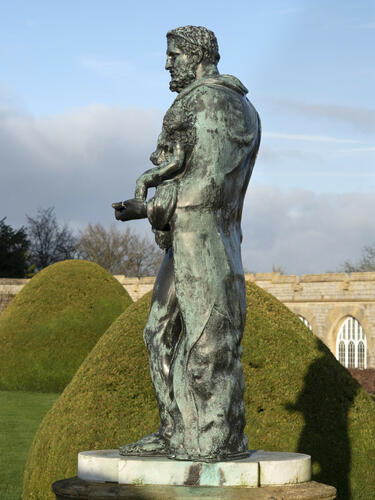
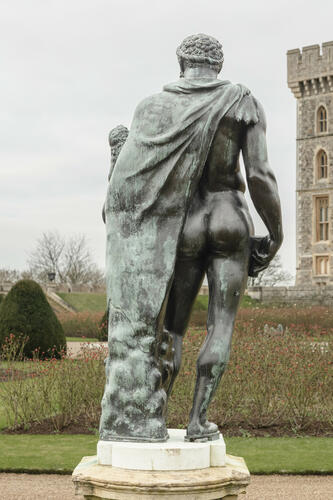
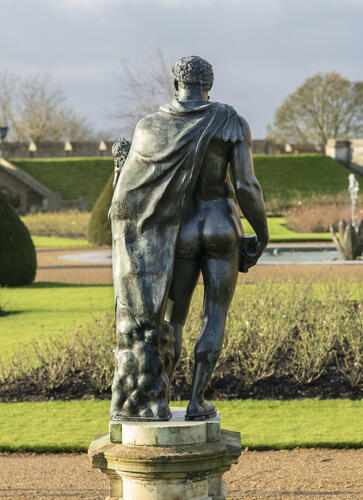
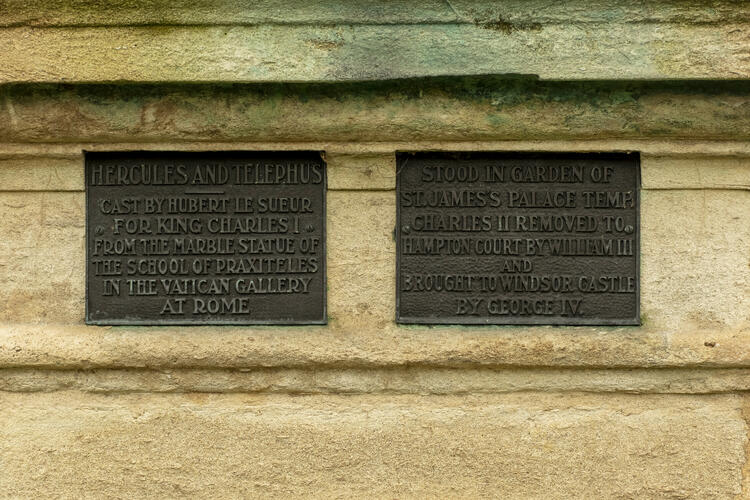
A full-length bronze male figure standing with his weight on his right leg, the left leg placed forward with the knee slightly bent, naked except for a lion’s pelt fastened over his right shoulder, which falls down his back and across his left breast, where the lion’s head is modelled in relief. The hero’s bearded head is turned slightly to his left, and he wears a coiled chaplet around his temples. His right arm is held against his side, and in his right hand is a short baton. His left elbow rests on a tall tree-stump and he cradles a naked male infant who sits up and reaches up with his right arm over the lion’s head. The feet are fastened to the marble base without the usual shaped fixing plates. On the side of the stone base are two lead plaques with raised lettering.
This statue is a cast from one of the antique marbles in the Belvedere Courtyard of the Vatican, where it had stood since the early sixteenth century. Although the principal figure clearly represents Hercules, the dubious identity of the infant has given the group a number of alternative names, among them Hercules and Ajax and Commodus as
Hercules. It is now thought that the infant post-dates the rest of the statue, but may have been intended to represent the hero’s son Telephus. In the antique group, and in most copies of it (including Primaticcio’s version, cast for Fontainebleau between 1541 and 1543), Hercules’ club rests by his right foot, and he holds the end in his right hand. The baton held by this figure may be a replacement following damage to the club during one of the statue’s movements.
Text adapted from Sculpture in the Collection of His Majesty The King (2025).Provenance
Made for Charles I, c. 1631–3; St James’s Palace; sold to Harrison October 1651 (£200); probably re-acquired for
Charles II in 1660 from Eleanor Drew; Whitehall; Hampton Court Palace Privy Garden by 1700 when the
‘figure caster’ Richard Osgood was paid £43 for ‘casting of new feet & part of ye Leggs of Copper to the great Hercules, & also part of the Lyon’s skin & the hands & making good severall other places, being melted & broke by ye Fire at Whitehall.’ Osgood also fixed it to its plinth and set it on a new pedestal. It was seen and (mis-)described at Hampton Court in 1761 by Robert Dodsley. Windsor Castle East Terrace garden, 1829.
Le Sueur made further casts after his return to France, for the marquis de Villeroy and the seigneur de la
Vrillière. One of these is now in the Henry E. Huntington Collection. In this example, the tree stump which links
to the drapery in the ancient marble so as to support the statue independently of the legs is entirely missing.
The Hercules and Telephus cannot be identified with certainty among the bronzes repaired at Windsor in 1856 by
John Thomas, but it was treated along with the others by Parlanti in 1924. It was conserved by Rupert Harris in
2004. XRF analysis found a higher proportion of lead in the ‘English’ cast than in the Huntingdon 'French' version. -
Creator(s)
Acquirer(s)
-
Medium and techniques
Bronze
Measurements
205.0 x 107.0 x 93.0 cm (including base/stand)
Alternative title(s)
Hercules with the infant Bacchus


