


-
1 of 253523 objects
Hermes c. 1631-6
Bronze | 213.0 x 89.0 x 103.5 cm (including base/stand) | RCIN 71438
-
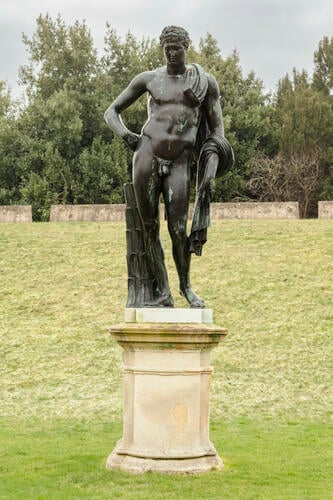
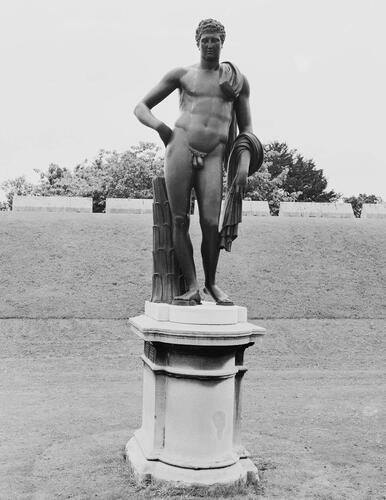
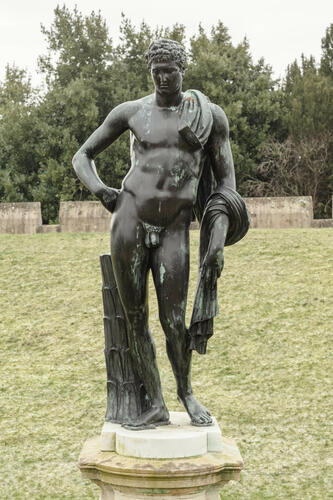
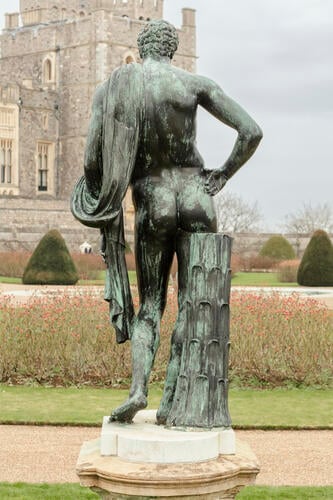
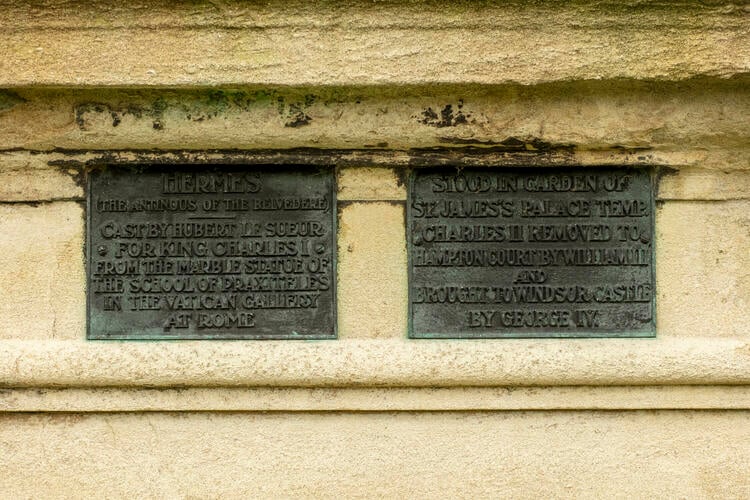
A bronze full length statue of a naked male youth in contrapposto with his weight on his right leg, his left knee slightly bent and his left heel raised. He looks forwards and slightly downwards.His right arm is bent at right angles with his right hand on his hip, while a length of drapery hangs from his left shoulder down his back and over his left forearm by his left side. The stump of a palm tree stands beside his right leg. The feet are fastened to the white marble base by label-shaped fixing plates. On one side of the stone base are two lead plaques with raised lettering.A full-size standing nude figure of Antinous of Belvedere with draperies over his left shoulder and arm, standing next to a palm tree stump.
This work was long known as the Antinous Belvedere, the original being famous since the sixteenth century as
one of the small group of antiquities in the Belvedere Courtyard of the Vatican. It is now generally considered a Roman copy of a statue of Hermes from the circle of Praxiteles and was one of the statues from which moulds were obtained by Primaticcio on his second visit to Rome on behalf of François I of France in 1545, only two years after it had entered the Vatican collection. Both Primaticcio and Le Sueur completed the figure by the addition of the
right arm and the lower part of the left.
Text adapted from Sculpture in the Collection of His Majesty The King (2025).Provenance
Made for Charles I c. 1631–5 and place by him at Greenwich Palace, moved to St James's Palace gardens by the reign of Charles II, sold to de Critz and others, November 1651 (£120) and then recovered for Cromwell’s use at Whitehall. During its time in the Privy Garden at Whitehall it was reportedly attacked with 'a smiths great hamer' by a cook (also described as a Quaker) who lived by the palace gate. It was rescued from further damage by the king's Serjeant Painter Emanuel de Critz. In 1700 the 'figure caster' Richard Osgood was paid £43 for ‘casting a large piece of Drapery of the great Statue of Antinous & making good what was wanting of ye Leggs & severall
other parts.’ At the Restoration in 1660 a petition was presented to the House of Lords on behalf of one Richard
Meredyth, Keeper of the volary in Whitehall:
He has kept the voilery since it was first erected, and has therein disbursed or engaged for 45l. for which he has been several times imprisoned, besides 12l. odd unpaid of his salary; he has preserved a brazen statue in the voilery from being demolished by a Quaker who had already defaced those in the Priory Garden, and had broken one door to come at this, a statue which had been formerly sold at Somerset House, and re-bought by Oliver Cromwell.
Subsequent restorations have obscured all traces of the injuries inflicted by the Quaker’s hammer.
Hampton Court Palace by 1701, moved to the East Terrace, Windsor Castle, 1829. The statue cannot with certainty be identified among the bronzes restored at Windsor by John Thomas in 1856, but it was treated by Parlanti in the course of his campaign of repairs in 1924.
-
Creator(s)
Acquirer(s)
-
Medium and techniques
Bronze
Measurements
213.0 x 89.0 x 103.5 cm (including base/stand)
Alternative title(s)
Belvedere Antinous


