


-
1 of 253523 objects
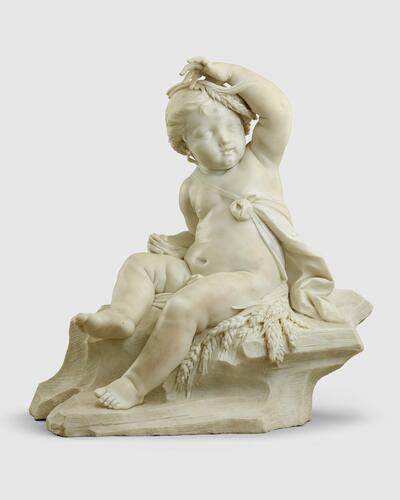
Summer c.1692-95
Marble | 74.9 x 52.7 x 45.0 cm (whole object) | RCIN 71427
-
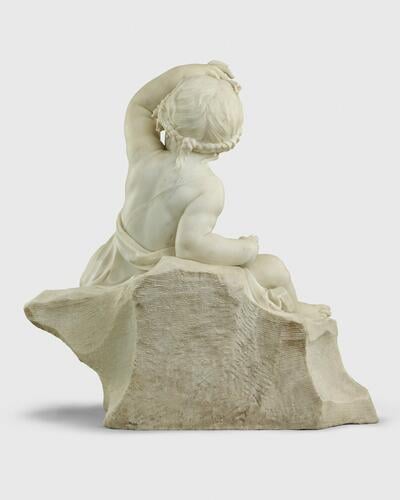
A white marble statue of Summer. A nude putti, seated on a rock with drapery loosely fitted around his back. His left hand raised above his head holding a wheatsheaf. There are further wheatsheafs on his left side on the rock. Part of a group (RCIN 71426, 71427, 71424 and 71425), The Four Seasons.
These four spirited groups are rare examples of Roman Baroque sculpture in the Royal Collection and were exceptional in early Georgian England. They include some virtuosic passages of carving, notably in the flowers and perhaps especially in Spring. They were among the first works in marble by Camillo Rusconi, who set up independently in Rome in 1686 following the death of his master, Ercole Ferrata (1610-1686). He was to become the leading sculptor of eighteenth-century Rome, employed for the most part on the embellishment of churches. His best-known works are the tomb of Pope Gregory XIII in St Peter’s and four colossal statues of apostles in St John Lateran. These four spirited groups can be compared to the winged putti that Rusconi carved in churches such as S. Silvestro in Capite, around 1690.
The four groups were made for the marchese Niccolò Maria Pallavicini (1650–1714), banker to the Roman aristocracy and leading patron of the arts. Rusconi had first modelled a group of a boy with grapes which was much admired by his friend the painter Carlo Maratta, who encouraged the sculptor to carve it in marble. This in turn came to the attention of Maratta’s great friend and patron the marchese Pallavicini, who commissioned three further groups to make a set of the Seasons, possibly between 1692 and 1695. They were placed, on pedestals of veneered onyx marble, in the marchese's gallery, the Sala dell’appartamento Nobile.
Pallavicini died in 1714 and the contents of the Palazzo all’Orso were gradually dispersed. From descriptions and drawings of the Four Seasons it is clear that they remained at the palace until at least 1723. The biographer Baldinucci relates that by around 1730 the four groups had been: ‘… sold to some Englishmen, who brought them to London and sold them to King George… for 4,000 scudi; [the King] placed them in his Royal Gallery, where … they are admired by all connoisseurs’ . The four groups and pedestals were on display at Kensington by November 1726. The groups and their pedestals may have suffered on their journey from Italy, for in that month Giovanni Battista Guelfi was paid £20 for ‘mending the Boys and Pedistals at Kensington &c’.
The timing of the acquisition suggests a connection to William Kent's redecoration of Kensington for George I, which took place between 1725 and 1727. The Four Seasons were not an isolated purchase for Kensington: in 1723 George I bought six large paintings from a Mr Law(s), including works by Guido Reni and the Holy Family with St Francis by Rubens. Kent was familiar with Pallavicini’s palace, which he had visited more than once during his studies in Rome before his return to England in 1719, and it may have served as part of the inspiration for his Kensington interior. The four groups appear with their pedestals in Charles Wild’s view of the King's Gallery.
The purchase of the groups by King George I for his gallery at Kensington has parallels in the formation of contemporary English collections such as that of the 1st Earl of Leicester at Holkham in Norfolk, where William Kent was also architect. The appeal of these emblems of nature to George I can also be understood by reference to his early life in the Electorate, where his mother had laid out elaborate gardens (notably at Herrenhausen) heavily populated by marble sculptures.
Representations of the seasons were a common adornment of Italian baroque palaces and gardens, but few examples show the expressive liveliness of Rusconi’s groups. Not content dutifully to identify each figure merely with the time-honoured attributes, Rusconi uses action, pose and gesture to characterise each Season, for example Winter draws a cape about him. The Four Seasons were remarkably influential. They were copied both in Italy and England and inspired works in other media. Rusconi’s own pupils and those studying at the French Academy in Rome were encouraged to copy them. All four groups were also reproduced in porcelain.
Text adapted from The First Georgians: Art and Monarchy 1714 - 1760 (2014) and Sculpture in the Collection of His Majesty The King (2025)Provenance
Commissioned by marchese Niccolò Maria Pallavicini; Rome, Palazzo all’Orso; purchased by George I; Kensington Palace; sent to Windsor Castle c.1828
-
Creator(s)
Acquirer(s)
-
Medium and techniques
Marble
Measurements
74.9 x 52.7 x 45.0 cm (whole object)


