


-
1 of 253523 objects
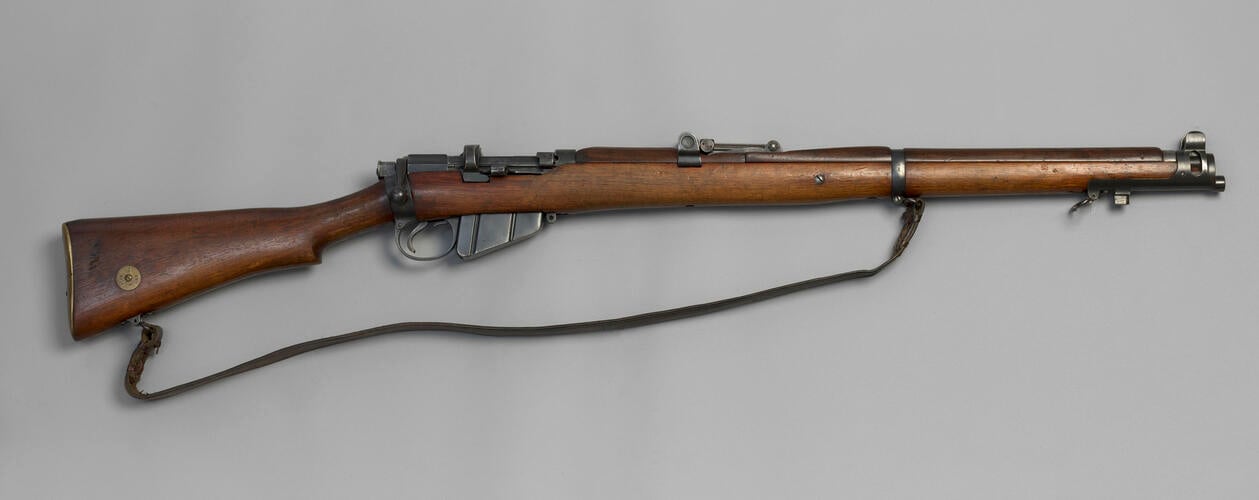
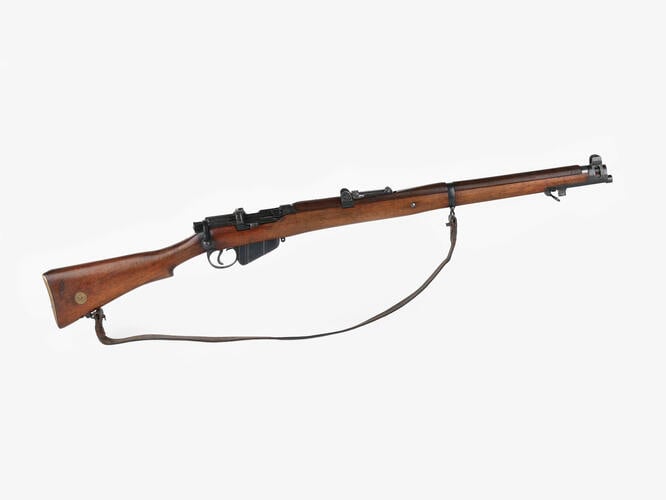
T E Lawrence's Lee-Enfield rifle 1914
Iron, steel, gold, copper alloy (brass), wood, leather. | 113 cm (Length) (length) | RCIN 69430
Royal Small Arms Factory (RSAF), Enfield
Master: T E Lawrence's Lee-Enfield rifle Item: TE Lawrence's Lee-Enfield rifle 1914
Royal Small Arms Factory (RSAF), Enfield
Master: T E Lawrence's Lee-Enfield rifle Item: TE Lawrence's Lee-Enfield rifle 1914
Royal Small Arms Factory (RSAF), Enfield
Master: T E Lawrence's Lee-Enfield rifle Item: TE Lawrence's Lee-Enfield rifle 1914
Royal Small Arms Factory (RSAF), Enfield
Master: T E Lawrence's Lee-Enfield rifle Item: TE Lawrence's Lee-Enfield rifle 1914
Royal Small Arms Factory (RSAF), Enfield
Master: T E Lawrence's Lee-Enfield rifle Item: TE Lawrence's Lee-Enfield rifle 1914
-
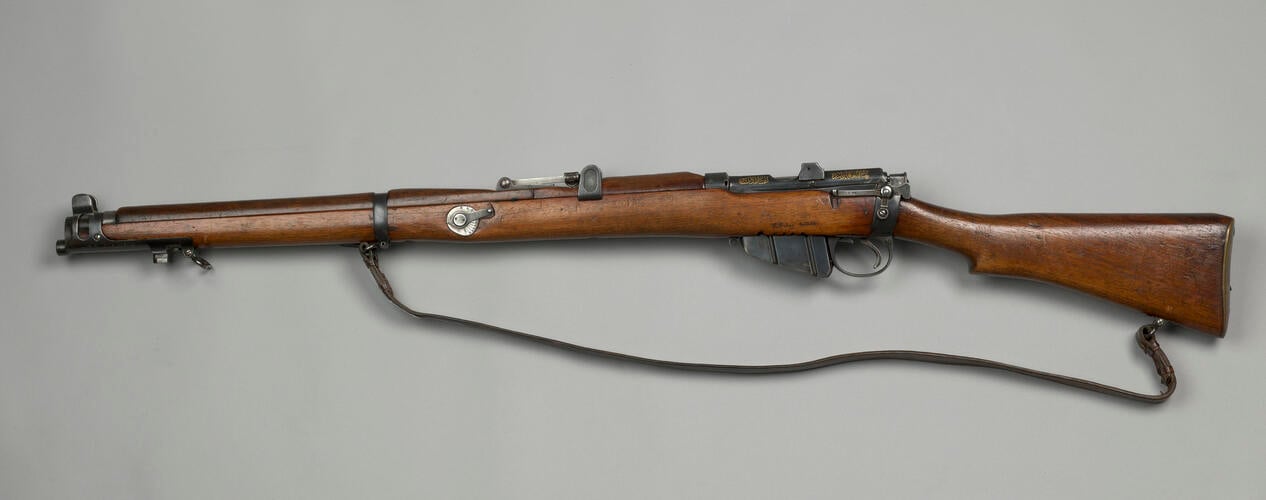
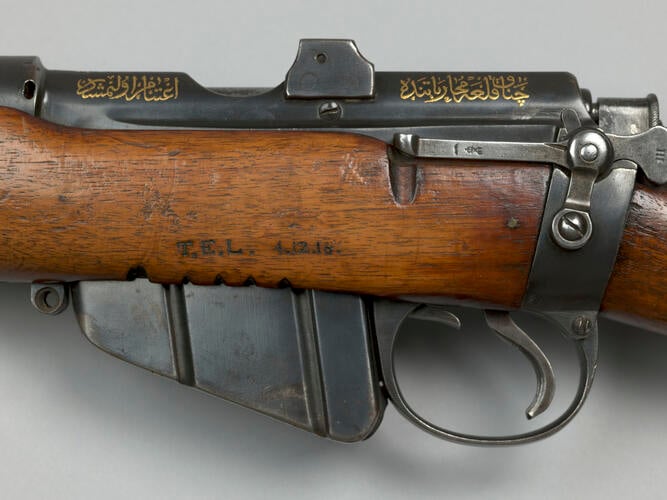
A short magazine Lee Enfield (SMLE) Mk III rifle; a bolt-action, magazine-fed, repeating rifle, with long-range sights and the magazine cut off.
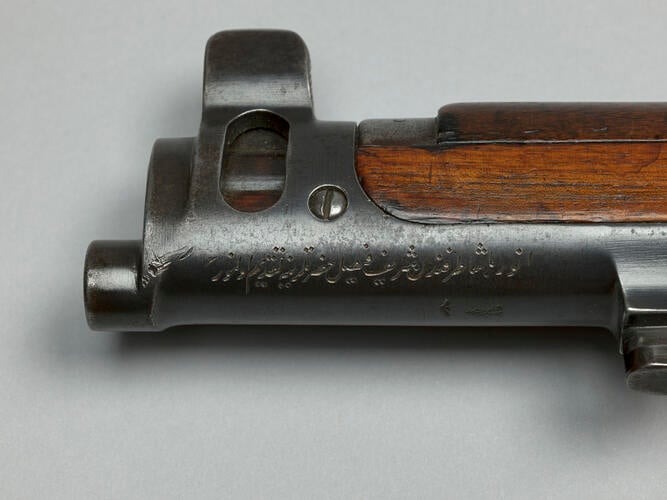
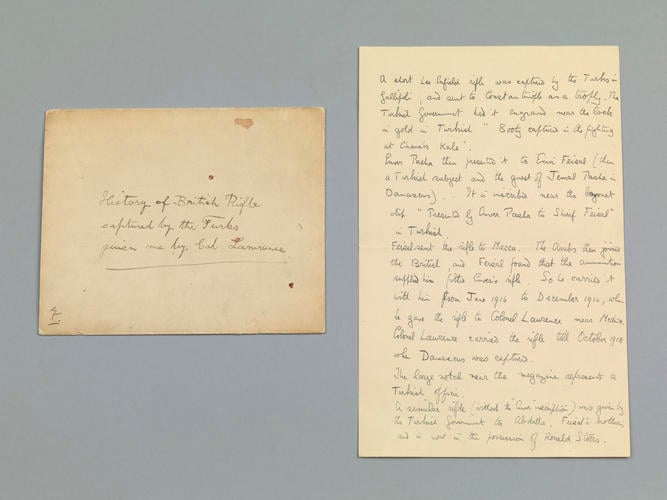
This rifle was carried during the First World War Arab Revolt against Turkish forces by T E Lawrence (1888-1935; "Lawrence of Arabia"), whose initials T.E.L are carved on the stock along with the date 4.12.16. It was given to him by the Emir Faisal (1885-1933; later King of Iraq), to whom it had been presented to by the Turks. The gold overlaid Turkish inscription records the fact that it was captured from the British at Gallipoli. The stamped marks on the brass butt stock disc indicate that the rifle was originally issued to the 1st Essex Regiment. The five notches cut in the stock denote kills by Lawrence with this rifle. The rifle was later given by Lawrence to George V.
During the First World War, British, Indian and Dominion troops participated in campaigns against Germany's ally, Turkey, on the Gallipoli peninsula as well as in Egypt, Palestine and Mesopotamia. Under T E Lawrence's direction guerrilla warfare was used to attack Turkish communications and supply routes.Provenance
Given to T E Lawrence by Emir Faisal, later presented to King George V, where it formed part of his War Museum at Windsor Castle, established to display his collection of First World War souvenirs; the King was assisted by the Royal Archivist & Librarian John Fortescue (1859-1933). Many of these objects were loaned to the Imperial War Museum in 1936 at the suggestion of King Edward VIII.
-
Creator(s)
(maker)(nationality)Acquirer(s)
-
Medium and techniques
Iron, steel, gold, copper alloy (brass), wood, leather.
Measurements
113 cm (Length) (length)
Category


