


-
1 of 253523 objects
Composite 'Gothic' armour late 15th century incorporating elements of 16th, 17th, 19th & 20th centuries
RCIN 67398
Flemish
Composite 'Gothic' armour late 15th century incorporating elements of 16th, 17th, 19th & 20th centuries
Flemish
Composite 'Gothic' armour late 15th century incorporating elements of 16th, 17th, 19th & 20th centuries
Flemish
Composite 'Gothic' armour late 15th century incorporating elements of 16th, 17th, 19th & 20th centuries
Flemish
Composite 'Gothic' armour late 15th century incorporating elements of 16th, 17th, 19th & 20th centuries
Flemish
Master: Composite 'Gothic' armour late 15th century incorporating elements of 16th, 17th, 19th & 20th centuries
Flemish
Master: Composite 'Gothic' armour late 15th century incorporating elements of 16th, 17th, 19th & 20th centuries

Flemish
Composite 'Gothic' armour late 15th century incorporating elements of 16th, 17th, 19th & 20th centuries
Flemish
Composite 'Gothic' armour late 15th century incorporating elements of 16th, 17th, 19th & 20th centuries
Flemish
Composite 'Gothic' armour late 15th century incorporating elements of 16th, 17th, 19th & 20th centuries
Flemish
Composite 'Gothic' armour late 15th century incorporating elements of 16th, 17th, 19th & 20th centuries
-
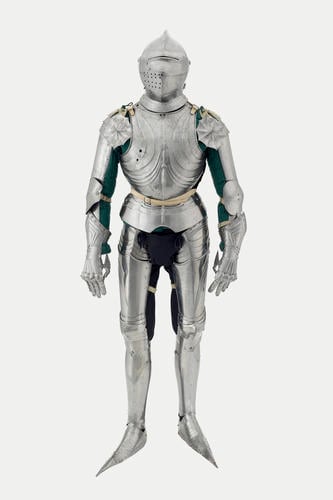
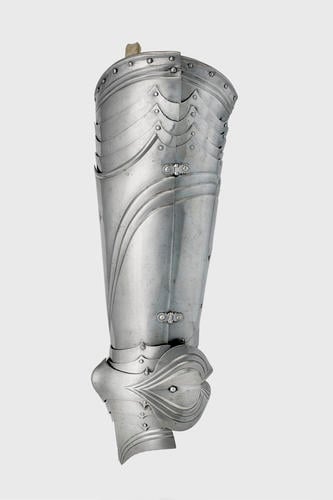
Composite 'Gothic' armour partly South German, late fifteenth century, but incorporating some elements of the early sixteenth, early seventeenth, nineteenth and twentieth centuries.
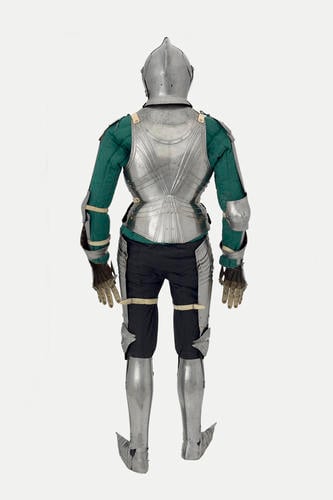
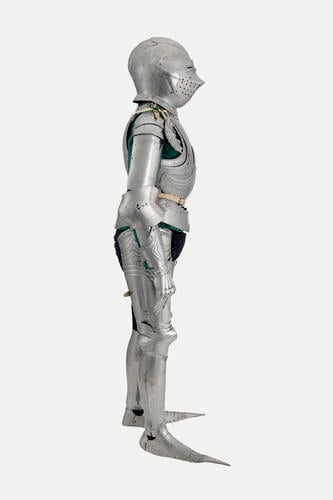
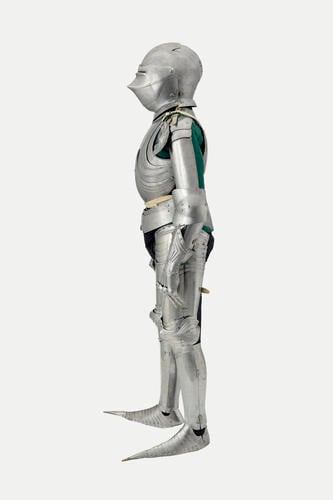
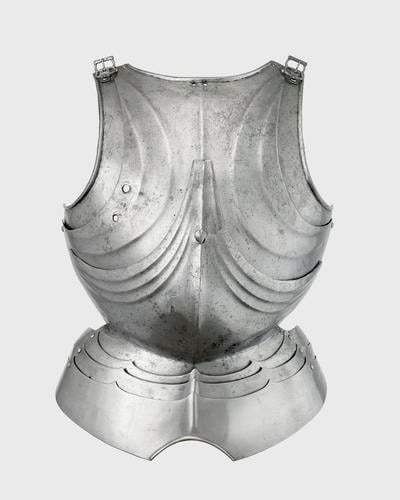
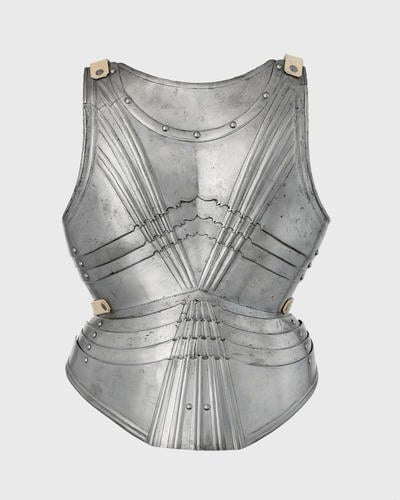
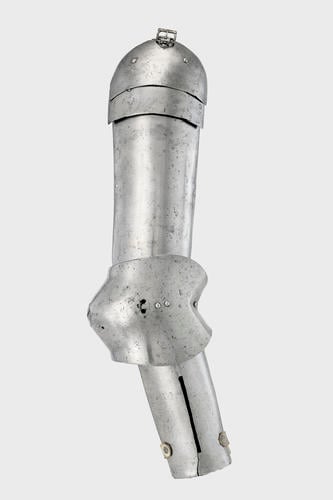
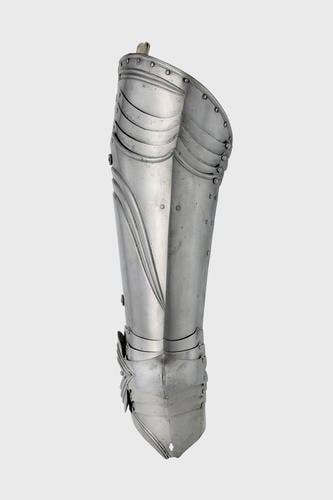
Consisting of a composite close helmet, probably Flemish or English, about 1520–40; a pikeman’s gorget, North European, about 1630; a composite two-piece breastplate with articulated fauld, South German, late fifteenth century; a four-piece backplate with articulated culet, South German, late fifteenth century; two splints or arm-defences not forming a pair, South German, early sixteenth century; a pair of besagues, nineteenth century in the German late fifteenth-century style; a pair of fingered gauntlets, nineteenth century in the German late fifteenth-century style; a pair of long cuisses with articulated poleyns, partly South German, about 1480–90, probably by Lorenz Helmschmid of Augsburg; a pair of tubular greaves, German, sixteenth century, modified in the nineteenth century to a late fifteenth-century style; and a pair of articulated sabatons, nineteenth century in the German late fifteenth-century style.
The close helmet is of a kind that was popular in England about 1520–40. Several examples, probably relics of the arsenal of Henry VIII, are preserved in the Royal Armouries, while even more are or were formerly to be found in English churches, serving as parts of funeral achievements. It is likely that some of them, at least, would have been of indigenous manufacture.
The ‘splints’ or arm-defences were originally intended for wear with a cheap type of infantry armour known in early sixteenth-century England as an ‘Almain rivet’. In 1512 the Florentine merchant Guido Portarini is recorded as having supplied to Henry VIII, at a cost of 16s a piece: ‘2,000 complete harness called Almayne ryvettes … accounting always a salet, a gorjet, a breastplate, a backplate and a pair of splints for every complete harness’.
Although somewhat restored, the cuisses and poleyns of the armour are of exceptional quality. The main plates of their poleyns compare closely in design with others bearing the mark of the imperial armourer Lorenz Helmschmid of Augsburg (active 1467–1515) and dating from about 1485. (See A62 Hofjagd- und Rüstkammer, Vienna and DIA 58.193 Detroit Institute of Art).
Tests undertaken on the lowest main plate of the backplate, the right splint, the left splint and the main plate of the right poleyn of the armour show them to have microhardnesses in the ranges 179–213 VPH, 234–289 VPH, 311–340 VPH and 167 VPH respectively. The results of similar tests undertaken on the main plate of the breastplate had to be discarded as the unusually high microhardness of 283–329 VPH obtained for it suggests that the probe may have struck a piece of slag. The breastplate, the backplate and the right poleyn are all formed of iron with slag-inclusions. The right splint is formed of a very low carbon steel, incapable of being hardened. The left, formed of a low carbon steel with a fragmented composition, is likewise incapable of being hardened.
Text adapted from Norman, A.V.B, & Eaves, I. 2016 Arms and Armour in the Collection of Her Majesty The Queen: European Armour, London.
Metallurgy by Williams, A, & Metcalf, S. 2016. Summary of the metallurgy of European Armour in the Royal Collection, London. Appendix II of Norman & Eaves.
Measurements: Helmet: height 28.1 cm, width 21.7 cm, depth 33.4 cm; Gorget: height 14.2 cm, width 27.1 cm, internal diameter of neck-opening 14.0 cm; Breastplate and Fauld: height from shoulders to lower edge of fauld 51.8 cm, width beneath arm-openings 36.0 cm, width at waist 22.5 cm; Backplate and Culet: height from shoulders to lower edge of culet 48.0 cm, width beneath arm-openings 35.7 cm, width at waist 26.3 cm, width of culet 35.5 cm; Right Splint: overall length 61.0 cm, height of couter 15.4 cm, width of couter 17.5 cm; Left Splint: overall length 63.5 cm, height of couter 14.5 cm, width of couter 14.8 cm; Right Besague: vertical diameter 16.0 cm, transverse diameter 12.5 cm; Left Besague: vertical diameter 16.1 cm, transverse diameter 12.5 cm; Right Gauntlet: length 37.5 cm; Left Gauntlet: length 38.5 cm; Right Cuisse and Poleyn: length 56.5 cm; Left Cuisse and Poleyn: length 59.0 cm; Right Greave: length 41.0 cm; Left Greave: length 41.6 cm; Right Sabaton: length 42.5 cm; Left Sabaton: length 42.2 cm.
Weights: Helmet: 2.495 kg; Gorget: 0.482 kg; Breastplate and Fauld: 2.920 kg; Backplate and Culet: 2.466 kg; Right Splint: 0.879 kg; Left Splint: 0.794 kg; Right Besague: 0.113 kg; Left Besague: 0.113 kg; Right Gauntlet: 0.510 kg; Left Gauntlet: 0.539 kg; Right Cuisse and Poleyn: 1.729 kg; Left Cuisse and Poleyn: 1.474 kg; Right Greave: 0.794 kg; Left Greave: 0.794 kg; Right Sabaton: 0.454 kg; Left Sabaton: 0.454 kg.Provenance
The cuisses and poleyns were at one time in the collection of Sir Samuel Rush Meyrick (1783–1848). The armour was lent by Meyrick’s heirs, together with the greater part of his collection, to the Manchester Art Treasures Exhibition of 1857 and to the South Kensington Museum (now the Victoria and Albert Museum) between 1868 and 1871. With the termination of the South Kensington Museum loan in 1871, the Meyrick collection underwent piecemeal dispersal. How and when the cuisses and poleyns entered the collections of the Tower of London is unrecorded.
The North Corridor Inventory, which records the arrangement of the Collection at Windsor Castle, describes the armour as ‘comprehensively German, third quarter of the fifteenth century, but, with the exception of the armpieces, helmet, and gorget of modern manufacture’, thus overlooking the authentic elements of its cuirass and legharness.
G.F. Laking noted of the armour that: ‘The various plates of which it is composed were sent from the Tower of London in 1901, and were put together at Windsor to give the appearance of a full suit … The close helmet or armet … was already at Windsor upon a seventeenth century three-quarter suit of armour, formerly standing upon a wall-bracket in the Grand Vestibule. There it was painted in stripes of brown and gold, with a bevor of the seventeenth century added.' -
Creator(s)
(nationality)(nationality) -
Medium and techniques
Category
Object type(s)
Other number(s)
Place of Production
Augsburg [Germany]


