


-
1 of 253523 objects
Italy
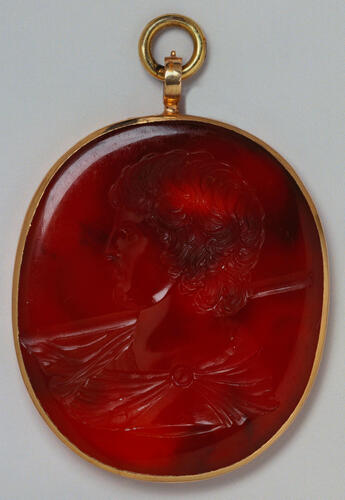
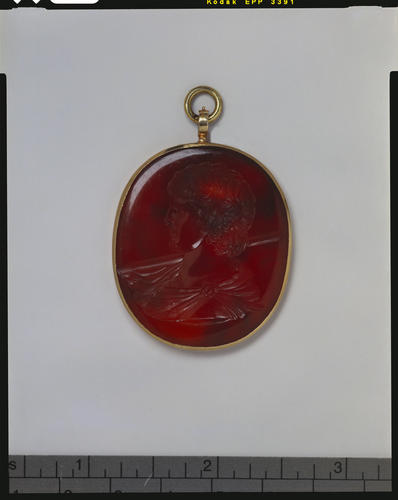
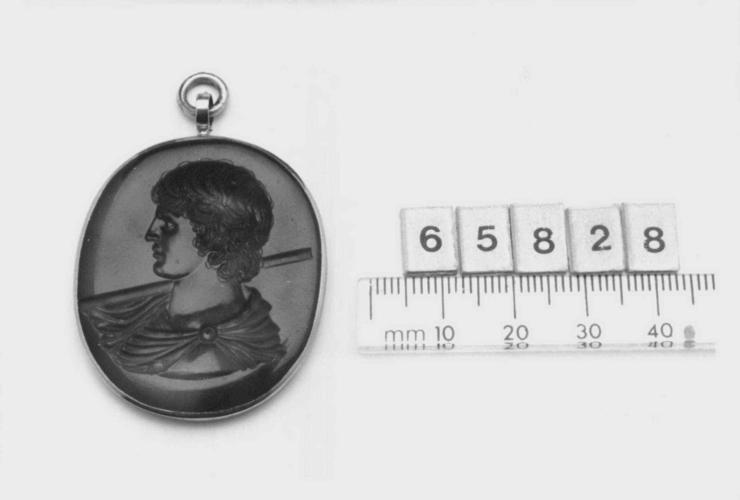
Antinous Intaglio: 18th c.; Mount: 18th c.
Carnelian; open gold mount with suspension loop and ring | 4.1 x 3.6 cm (image) | RCIN 65828
-
Intaglio of a bust of Antinous (c. AD 110/11-30), young male lover of the Roman Emperor Hadrian, in profile to the left. He wears a cloak fastened by a brooch over his left shoulder and holds a spear over his right shoulder.
There are nine similar carnelian intaglios from the same hand recorded in the 1830 Windsor inventory of jewels. All the pieces are after highly popular and frequently copied ancient prototypes. They are all similarly shaped and have identical late 18th century mounts.
The intaglio is from the collection of Consul Joseph Smith of Venice and was acquired by George III with the Consul’s paintings, drawings, books, manuscripts and medals in 1762. However, whilst the gem was part of Consul Smith’s collection it is unlikely that it was executed in Venice; engravers capable of such high-quality work were found only in Rome. The group may tentatively be attributed to Anton Pichler (1697-1779) or Carlo Costanzi (1703-81). Both were Roman gem-engravers of great repute; Costanzi was particularly famous for his copies after the antique - he is known to have engraved the head of Antinous several times - ‘and none better’ - according to one contemporary.
Text adapted from Ancient and Modern Gems and Jewels in the Collection of Her Majesty The Queen, London, 2008Provenance
From the collection of Consul Joseph Smith of Venice; acquired by George III with the Consul’s paintings, drawings, books, manuscripts and medals in 1762. One of the '9 cornelian intaglios' listed at Windsor Castle in 1830 (WCIJ 1830 f.38).
-
Creator(s)
(nationality)Acquirer(s)
-
Medium and techniques
Carnelian; open gold mount with suspension loop and ring
Measurements
4.1 x 3.6 cm (image)
Category
Place of Production
Italy


