

-
1 of 253523 objects
After Mathias, Gabriel (d.1804)
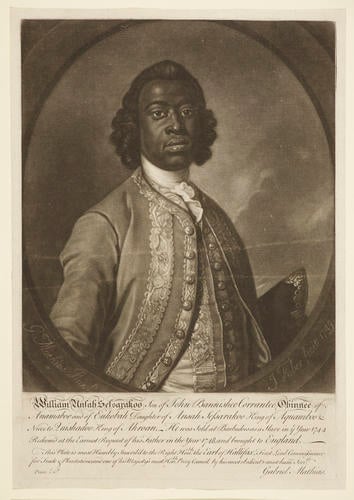
William Ansah Sessarakoo 1749
Mezzotint | RCIN 619135
After Mathias, Gabriel (d.1804)
William Ansah Sessarakoo 1749
-
A mezzotint of a half-length figure of a man in embroidered waistcoat, jacket and cravat. Lettered: G. Mathias Pinxit J Faber Fecit 1749. Full lettering below, with a brief biography.
The print reproduces a portrait painting of William Ansah Sessarakoo by Gabriel Mathias (in the Menil Collection, Houston, Texas). Born in or near Annamaboe (Anomabu) on the Gold Coast of West Africa, William Ansah Sessarakoo was the son of Eno Baise Kurentsi (otherwise John Bannishee Corrantee) and Eukobah — the daughter of the king of Aquamboo. Corrantee was a prominent member of the Fante family who profited from the trade of gold and enslaved people by acting as an intermediary for European traders.
Corrantee traded with both the British and French, both offered to provide education for his sons as a means of ensuring his loyalty. The education of his elder son in Paris was sponsored by the French; the British offered to educate Sessarakoo in Britain. Sessarakoo travelled onboard the 'Lady Carolina', bound for England via Barbados, accompanied by David Bruce Crichton. Crichton died on the journey, and when the ship arrived in Barbados in 1744, Sessarakoo was enslaved and sold as 'Prince William Ansah Sessarakoo' or 'The Royal African'. On hearing that his son had been enslaved, Corrantee refused to deal with the British until Sessarakoo had been located and released. Sessarakoo was later recognised by a Fante businessman and the Royal African Company payed for Sessarakoo to be freed. The Royal African Company, established by James II when Duke of York, was a brutal company trading in enslaved Africans, shipping over 200,000 enslaved people from Africa across the Atlantic between 1662 and 1731. Sessarakoo's rescue can be seen as a public relations attempt to promote the Royal African Company's treatment of enslaved people.
Sessarakoo was sent to London with George Montagu Dunk, second earl of Halifax and president of the Board of Trade and Plantations, where he became a celebrity, meeting George II and attending society events. In 1749, the Gentleman's Magazine published a brief biography of Sessarakoo, promoting the Royal African Company and noting that Sessarakoo and a fellow African were being clothed and educated 'in a very genteel manner' (a copy in the Royal Collection is RCIN 1020462.b). On 2 February 1749 Sessarakoo attended a performance of Thomas Southerne's 1695 play Oroonoko, based on a 1688 novel by Aphra Behn about an enslaved African nobleman. Newspapers reported that the play's storyline caused him to leave the box in distress. That same year, Sessarakoo's portrait was painted by Gabriel Mathias, and prints after the portrait disseminated his image more widely. While the high-born status that had rescued him from enslavement had apparently also given him status and celebrity in England, Sessarakoo's image and story was used as part of the promotion of the Company's 'favourable' treatment of enslaved people. Sessarakoo returned to the Gold Coast and became involved in the trade of enslaved people. -
Creator(s)
(mezzotinter) -
Medium and techniques
Mezzotint
Category
Object type(s)
Subject(s)


