


-
1 of 253523 objects
Sèvres porcelain factory
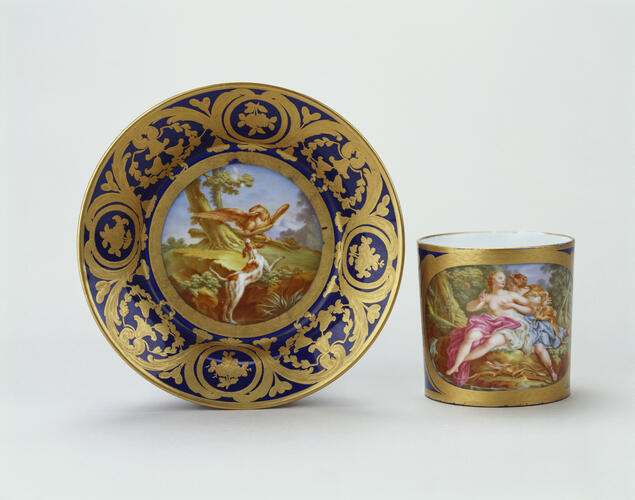
Gobelet litron ?1778
Soft-paste porcelain, beau blue ground and gilded decoration | 7.5 x 10.4 x 7.7 cm (whole object) | RCIN 58195
Green Drawing Room, Windsor Castle
-
First produced in 1752, the gobelet litron was a popular model at Vincennes and Sèvres throughout the eighteenth century. The cylindrical cup received its name because of its resemblance to the litron, an old wooden cubic measure of slightly larger dimensions, used to quantify salt, grain, flour and peas.
The gobelet litron was among the earliest ‘useful wares’ produced at the manufactory. Although the vast majority of gobelets litrons were made to be used, some were intended to serve as eye-catching knick-knacks for display on chimneypieces and occasional tables. They were perfect gifts and towards the end of each year the production of expensive gobelets litrons sharply increased in order to provide sufficient stock for the Kings’ end-of- year sales staged in Versailles. While matching sets of gobelets litrons were produced to be incorporated into déjeuners and cabarets, others were sold singly, and yet others were grouped together to form sets of contrasting decoration.
The cup and saucer are painted in polychrome with two scenes: on the cup, the mythological characters, Jupiter and Callisto (one of Diana’s attendants), and on the saucer, a spaniel barking at an eagle on a branch. In the scene on the cup Jupiter, who is disguised as Diana, the huntress, wears a crescent in his hair and an animal pelt over a pale blue undergarment. He is trying to embrace a startled and partly naked Callisto, who is seated on a bank by a stream. White and scarlet drapery cover her lap. Lying at her feet are a quiver of arrows and a bow. The spaniel on the saucer is painted white and brown.
The two scenes are after Jean-Franîois Detroy and derive from an engraving by Etienne Fessard; the painter at the manufactory was probably Pierre-Nicolas Pithou l’aîné. A version of the engraving, which bears an eighteenth-century portfolio inventory number, is still preserved at Sèvres. The story ends tragically as Diana, on discovering Callisto’s pregnancy, has her revenge and transforms her into a bear.
Text adapted from French Porcelain: In the Collection of Her Majesty The Queen, London, 2009Provenance
Recorded in 1826 in the Bow Room, Principal Floor, Carlton House: ‘No. 13. A blue and gold Seve Porcelain Cup, painted with two Figures in red and blue Draperies and a Saucer painted with a Spaniel and a Vulture’.
-
Creator(s)
(porcelain manufacturer)(porcelain painter)(nationality)Acquirer(s)
-
Medium and techniques
Soft-paste porcelain, beau blue ground and gilded decoration
Measurements
7.5 x 10.4 x 7.7 cm (whole object)
3.1 x 15.7 cm (diameter)
Place of Production
Sèvres [France]


