


-
1 of 253523 objects
Thomas Heming (active 1745-1795)
Salt 1761
Silver gilt | 6.8 x 10.6 x 10.6 cm (whole object) | RCIN 51325
-
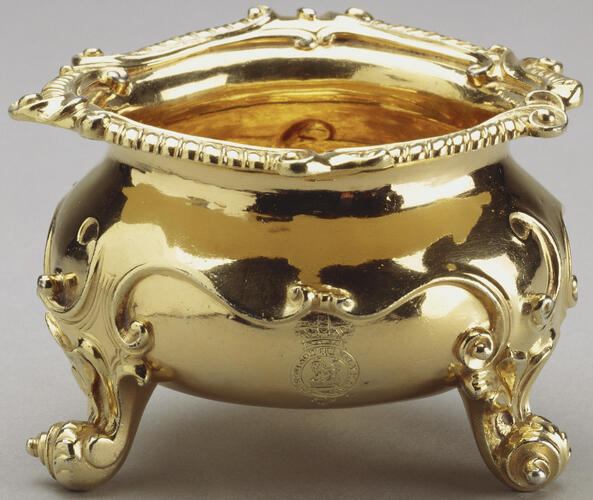
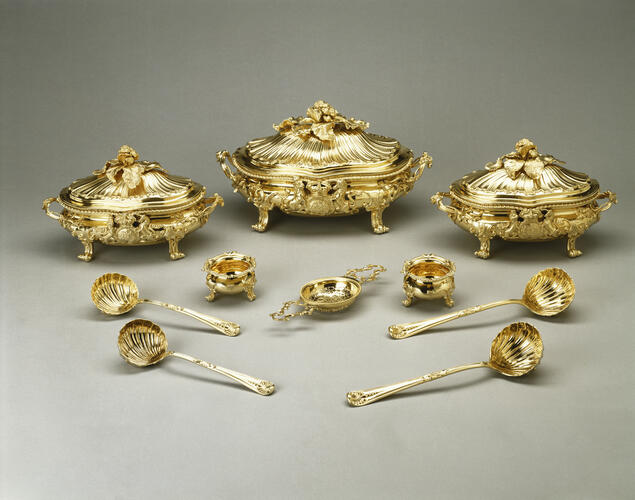
Twelve circular silver-gilt salts, each with gadrooned rim interspersed with flattened scrolls; the squat bulbous body is embossed with scrolls, on three scroll feet cast with laurel sprays. The body is engraved with the Royal crest, Garter and crown. These salts form part of the Coronation Service supplied to George III between 1760 and 1763, largely by Thomas Heming, Principal Goldsmith to the King. Heming was the first working goldsmith to hold this post since the early seventeenth century and the majority of the Coronation Service was made in his workshop. The style chosen for the service was a modified version of the French rococo, still fashionable in the early years of George III's reign and shows the strong influence of Pierre Germain's 'Eléments d’orfèvrerie devisés' published in Paris in 1748. The term Coronation Service has been used for this dining service since the 1820s. Despite this title, the commission for the service took nearly a year to complete and was therefore not finished in time for use at the King and Queen's coronation banquet on 22 September 1761. The service was used at the 'extremely magnificent banquet' held on 19 September 1768 at the Queen's House in honour of Christian VII of Denmark. Modest additions were made to the service throughout the 1760s.
Provenance
The twelve salts were commissioned by George III, 24 July 1761 (TNA LC5/110, f.339) and invoiced 27 October 1761 (£58 3s. 2d.; TNA LC9/48, f.202).
-
Creator(s)
(nationality)Acquirer(s)
-
Medium and techniques
Silver gilt
Measurements
6.8 x 10.6 x 10.6 cm (whole object)
Place of Production
London [Greater London]


