


-
1 of 253523 objects
Anton Michelsen (1809-1877)
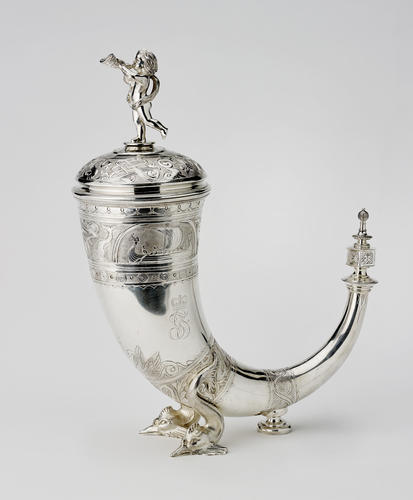
Drinking horn 1868
Silver, gilt interior | 28.0 x 23.0 x 9.5 cm (whole object) | RCIN 47001
-
Silver drinking horn of traditional form with slightly domed cover surmounted by a putto blowing a horn and standing on one foot. Lid chased with zoomorphic scrolls and sea monsters on a matted ground. Gilt interior. Horn with a scalloped border and scenes of Viking ships and similar great dolphins. Engraved on the side with the date 24 Decbr. 1868 and crowned G on the other, with a pair of swans flanking a trident. On two cast dolphin feet and a bun-shaped third foot with a band of scrollwork and a shaped geometric finial.
Ceremonial drinking horns were known in the Norse culture from ancient times and retained throughout the medieval period, their use symbolic of high status. Christian I of Denmark, for example, was presented with the Oldenburg horn 1475 – a silver-mounted horn made in Cologne that was a gift from Charles the Bold of Burgundy, although it later had its own mythology attached to it. The traditional horns, both the large aurochs horns and the smaller cattle horns used in Scandinavia, were tipped in silver and often had further silver mounts.
In the nineteenth century in Denmark, there was an increased interest in the archaeology and culture of the Vikings, led by the studies of Christian Jurgensen Thomson (1788-1865) and Jens Jacobs Asmusen Worsaae (1821-85), the latter under the patronage of Christian VIII of Denmark. Danish archaeology became linked with a sense of nationalism. Although Michelsen's design relies on historic sources, he does not attempt here to recreate a specific horn. The elements of zoomorphic motifs and interlaced bands are clearly drawn from ancient prototypes and small cast figures on the lid of the horn are seen in fifteenth and sixteenth century examples, but the scenes of Viking ships and the dolphin feet are not related to any known horns. The first Viking ship was excavated in Norway in 1867 at Ostfold which may have inspired the choice of scenes on this example, although Michelsen had previously produced a beaker with scenes of ships for Christian IX as a gift for his grandson, George V's elder brother, Prince Albert Victor.
Anton Michelsen was born in Odense in 1809. In 1830 he moved to Copenhagen and worked for various goldsmithing workshops in the city for the following eleven years. Between 1834 and 5 he was employed by Jorgen Balthasar Dalhoff who assisted him in gaining a scholarship to travel to Berlin and later to Paris where he worked for the firm of Mention et Wagner, learning enamelling. In 1840 he gained his master's registration and the following year he set up his own premises in Copenhagen. In 1855 he exhibited at the Paris Exposition universelle with a modest range of tea and coffee wares, flatware and wine coolers as well as an escritoire incorporating a cloche.
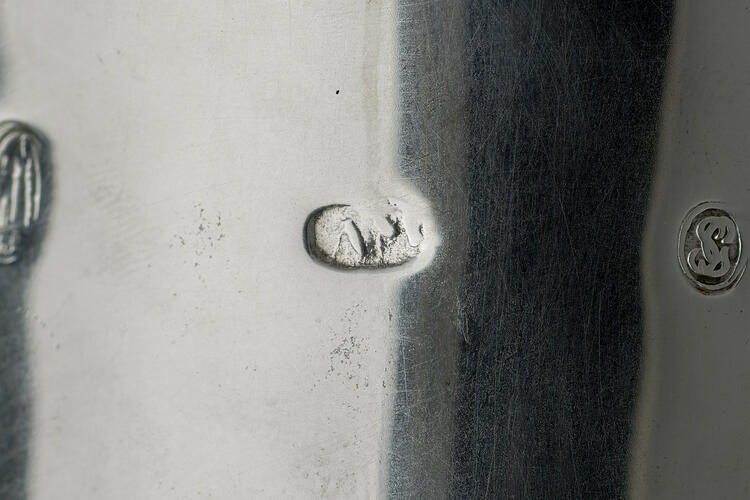
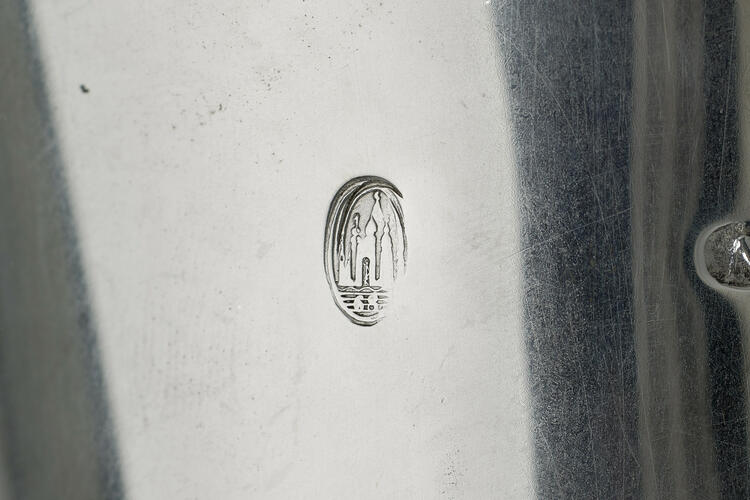
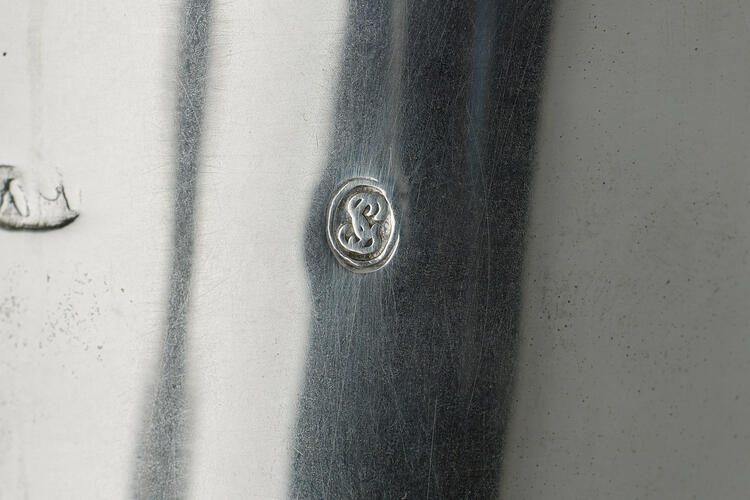
Struck on body of horn with city mark of Copenhagen (1868), assayer's mark of S. Groth, and maker's mark of Anton Michelsen; scratch marks on foot, 5748 and 576; engraved, 24 Decbr. 1868; engraved on sides of horn with coronet and G.Provenance
Presented to King George V when Prince George of Wales by Christian IX and Queen Louise of Denmark, 1868.
-
Creator(s)
(silversmith)(nationality)Acquirer(s)
-
Medium and techniques
Silver, gilt interior
Measurements
28.0 x 23.0 x 9.5 cm (whole object)
739.4 g (Weight) (whole object)
Place of Production
Copenhagen [Zealand]


