


-
1 of 253523 objects
Mary Delany (1700-88)
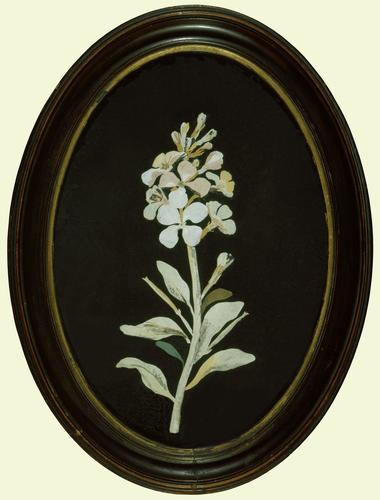
A stem of stock Oct 1781
Watercolour and gouache on paper, cut and pasted onto backing paper painted black | 25.0 x 17.0 cm (sight) (sight) | RCIN 452388

-
Mrs Delany, an extraordinarily proficient needlewoman and artist, had been interested in botany since her youth. After the death of her second husband in 1768 she was invited to spend a large part of each year with the widowed Duchess of Portland at Bulstrode, Buckinghamshire, where gardeners and plant collectors - such as John Lightfoot, Philip Miller, Joseph Banks and Daniel Solander - were frequent visitors. In 1772, while artists such as G.D. Ehret made painted records of plants and the Duchess continued to add to her collection of dried flowers, Mrs Delany began work on her own florilegium or Hortus siccus (dry garden). She wrote: ‘I have invented a new way of imitating flowers’, using scissors, paints and paper - often cut into many hundreds of tiny pieces - to depict a single plant. The surface or finish of the paper was carefully chosen to ensure that the correct impression was given. Typically in this late specimen (made when Mrs Delany was in her early 80s), the matt, almost furry, texture of the stock leaves is carefully imitated, and the plant is shown at life size. The florilegium project occupied Mrs Delany for much of the following decade. The major surviving records of her activity are the ten volumes in the British Museum, containing nearly one thousand separate flower studies or silhouettes. The King and Queen took a keen interest in Mrs Delany’s work, visiting Bulstrode to see the Hortus siccus for the first time in 1776. Soon after this visit plant specimens began to arrive at Bulstrode from Kew. After a visit to Bulstrode in December 1781, the Queen sent Mrs Delany a pocket-book containing tiny tools and bodkins, to assist her in her work. However, by this time the artist’s eyesight was failing. The later flower mosaics, including this one, are less complex and include much less fine detail than those of the 1770s. In the twelfth codicil to her will (first made in 1778), Mrs Delany bequeathed to the Queen a selection of twenty of her flowers in paper mosaic. The backboard of the oval fruitwood frame bears the label of ‘Dodds, No. 51 St Martin’s Lane’, presumably identifiable with William Dodds, active at this address at the end of the eighteenth century and documented as supplying frames to the Dowager Duchess of Bedford . The fact that the backboard is also inscribed by Mrs Delany’s nephew Bernard Dewes, at the time that he presented the piece to his niece, indicates that it has been framed - and exposed to light - for around two hundred years. The faded colouring in comparison with the brightly preserved colours of the British Museum florilegium is particularly marked. Inscribed by the artist on the verso of the backing paper Bulstrode Oct.r Catalogue entry adapted from George III & Queen Charlotte: Patronage, Collecting and Court Taste, London, 2004
Provenance
The artist‘s nephew, Bernard Dewes (d. 1822); by whom given to his niece, Fanny Ram (née Port); by descent to her great-grandson, Sir Granville Ram; by whom presented to King George VI, July 1942
-
Creator(s)
Acquirer(s)
-
Medium and techniques
Watercolour and gouache on paper, cut and pasted onto backing paper painted black
Measurements
25.0 x 17.0 cm (sight) (sight)
30.5 x 22.5 cm (frame, external)
Category
Object type(s)
Other number(s)
RL 27999Alternative title(s)
A specimen of Mrs Delany's flowers


