


-
1 of 253523 objects
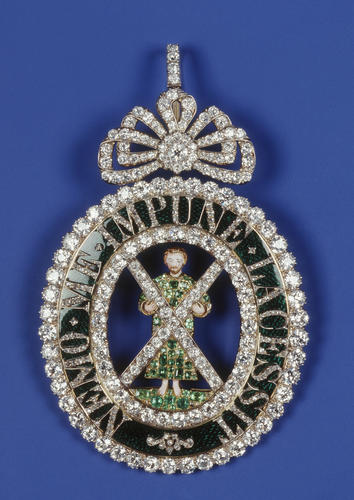
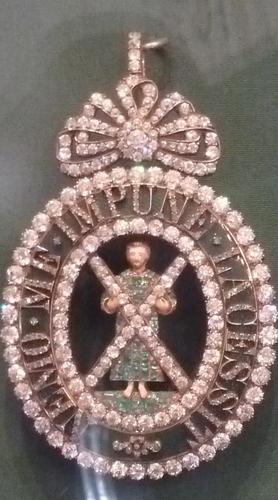
Order of the Thistle. King George V's sash badge 1893
Gold, diamonds, emeralds, enamel | 9.5 x 9.0 cm (whole object) | RCIN 441238
-
In Scottish royal iconography from the reign of James III (reigned 1460-88) the royal arms are represented surrounded by a collar of thistles and rue, with a pendant badge showing St Andrew holding his cross. It was not, however, until 1687 that a formally statuted "Most Ancient and Noble Order of the Thistle" was founded by James VII (James II of England) to reward Scottish peers who supported the King's political and religious aims. The 'Glorious Revolution' of 1688 let the Order fall into abeyance, until Queen Anne revived the Order in 1703 and appointed twelve Knights before her death in 1714.
In spite of the rebellions of 1715 and 1745 and its Stuart connections, the Old and Young Pretenders appointed Knights of the Garter in exile; the Thistle owed its survival in part to the use made of it by George I, George II and George III to reward those Scottish nobles who supported the Hanoverian and Protestant cause. This was ironic in that the founder had used the order to reward adherents of his own Catholic cause.
The revival of royal interest in Scotland, which was encouraged by George IV's visit in 1822, when he wore the Order, and by the regular residence of Queen Victoria in Scotland, ensured a continued support for the Order, which has remained an exclusively Scottish honour. Of George IV's collection of insignia, only two sash badges and a collar and badge were retained; seven badges and five stars were sold. But the present collection has been enriched by gifts of insignia made by the people of Scotland to members of the Royal Family. In this way the Duke of York (later King George V) received the insignia as a wedding present in 1893 and Queen Elizabeth received a set of insignia in 1937.
Text adapted from Royal Insignia: British and foreign orders of chivalry from the Royal Collection, London 1996Provenance
Presented to King George V when Duke of York by the people of Scotland on the occasion of his marriage, 1893.
Presented with the Star (RCIN 441237) by a deputation of Scottish ladies to the couple at York House, St James's Palace, 28 July 1893. It was described at the time as 'a specially fine one, and is copied from one in the possession of the Duke of Buccleuch, which belonged to his grandfather. His Grace kindly allowed Messrs James Crichton & Co. to copy it in every detail. The centre of the jewel consists of the figure of St Andrew. The body is set with emeralds, the face, hands, and feet are enamelled in flesh colour, and the cross is composed of diamonds of the purest water. On the outer border, between two rows of fine diamonds, is the motto 'Nemo me impune lacessit', set in diamonds on an enamelled ground; the back of the jewel is also enamelled in a very artistic manner. The jewel is suspended from the collar by a very fine loop set with diamonds.' (Gentlewoman, 19 August 1893).
Following presentation the Star (RCIN 441237) and the Sash Badge were placed on display in Crichton's showroom in Edinburgh, 7 August 1893. -
Medium and techniques
Gold, diamonds, emeralds, enamel
Measurements
9.5 x 9.0 cm (whole object)
Other number(s)
Place of Production
Edinburgh [Lothian]


