


-
1 of 253523 objects
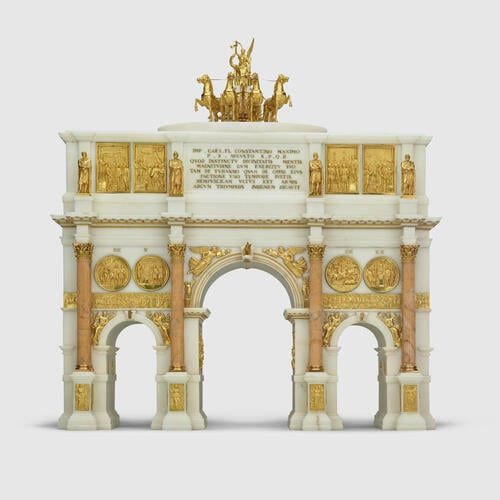
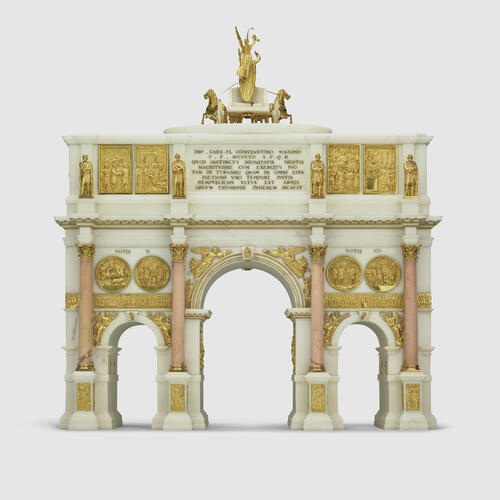
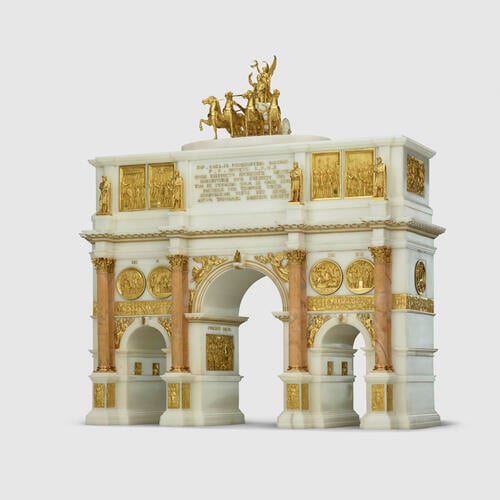
Arch of Constantine c.1808-15
Marble and gilt bronze | 64 x 60.3 x 24.5 cm (whole object) | RCIN 43918
-
A white marble and gilt bronze model of the Arch of Constantine, of triple arch form, with four free standing Corinthian columns and fluted pilasters on front. On both faces of the arch, either side of the central opening are applied roundels with reliefs of hunts and sacrifices. Above these the inscriptions VOTIS X and VOTIS XX are repeated on each side. Flanking the arch are Winged Victories holding trophies on spears. A gilt-metal processional frieze surrounds the entire model, below the roundels. Set into the attic are ten rectangular reliefs (four on the sides and one on each end), and figures of captives stand on dies above each column. In the centre is a long dedicatory inscription in gold-filled letters, repeated on each side. The arch is surmounted by a group of the emperor Constantine in a marble chariot drawn by four horses. The emperor is accompanied by a standing Victory holding a garland over his head.
The arches of Titus (dedicated in AD 82), Septimius Severus (AD 203), and Constantine (AD 315), standing in or adjacent to the Roman Forum, are the three most prominent survivors from a total of approximately three dozen monuments in this form erected in the city to celebrate particular military achievements of successive emperors. Many others were built in further parts of the Roman Empire. For their very prominence the Forum arches held the attention of artists and of historians of Roman civilisation from the Renaissance onwards, yet as late as the end of the eighteenth century they remained dilapidated, in shared occupancy and ownership.
George IV never experienced what had become a standard component of the education of English gentlemen of his generation, the Grand Tour to Italy, of which the culmination was invariably Rome. Here, in the Forum, at that time an only partly excavated field known as the Campo Vaccino, the English milordi were shown the three partly ruined triumphal arches set up by the Emperors. Models of the arches in their semi-ruined condition (often effectively imitated in cork) were among the souvenirs with which the tourists returned to England. However, these marble models are reconstructions of the original form of the arches, complete with figurative sculpture.
This model of the Archi of Constantine together those of Septimus Severus and Constantine were made under the auspices of the Roman Accademia di San Luca by the gold- and silversmiths Giovacchino Belli and his son Pietro. The Belli supplied liturgical plate for the church and ornamental and dining silver for aristocratic clients. Their business had been founded by Giovacchino’s father, Vincenzo (1710–87), who was originally from Turin. The maker of the marble structures of the arches is not known. Pietro Santi Ammendola, who also signed all three arches, was a dealer or merchant who probably financed the Belli during their seven-year task.
In a printed description of the arches published in 1815, the secretary of the Accademia di San Luca, Giuseppe Antonio Guattani (1748-1830), praised the artists for their 'seraphic patience'. This publication, which is tantamount to a sale brochure, ends with a testimonial from the Perpetual Principal of the Academy, Antonio Canova, praising the 'genius, accuracy and infinite precision' of the models. This was not unjustified; more than a thousand individual gilt bronze plaques in various sizes were used to ornament the vaults of the Arch of Septimius Severus, which are largely invisible in normal circumstances. The specification for the models clearly combined a desire for archaeological precision with the use of the most luxurious materials.
In their reconstruction of the original appearance of the arches, including the entirely conjectural figurative groups with which they are crowned, the Belli were guided by the architect Giuseppe Camporese (1763–1822) who served from 1810 as superintendent of public works in Rome and had previously partly directed excavations in the vicinity of the Arch of Septimius Severus. The visual evidence for the reconstruction of the figurative groups surmounting the arches was confined to very perfunctory representations on coins. Some evidence for the disposition of the figures was extant in the form of slots in
the masonry.
In the course of his description, Guattani suggested that no ornaments more beautiful than these models could be found 'for the tables of the Great or the cabinets of Princes'. In view of the recent defeat and exile of Napoleon, to whom this comment might formerly have been directed, Ammendola brought the completed models to London where, according to Joseph Farington, they were offered to George IV on 10 November 1816. 'He thought them very beautiful; but the price demanded, viz. 3000 guineas appeared to Him to be too much.' The price was eventually reduced to 500 guineas, the sum recorded by Benjamin Jutsham in his Day Book for 8 November. The arches were placed on Boulle pedestals in the window reveals of the library at Carlton House, where they were noticed by Pyne as 'most ingenious specimens of sculpture in miniature'. Certain repairs to the metalwork were undertaken by Charles Brandt in January 1818, and later the same year B.L. Vulliamy replaced some of the ornaments, apparently in silver gilt, and made glass covers for the three arches. Following the demolition of Carlton House in 1826 the models were taken to Buckingham Palace; they were subsequently transferred to Windsor Castle, where they can be seen in Joseph Nash's watercolour of the Grand Corridor.
Catalogue entry from Royal Treasures, A Golden Jubilee Celebration (2002) and Sculpture in the Collection of His Majesty The King (2025)Provenance
Bought, together with two further arches, by George IV when Prince Regent from G.B. Ammendola of Rome, November 1816 (500 guineas); Carlton House, Library; Buckingham Palace (1838); Windsor Castle, Grand Corridor; Garter Throne Room.
Included in the Pictorial Inventory of 1827-33 – RCIN 934840. The inventory was originally created as a record of the clocks, vases, candelabra and other miscellaneous items from Carlton House, as well as selected items from the stores at Buckingham House, the Royal Pavilion, Brighton, Hampton Court and Kensington Palace for consideration in the refurbishment of Windsor Castle. -
Creator(s)
(retailer/supplier)Acquirer(s)
-
Medium and techniques
Marble and gilt bronze
Measurements
64 x 60.3 x 24.5 cm (whole object)
Category
Object type(s)


